



Outsourcing has become a strategic advantage for companies seeking efficiency, specialized expertise, and scalable operations. Yet the distinctions between onshore, nearshore, and offshore can be hard to parse when you are deciding how to structure customer experience, back-office, and technical support programs. This guide clarifies each model, compares them across key considerations, and outlines practical steps to select and implement the right approach.
As a U.S.-based provider with deep nearshore expertise, The Office Gurus helps organizations design outsourcing strategies that improve performance and reduce costs while protecting quality, compliance, and customer satisfaction. Throughout this guide, we will examine onshore vs nearshore vs offshore models, break down each model with comparisons, and provide practical advice to make strategic decisions.
What Is Onshore Outsourcing?
Onshore outsourcing is the practice of partnering with service providers located in the same country as the client. For U.S. companies, that means working with teams based within the United States that deliver services such as customer support, technical helpdesk, back-office processing, and administrative operations. In the context of onshore vs nearshore vs offshore outsourcing services, onshore is often selected when proximity and governance are top priorities.
Onshore offers strong advantages for programs where alignment and oversight are paramount. Communication benefits include shared language, cultural context, and business norms, which reduces friction and accelerates decision-making. Time zone alignment enables real-time collaboration across teams, speeding issue resolution and supporting tight operational cadences. Regulatory consistency is another key benefit: operating under U.S. laws and standards simplifies compliance oversight and audit readiness, particularly for industries subject to HIPAA, PCI DSS, SOX, GLBA, and other frameworks. These strengths often tip the balance in offshore vs onshore comparisons when sensitive data and customer trust are central.
Onshore providers also bring familiarity with local customer expectations, regional nuances, and market dynamics. That translates to stronger brand representation in customer-facing interactions and smoother alignment with sales, product, and operations stakeholders. While many organizations explore nearshore outsourcing or offshoring outsourcing options for cost benefits, onshore remains the benchmark for programs requiring daily collaboration in the same regulatory environment.
Common onshore use cases include:
- Healthcare: patient support, medical billing, prior authorizations, and claims assistance.
- Financial services: KYC/AML processing, account servicing, dispute resolution, and collections.
- Technology: helpdesk, software QA, tier 1–2 support, and device troubleshooting.
- E-commerce: order management, returns processing, and loyalty program support.
- Public sector and contractors: records management, citizen services, and program administration.
Organizations with high regulatory complexity, sensitive data handling, or processes that require daily cross-functional collaboration often favor onshore arrangements. When evaluating offshore and nearshore models against onshore, consider whether governance demands and brand protection outweigh potential savings from nearshoring or offshoring outsourcing.
What Is Nearshore Outsourcing?
Nearshore outsourcing refers to partnering with providers in nearby countries that offer overlapping time zones, cultural compatibility, and easy travel. For U.S. and Canadian companies, nearshore typically includes Latin America and the Caribbean. Within the broader onshore vs nearshore vs offshore discussion, nearshore stands out for balancing cost control with collaboration.
The primary value of nearshore outsourcing is the balance it strikes between cost savings and collaboration.Near time zone alignment supports daily standups, shared working windows, and real-time escalation without the operational challenges of overnight coverage. Many nearshore hubs feature strong English proficiency, which supports customer-facing roles and reduces training overhead. Travel is faster and more affordable than long-haul international trips, making onsite training, process workshops, and regular governance visits practical.
Nearshore models often deliver meaningful savings compared to onshore rates while preserving high levels of quality and responsiveness. Partners in key nearshore regions frequently operate modern facilities and follow U.S.-compatible compliance controls with robust physical, technical, and administrative safeguards. When weighing offshore vs nearshore options, teams that rely on frequent collaboration and real-time coaching tend to favor nearshore. In addition, hybrid strategies that combine offshore and nearshore talent can optimize coverage and cost.
Prominent nearshore regions include:
- Central America: Belize, El Salvador, Costa Rica, Guatemala, Honduras,
- Dominican Republic and Jamaica
- Mexico and Colombia
These markets offer strong talent pools for customer experience, sales support, back-office processing, multilingual services, and technical support. Nearshore is ideal when you need cost efficiency without compromising real-time collaboration, cultural alignment, or service quality. It is especially effective for omnichannel customer care, revenue generation programs, and operations that benefit from daily interaction with U.S.-based teams. In the context of nearshore vs offshore outsourcing, nearshore helps maintain communication quality and speed while still achieving savings relative to onshore.
What Is Offshore Outsourcing?
Offshore outsourcing involves working with partners located in distant countries, often with significant time zone differences from the United States. Common offshore regions include South and Southeast Asia, Eastern Europe, and parts of Africa. Offshore partners are known for mature outsourcing ecosystems, large talent pools, and competitive pricing driven by labor market dynamics. As part of onshore vs nearshore vs offshore decision-making, offshore typically offers the highest arbitrage for standardized processes.
Offshore advantages include substantial cost savings and access to specialized skill sets at scale. Many offshore hubs have decades of experience serving global enterprises with sophisticated training programs, workforce management practices, and quality assurance frameworks. Offshore arrangements are particularly effective for high-volume transactional processes, standardized back-office operations, and technology work that can be executed within well-documented workflows. Offshoring outsourcing is often leveraged where clear documentation, robust QA, and handoffs enable teams to work effectively across time zones.
Potential challenges include time zone gaps that complicate same-day collaboration, cultural and language differences in customer interactions, and the need for extra diligence to ensure compliance alignment. While reputable offshore providers maintain strong data security controls, companies must invest in governance, documentation, and ongoing performance management to consistently meet brand, regulatory, and customer experience expectations. When comparing offshore vs onshore and offshore vs nearshore outsourcing, these governance considerations should be factored into total cost of ownership.
Representative offshore destinations and strengths:
- India and the Philippines: customer support, back-office processing, and IT services.
- Eastern Europe (e.g., Poland, Romania): engineering, software development, and QA.
- South Africa: multilingual customer support with strong voice quality.
With the right vendor selection and operational oversight, offshore teams can deliver excellent outcomes across a range of functions. Many organizations adopt offshore and nearshore blends to achieve round-the-clock coverage and optimize budgets while keeping critical collaboration windows aligned to U.S. hours.
Comparative Analysis: Onshore vs. Nearshore vs. Offshore
Choosing among onshore, nearshore, and offshore models requires a clear view of your objectives and constraints. Consider how each option affects cost, collaboration, customer experience, compliance, and scalability. The following analysis provides a practical breakdown to help you navigate onshore vs nearshore vs offshore choices.
Key Differences
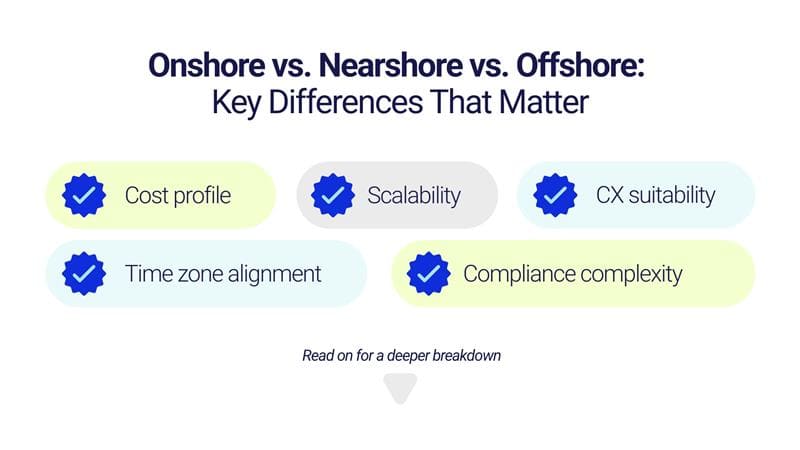
- Cost: Onshore generally has the highest labor costs but delivers tight alignment and simplified oversight. Nearshore provides a middle ground, resulting in significant savings relative to U.S. rates with strong collaboration and cultural compatibility. Offshore typically offers the greatest savings, especially for standardized, high-volume work. Comparing offshore vs nearshore vs onshore in total cost of ownership helps reveal which model fits your long-term goals.
- Communication: Onshore minimizes language and cultural differences for U.S. brands. Nearshore markets often combine strong English skills with familiarity with North American business norms, making them suitable for customer-facing teams. Offshore communication quality varies by region and role; customer-facing work requires targeted training and rigorous QA, or specialized tools to neutralize accent. For nearshore vs offshore outsourcing decisions, weigh the impact of time zone and cultural differences on CX outcomes.
- Time Zones: Onshore and nearshore enable same-day collaboration, fast escalations, and agile operations. Offshore teams often operate across large time differences, making asynchronous workflows, handoffs, and well-defined SLAs critical. Many organizations combine offshore and nearshore coverage for 24/7 service while preserving business-hours collaboration.
- Compliance and Security: Onshore simplifies regulatory oversight under U.S. laws. Nearshore and offshore can meet strict requirements with the right controls, certifications, and governance, but they demand thorough due diligence and ongoing monitoring. Hybrid models that blend onshore governance with nearshoring or offshoring outsourcing can balance risk and cost.
- Talent and Specialization: Offshore markets frequently provide the largest talent pools for scale, while nearshore and onshore offer strong customer-facing and hybrid skill sets with faster travel and tighter operational coordination. Offshore vs onshore comparisons often highlight scale and cost, while offshore vs nearshore focuses on collaboration and language skills.
Pros and Cons at a Glance
| Model | Advantages | Trade-offs |
| Onshore | Highest alignment, immediate collaboration, straightforward compliance and audit readiness. | Higher costs, limited labor arbitrage, potential capacity constraints in niche skill areas. |
| Nearshore | Meaningful savings, real-time collaboration, cultural proximity; easier travel and oversight. | Costs typically higher than offshore, talent availability varies by country and language. |
| Offshore | Lowest cost at scale, deep talent pools, mature outsourcing ecosystems. | Time zone challenges, potential language and cultural gaps, increased governance requirements. |
When to Choose Each Model
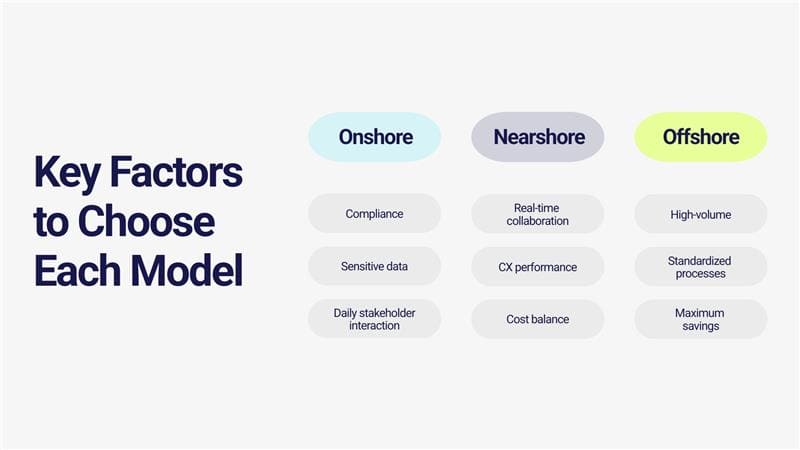
- Onshore: Best for heavily regulated processes, sensitive customer interactions, or programs that require tight integration with U.S. stakeholders.
- Nearshore: Ideal when you need cost savings without sacrificing same-day collaboration and cultural alignment. It is a strong fit for customer experience, sales support, and operations that benefit from daily interaction.
- Offshore: Effective for price-sensitive, standardized work such as back-office processing or development tasks that can succeed with structured workflows, handoffs, and robust QA.
As you determine which model to pursue, compare offshore vs nearshore for collaboration intensity, offshore vs onshore for compliance and governance requirements, and the overall onshore vs nearshore vs offshore picture for long-term scalability. Many enterprises succeed by blending offshore and nearshore teams with an onshore leadership layer to manage quality and compliance. Experienced and global partners, like The Office Gurus, are able to adapt your needs to any of these models.
How The Office Gurus Helps You Decide
A successful outsourcing decision begins with a grounded assessment of goals, risks, and operating requirements. We partner with your team to define objectives, audit current workflows, and quantify trade-offs across onshore, nearshore, and offshore models, ensuring decisions are based on operational realities, not cost alone.
As a nearshore specialist with U.S.-based leadership, The Office Gurus delivers the advantages of same-day collaboration alongside the efficiencies of regional labor markets. Our solutions span customer care, tech support, sales enablement, and back-office operations, supported by rigorous training, standardized QA frameworks, security controls, and performance analytics. These quality systems are intentionally designed to perform consistently across delivery models, whether work is handled onshore, nearshore, offshore, or through a blended approach.
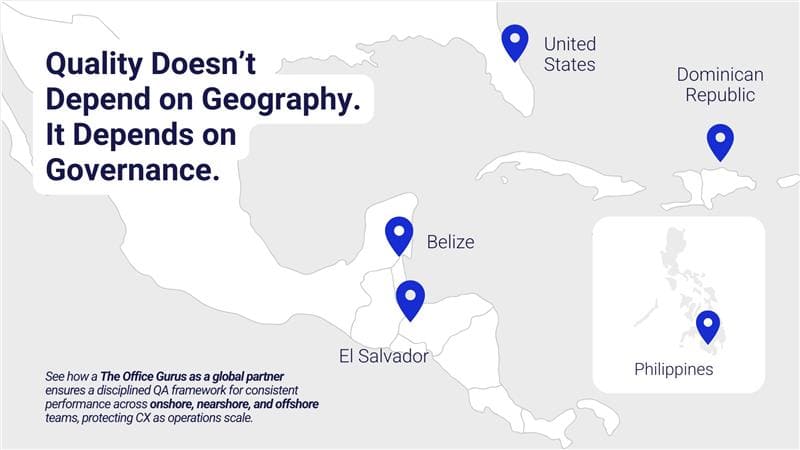
That consistency is critical and measurable. In the case study featured in the video below, we demonstrate how a structured QA program helped improve accuracy, adherence, and overall performance across a distributed delivery environment. By implementing clear QA rubrics, real-time monitoring, and targeted coaching, TOG was able to elevate quality outcomes while maintaining flexibility in staffing. The same QA discipline shown in this case study underpins every outsourcing model we deploy, giving clients confidence that performance standards won’t erode as operations scale or shift locations.
Whether you are evaluating offshore vs. nearshore, offshore vs. onshore, or a blended onshore vs. nearshore vs. offshore strategy, we provide evidence-based recommendations aligned to your outcomes, supported by performance data, governance structures, and proven quality management practices.
Our engagement approach includes:
- Discovery and Blueprinting: Confirm scope, SLAs, and compliance needs; map processes; identify quick wins.
- Pilot Design: Establish KPIs, QA rubrics, reporting cadence, and escalation paths; select a representative subset of volume.
- Operational Readiness: Recruit talent aligned to brand voice and technical requirements; deliver comprehensive training and certification.
- Governance and Analytics: Provide dashboards, monthly business reviews, root cause analysis, and continuous improvement plans.
- Scale and Optimization: Expand capacity, refine workflows, and optimize staffing models based on performance data.
The Office Gurus is a trusted leader in the industry, combining onshore oversight with nearshore and offshore delivery to accelerate time to value. Our teams specialize in nearshore outsourcing for customer experience, while our offshoring outsourcing partners provide cost-effective scale for standardized work. We help clients operationalize onshoring outsourcing where compliance demands it, and we design hybrid models governed by the same QA standards that integrate offshore and nearshore talent with U.S.-based leadership.
FAQs on Outsourcing Models
Common Misconceptions
- “Offshore always sacrifices quality.”
Reality: Many offshore providers, like The Office Gurus, deliver excellent results for standardized processes. Quality is a function of vendor selection, training, and governance, regardless of geography. When weighing nearshore vs offshore outsourcing, match process complexity to the model’s strengths and invest in QA.
- “Nearshore is only slightly cheaper than onshore.”
Reality: Nearshore often delivers substantial savings while preserving same-day collaboration and cultural proximity, making it highly competitive for customer support and back-office operations. This holds up in offshore vs nearshore comparisons when collaboration intensity is high.
- “Onshore is the only option for regulated industries.”
Reality: With appropriate controls, certifications, and contractual frameworks, nearshore and offshore providers can meet strict compliance requirements and audit standards. Hybrid models that combine onshoring outsourcing for governance with offshoring outsourcing for scale can be effective.
Quick Answers to Frequent Questions
- What is the main difference between nearshore and offshore? Nearshore providers operate in nearby countries with overlapping time zones and cultural similarities. Offshore providers are in distant regions with larger time zone gaps and typically lower costs. When deciding on nearshore vs offshore outsourcing, consider collaboration needs and the maturity of your processes.
- How do I decide between onshore vs nearshore vs offshore? Start with your priorities: real-time collaboration, cost savings, compliance, and customer experience. If daily coordination and tight brand alignment are essential, choose nearshore or onshore. If your processes are standardized and price-sensitive, offshore may be the best fit. Many organisations adopt offshore and nearshore hybrids for coverage and cost balance.
- What about data security? Evaluate partner certifications and controls, including physical security, secured networks, encryption, privileged access management, endpoint protection, and audit readiness. Require documented policies, training, and regular compliance testing. The Office Gurus builds governance frameworks that span onshore oversight with nearshore and offshore execution.
- Can I blend models? Yes. Many organizations succeed with hybrid strategies. For example, onshore governance, nearshore customer support, and offshore back-office processing. Hybrids balance cost, quality, and coverage. In offshore vs nearshore vs onshore analyses, blended models often deliver the best overall outcomes.
Getting Started with The Office Gurus
Book a discovery consultation where we assess objectives, processes, and service-level requirements. We recommend the operating model, whether onshore, nearshore, offshore, or hybrid, and then design a pilot with you with clear KPIs. Our approach includes recruiting talent aligned to your brand, comprehensive training, robust QA, and performance analytics.
To explore options or schedule a consultation, contact our Gurus today and we will guide you from strategy through launch and scale. Whether you choose nearshoring, offshoring, or onshoring outsourcing, our team provides the leadership and discipline to achieve your goals.
Summary: Align Outsourcing Strategy with Outcomes
Onshore, nearshore, and offshore each offer distinct advantages. Onshore delivers maximal alignment and simplified compliance. Nearshore provides meaningful savings with real-time collaboration and cultural compatibility. Offshore offers the greatest cost efficiencies and access to scale for well-structured, standardized work. The best choice depends on your objectives, risk profile, and operational maturity. With disciplined evaluation and the right partner, you can build an outsourcing program that enhances customer experience, accelerates transformation, and reduces cost without compromising quality.
As you compare these models, consider hybrid configurations that align work types to the best-fit locations. Offshore vs nearshore decisions should factor collaboration windows and language requirements, while offshore vs onshore choices must weigh compliance and governance impact. The Office Gurus stands ready to help you design, pilot, and scale programs that leverage nearshore and offshore outsourcing where they make sense, and onshoring outsourcing where regulatory demands require it.
By combining proven methodologies, robust security controls, and hands-on leadership, The Office Gurus has earned its reputation as a trusted leader in the industry. We deliver results across customer experience, technical support, sales enablement, and back-office operations, using offshore, onshore and nearshore teams orchestrated by U.S.-based leadership to maximize value. When you need clarity across these models, our team provides the data, playbooks, and execution support to make your strategy work in practice.