



AI assisted agents blend the speed and scale of artificial intelligence with the judgment, empathy, and accountability of human professionals. In contact centers, sales teams, and back-office operations, these hybrid approaches help teams resolve issues faster, personalize interactions, and make informed decisions without losing the human touch. This guide covers what AI assisted agents are, how they work, and why they are essential for modern customer experience and efficient business operations.
What Are AI Assisted Agents?
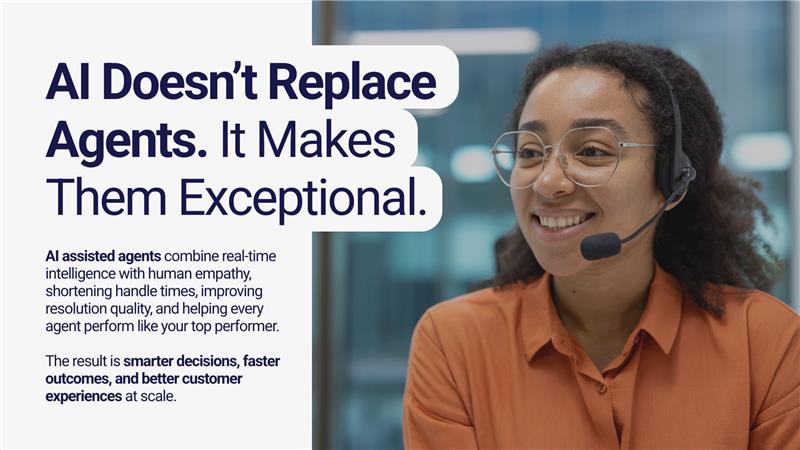
AI-assisted agents are human agents supported by an AI agent assistant system that provide real time guidance, automation, and insights during customer interactions and operational workflows. Rather than replacing people, these solutions elevate human performance by surfacing the right knowledge, recommending next-best actions, summarizing conversations, and automating routine tasks so agents can focus on complex problem-solving.
Unlike traditional, rules-based automation, AI assisted agents apply contextual understanding to each interaction. They interpret intent, sentiment, and history, then offer options that align with policies and customer needs. This adaptability drives consistent, high-quality service, even in unfamiliar situations, and empowers every real time agent to act with clarity and confidence.
AI analyzes large volumes of data, identifies patterns in language and behavior, and learns from outcomes. Human agents remain in control, validating recommendations, correcting inaccuracies, and providing empathy. This human-in-the-loop approach builds accuracy, confidence, and trust over time. If you are asking how AI agents work, think of agent assist platforms coordinating data, models, and workflows so people make better decisions faster.
Core Capabilities
- Natural Language Processing (NLP): Advanced NLP interprets customer intent, extracts entities like names or account numbers, detects sentiment, and generates concise responses and summaries. This reduces manual note-taking and helps agents tailor their tone, pacing, and approach with real time guidance from an AI agent assistant.
- Machine Learning and Adaptive Learning: Models analyze historical interactions to suggest next-best actions, relevant knowledge articles, and offers. Feedback loops improve results as agents accept, refine, or reject guidance, teaching the system what works in specific contexts. This is a core part of how AI agents work inside agentic AI systems.
- CRM and System Integrations: Effective solutions connect with CRMs and case management platforms to pull context (customer history, prior tickets, order data) and push outcomes (notes, dispositions, and follow-ups). Common integrations include Salesforce, Microsoft Dynamics 365, Zendesk, ServiceNow, telephony, and workforce systems. Unified integrations keep records accurate and ensure recommendations align with policy, enabling agent assist ai to operate as a reliable copilot.
Business Benefits
- Efficiency and Productivity: AI can auto-summarize calls, pre-fill forms, verify customer details, and surface targeted knowledge at the right moment. This shortens average handle time, reduces after-call work, and accelerates onboarding with guided workflows for new agents who learn faster with real time guidance from agent assist platforms.
- Personalized Customer Experience: By combining CRM context with real-time interaction analysis, agents can tailor recommendations, anticipate concerns, and deliver continuity across channels. Personalized guidance improves first contact resolution and satisfaction, demonstrating how AI agent assist strengthens every real time agent.
- Cost Savings and Resource Optimization: With less manual effort and higher per-agent capacity, teams handle more interactions without scaling headcount at the same rate. Better forecasting, lower rework, and fewer escalations reduce operating costs while maintaining quality. This is where AI assisted agents prove their value with measurable outcomes.
Common Use Cases
- Customer Support and Service: Real time guidance proposes empathetic phrasing, de-escalation strategies, and compliant resolutions. Automated knowledge retrieval and case summaries streamline workflows. Post-interaction analytics highlight root causes and training opportunities, reinforcing how AI agents work to lift overall quality.
- Sales and Marketing: AI surfaces next-best offers using purchase history and behavior, drafts follow-up emails, and prioritizes leads with predictive scoring. During calls, recommendations help with objection handling and point agents to relevant case studies or promotions. AI agent assist ensures every message aligns to context and brand.
- Data Analysis and Reporting: AI generates summaries, sentiment trends, and topic clusters to reveal emerging issues and product feedback. Managers gain dashboards with objective quality insights, compliance alerts, and targeted coaching recommendations that flow through agent assist platforms.
Challenges and Risks
- Data Privacy and Security: AI systems process sensitive customer information. Compliance with regulations and adherence to industry standards are essential. Strong governance, encryption, access controls, and audit trails protect privacy and support regulatory requirements across all agent assist platforms.
- Technology Dependence and Workforce Impact: Overreliance on AI can weaken human judgment if not managed. Clear policies, human approvals for sensitive actions, and ongoing training preserve a healthy balance. AI typically shifts work toward higher-value tasks, such as complex issue resolution and relationship management. AI assisted agents keep humans accountable while agentic AI handles routine tasks.
- Managing Expectations and Trust: Transparency matters. Clarify when AI is assisting, ensure agents can correct outputs, and provide an easy path to human-led resolution. Regular model calibration and performance reviews reduce hallucinations and build trust, especially when explaining AI assistant roles to teams.
How AI Assisted Agents Work
| Stage | What Happens | Value Delivered |
| Data Ingestion | CRM, tickets, knowledge base, orders, and interaction data are connected via APIs and event streams within agent assist platforms. | Creates a unified view for context-aware recommendations. |
| Real-Time Understanding | NLP detects intent, entities, and sentiment from voice or text; integrates screen and workflow context to feed AI agent assist. | Accurate, timely guidance that matches customer needs. |
| Recommendation & Automation | Next-best actions, knowledge snippets, and workflow steps are surfaced; routine actions are automated by agentic AI services. | Shorter handle times and fewer errors. |
| Human Oversight | Agents approve, modify, or reject suggestions and escalate when necessary, ensuring clarity in AI assistant responsibilities. | Maintains accountability, empathy, and compliance. |
| Learning & Optimization | Feedback and outcomes retrain models and refine playbooks, illustrating how AI agents work to improve over time. | Continuous improvement in accuracy and customer outcomes. |
If you are evaluating what is agentic AI, think of it as AI that can sequence tasks, take actions across systems, and adapt plans to achieve a goal, while humans set guardrails and approve sensitive steps. In this model, the AI agent assistant becomes a trusted copilot, and the real time agent remains the final authority.
Implementation Best Practices
- Start with a Focused Pilot: Select a high-volume, well-defined use case with clear KPIs such as average handle time, first contact resolution, and customer satisfaction. Limit the pilot to a subset of agents and channels so you can observe how AI agents work in your environment.
- Integrate for Context: Connect CRM, telephony, ticketing, and knowledge base systems. Use event streaming where possible to enable real time guidance and accurate record updates through agent assist platforms.
- Design Human-in-the-Loop Controls: Establish approval workflows for sensitive actions, clear escalation paths, and guardrails for compliance and brand tone. Clarify AI assistant boundaries, especially where automation triggers downstream actions.
- Measure and Iterate: Track both operational metrics and quality outcomes. Use agent feedback to refine prompts, knowledge snippets, and playbooks. Calibrate models regularly and document what is agentic AI within your governance model.
- Invest in Change Management: Train agents and supervisors on new workflows. Communicate the why, highlight quick wins, and celebrate adoption milestones. Empower each real time agent to use AI agent assist as a strength multiplier.
Future Outlook
AI assisted agents are rapidly evolving from point tools to comprehensive copilot platforms. Multimodal AI will interpret voice, text, and screen context simultaneously, enabling richer, real time guidance. Translation and tone adaptation will make global support more seamless. Dynamic playbooks will update continuously based on outcomes and policy changes, while domain-specialized models will improve accuracy in regulated industries such as healthcare and financial services. As agentic AI matures, AI assistance will be clearer: assistants will inform and suggest, while agents will plan and act within guardrails.
As autonomous workflows mature, routine requests like password resets or shipping updates will be handled end to end, with humans stepping in for complex judgment or sensitive conversations. Organizations that pair strong data governance with ongoing coaching and measurement will set a new bar for service quality and operational efficiency. The path forward is balanced power: let the AI agent assistant automate the routine, allow the real time agent to lead with empathy and judgment, and use agent assist AI to bring wisdom into every decision.
Frequently Asked Questions
How do AI assisted agents differ from chatbots?
Chatbots typically automate entire conversations within predefined boundaries and may operate without human oversight. AI assisted agents augment human agents with real time guidance, summaries, and automations. The human remains accountable for the final outcome, while agent assist ai reduces friction in the moment.
What metrics improve with AI assisted agents?
Organizations often see lower average handle time and after-call work, higher first contact resolution and customer satisfaction, improved agent productivity, and better compliance adherence. Automated quality scoring expands coverage and consistency, making it clear how AI agents work to create measurable value.
How long does implementation take?
Timelines depend on scope and integrations. Many teams launch a pilot within a few weeks for a focused use case and a subset of agents. Broader deployment follows after refining models, playbooks, and workflows based on pilot results with the AI agent assistant.
Will AI replace human agents?
AI primarily shifts work rather than replacing it. Routine steps are automated while people concentrate on nuanced issues, relationship-building, and complex problem-solving. Human-in-the-loop governance ensures people remain in control for sensitive or high-impact decisions, which is central to what is agentic AI in responsible operations.
Learn More About The Guru Way
AI assisted agents are no longer experimental tools, they are a practical, proven way to elevate performance, protect quality, and scale customer experience without sacrificing human judgment. The organizations that win with AI are the ones that implement it responsibly, integrate it deeply, and empower their agents to lead with confidence.
At The Office Gurus, The Guru Way consists of helping enterprises design, deploy, and optimize AI assisted agent solutions that align with real-world operations, compliance needs, and CX goals. If you’re ready to turn AI into a true partner for your teams, connect with The Office Gurus to start the conversation.