



Virtual agents are reshaping modern contact centers by delivering fast, accurate support at scale. When designed with natural language understanding, secure integrations, and thoughtful handoffs, AI-powered virtual agents improve customer experience, reduce operational costs, and strengthen service resilience. This guide explains what virtual agents are, how they differ from related technologies, and how to implement them effectively for measurable impact. For leaders seeking clarity and confidence, this is your roadmap to deploying virtual agents in contact centers with purpose, strategy, and care.
What Is a Virtual Agent in a Contact Center?
What is a virtual agent? A virtual agent is an AI-driven software that interacts with customers across voice, chat, SMS, social messaging, and email. It understands natural language, detects intent, and uses context to resolve inquiries, route requests, and complete tasks in real time. An AI virtual agent combines conversational intelligence with secure system access to get work done quickly and correctly.
In a contact center, virtual agents serve as intelligent front lines. They greet customers, authenticate users, answer common questions, retrieve information from knowledge bases and CRMs, and trigger workflows such as order status checks, appointment scheduling, or password resets. When a conversation requires deeper expertise, virtual agents hand off to a human agent with full context, including verified identity, prior steps, and captured data, so the customer does not need to repeat themselves. This is how virtual agents in contact centers earn trust and deliver consistent outcomes.
Key outcomes include lower average handle time, improved first-contact resolution, shorter queue wait times, and consistent service quality across channels and hours. Virtual agents provide 24/7 coverage, collect structured data during interactions, and help contact centers scale without proportional staffing increases. Whether you call it a call center virtual agent or an AI virtual agent, the value is the same: faster resolutions backed by smart automation.
Virtual Agents vs. Chatbots vs. Virtual Assistants
These tools often get lumped together, but they serve different purposes:
- Virtual agents: Enterprise-grade AI for customer service operations. They manage multi-turn conversations, integrate with business systems, and perform actions such as ticket creation, payment processing, or account updates. A call center virtual agent is built for reliability, scale, and secure execution.
- Chatbots: Usually rule-based, following scripted flows. They work for simple FAQs and single-step tasks but struggle with complex or ambiguous conversations.
- Virtual assistants: Productivity tools that support employees. In contact centers, they help agents internally by surfacing policies, generating summaries, or guiding troubleshooting.
Use chatbots for straightforward, low-risk inquiries. Deploy virtual agents for journeys that require authentication, data retrieval, and decisioning. Apply virtual assistants behind the scenes to boost agent productivity during live interactions. If the question is what is a virtual agent best suited for, the answer is complex, high-volume service tasks that demand both intelligence and action.
Benefits for Customers, Agents, and Operations
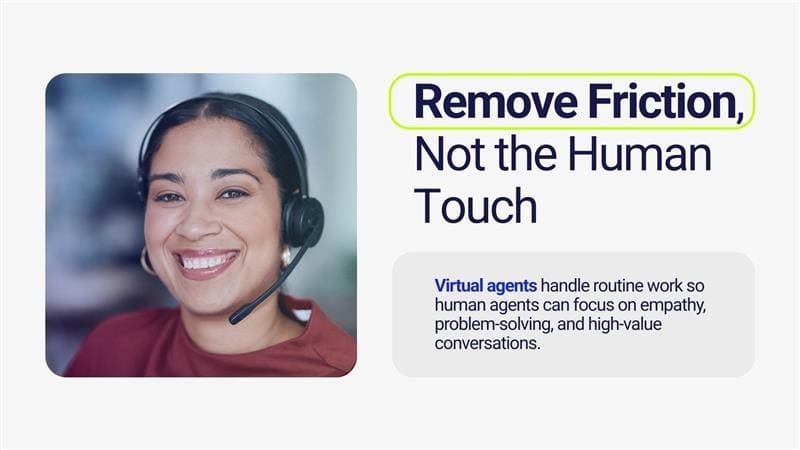
Customers benefit from speed and consistency. Virtual agents deliver instant responses, reduce hold times, and provide accurate information aligned to account history and preferences. Personalization strengthens trust and satisfaction, proving that virtual agents in contact centers can elevate every connection.
Human agents benefit from reduced repetitive workloads. Virtual agents handle high-volume tasks like order tracking, policy lookups, and appointment management, allowing agents to focus on empathy-driven conversations, escalations, and revenue opportunities. This improves morale and retention, while an AI virtual agent handles routine tasks with precision.
Operationally, virtual agents streamline processes and enhance outcomes. They raise containment rates, reduce transfers, and standardize compliance steps. Analytics reveal emerging issues and friction points, helping teams refine knowledge and workflows. The result: better resource allocation, predictable service levels, and lower cost per contact. A call center virtual agent brings strength and resilience to the operation, so performance remains steady under pressure.
How The Office Gurus Uses Intelligent Virtual Agents
At The Office Gurus (TOG), we design and operate Intelligent Virtual Agents (IVAs) that understand customer requests, execute tasks via secure backend integrations, and resolve interactions across voice or chat channels. Our approach removes friction, not people, so human agents can focus on complex, high-value conversations where empathy and problem-solving matter most. We build AI solutions that lead with wisdom and act with courage.
Our IVAs cover core service needs:
- Front Door / Triage: Greet, authenticate, route, and classify intent before reaching an agent.
- Self-Service FAQs: Provide policy information, account questions, and status updates.
- Case Intake: Collect structured data, create tickets, file claims, and submit forms.
Primary use cases include repetitive, high-volume tasks (intake, authentication, appointment scheduling, status checks) and pre-qualification before a live agent.
What makes our approach different is how we decide where to automate. Using conversation analytics from GuruAssist, we identify:
- High-repeat call reasons
- Low-complexity interactions
- Long average handle times caused by simple questions
Why clients should care:
- Lower cost per interaction
- Reduced queue pressure
- Agents spend more time on complex, higher-value conversations
Our key message: IVAs are not about replacing agents, they’re about removing friction and freeing humans to do human work. This is the promise of virtual agents in our contact center: clarity for customers, strength for teams, and results that scale.
Example Capabilities Our Gurus Deliver
- Appointment Handling: Scheduling, rescheduling, canceling, and reminders.
- Order and Payment Support: Order status, cancellations, and basic payment processing.
- Lead Qualification: Gather lead details, score, and route to sales.
- Identity Verification: Multistep authentication before exposing account information.
- Knowledge Retrieval: Pull answers from internal knowledge bases, FAQs, and SOPs.
- Post-Call Tasks: Summarize intent, disposition, and notes for CRM updates.
- Outbound Notifications: Reminders, follow-ups, and proactive outreach.
- After-Hours Coverage: Maintain service continuity when agents aren’t staffed.
These capabilities show how a virtual agent moves beyond conversation to execution. When leaders ask, “What is a virtual agent capable of?”, the answer is simple: it’s a disciplined, reliable teammate that gets work done.
Implementing Virtual Agents the Right Way
Successful programs blend technology, process, and change management. Start with a focused use case that has clear value and measurable outcomes, like password resets, billing inquiries, or appointment scheduling. Map the customer journey, identify intents, and document required integrations. This is how to build a call center virtual agent that performs under pressure.
Practical steps to integrate virtual agents:
- Connect IVAs to CRM, ticketing, and knowledge systems via secure APIs.
- Define authentication and security policies, including role-based access and audit trails.
- Design conversation flows with compliance guardrails and clear escalation paths to live agents.
- Select channels that match customer preferences and ensure consistent behavior across voice and digital.
Best practices for training and governance:
- Use well-structured knowledge content and maintain version control.
- Create intent libraries with representative utterances; refine using real interaction data.
- Implement prompt safety and test for edge cases and ambiguity.
- Provide fallback options and human handoffs to avoid dead ends.
Measuring effectiveness:
- Track containment rate, average handle time, and deflection from high-cost channels.
- Monitor CSAT, agent satisfaction, resolution accuracy, escalation quality, and compliance adherence.
- Review transcripts to find knowledge gaps and refine intents.
- Tie metrics to cost per contact, revenue per interaction, and queue health.
Security and Compliance
Enterprise virtual agents support role-based access, encryption in transit and at rest, and detailed audit logging. Programs should align with frameworks such as SOC 2, ISO 27001, PCI DSS, and HIPAA where applicable. Use secure authentication methods (OAuth, SSO) and tokenization when accessing customer data. IVAs must adhere to privacy policies and regional regulations while maintaining transparent escalation paths for sensitive requests. Security is non-negotiable for virtual agents in contact centers, and every call center virtual agent we deploy follows strict controls.
Frequently Asked Questions
- Do virtual agents replace human agents? No. They complement human teams by handling routine tasks and triaging complex ones. Human agents remain crucial for nuanced, emotional, or exception-heavy cases. A virtual agent amplifies human capability rather than replacing it.
- How long does deployment take? It depends on the business needs and goals, but some targeted use cases can go live in 4 to 8 weeks. Multi-channel programs with deeper integrations, for example, may take 3 to 6 months, especially if knowledge content needs restructuring.
- Which channels do virtual agents support? Leading solutions operate across voice IVR, web chat, mobile chat, SMS, social messaging, and email, with omnichannel consistency to ensure a unified experience.
- How do virtual agents manage tone and language? IVAs can be configured to match brand voice and tone, with templates for clarity and empathy. Multilingual models support global audiences, and routing ensures the right team handles escalations.
- What does success look like at scale? Mature programs achieve higher containment on eligible intents, reduce handle time for escalations, raise CSAT by shortening time to resolution, and lower cost per contact. Ongoing training and governance sustain these results. This is the level of performance leaders expect from AI virtual agent deployments.
Why Partner with The Office Gurus
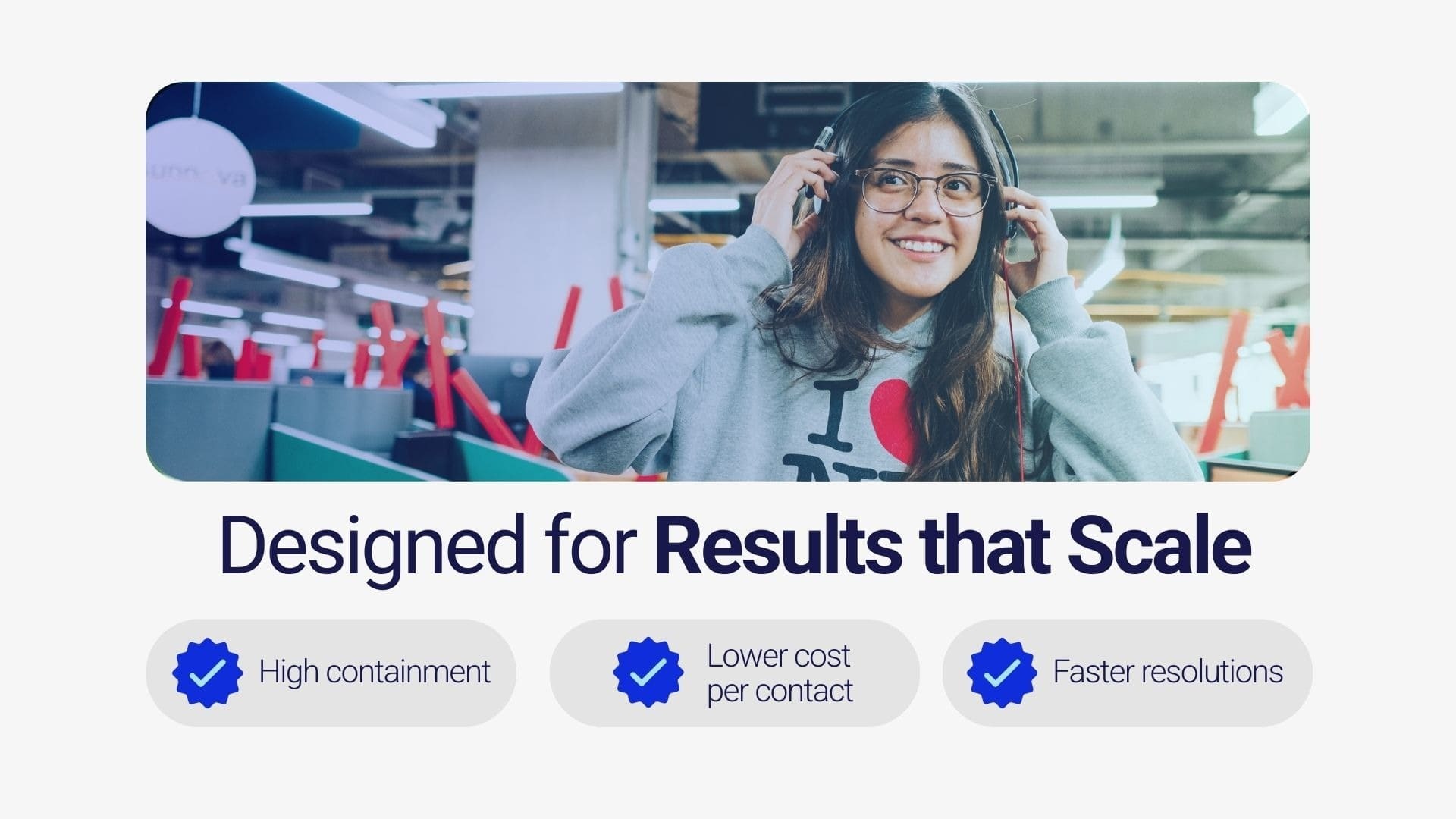
Our teams design IVAs to remove friction from customer connections, not replace people. By automating high-volume, repetitive steps like appointment scheduling, status checks, authentication, and basic intake, we free agents to handle complex, high-value conversations. Using GuruAssist analytics, we pinpoint the best opportunities for self-service, such as repeating call drivers, simple requests with long handle times, and low-complexity interactions, so automation improves both efficiency and experience.
Here are some examples of on how IVAs can make a difference for your business:
| Objective | IVA Impact | Outcome |
| Reduce queue pressure | Front Door triage and pre-qualification | Shorter waits, higher containment |
| Lower cost per contact | Self-service for FAQs and status checks | Fewer agent minutes per interaction |
| Improve agent productivity | Automate intake and identity verification | Agents focus on complex issues |
| Strengthen compliance | Standardized flows and audit trails | Consistent policy adherence |
| Extend coverage | After-hours and outbound notifications | 24/7 continuity and proactive outreach |
With operations across the United States, nearshore and offshore locations, we build and manage programs that scale, comply, and deliver measurable value. If you’re ready to reduce friction and give your customers faster, smarter service, we’re here to help. Together, we will deploy virtual agents in contact centers that act with strength and clarity, so every virtual agent becomes a trusted force for positive change.
Virtual agents are no longer a future concept, they are a proven way to deliver faster, more reliable service while strengthening the human core of your contact center. When implemented with intention, secure design, and clear governance, virtual agents reduce friction for customers, restore focus for agents, and create operational resilience at scale.
If you’re ready to move beyond experimentation and deploy virtual agents in contact centers with clarity and confidence, The Office Gurus is here to help. Contact us today to explore how Intelligent Virtual Agents can streamline your operations, elevate customer experience, and deliver measurable results without losing what makes your service human.