


Cost will always matter, but the best results come from optimizing for business impact, resilience, and customer experience. Treat outsourcing as a disciplined way to extend your capabilities, accelerate results, and manage risk without sacrificing quality. Here’s what separates a strategic outsourcing partnership from a cost-driven vendor relationship. These metrics show the difference.
1) Why “Cheaper” and “Better Value” Aren’t the Same Thing
Chasing the lowest price is a false economy. The upfront number rarely reflects the downstream consequences that erode savings and can harm your brand. This is the core tension behind total cost vs. total value outsourcing decisions: the sticker price is only ever part of the story.
- Quality degradation: Insufficient training and aggressive handle-time targets drive up rework, compliance exposure, and churn. Each one carries real financial and brand costs.
- Turnover and scalability: High attrition inflates recruiting and training spend, drains institutional knowledge, and weakens service levels, often requiring costly stopgaps.
- Security and compliance: Not investing enough in controls and audits raises the risk of breaches, fines, and legal exposure. Any of these can quickly outweigh the initial savings.
Better value comes from improving outcomes: revenue lift, faster cycle times, higher customer satisfaction, and scalable coverage. A smarter approach keeps core strengths in-house: strategic decision-making, customer relationships, and brand-defining moments. Partnering makes sense for heavy operational work like tier-1 support, back-office processing, QA, and seasonal surge capacity.
Hybrid models excel when you retain strategy and sensitive decision-making in-house. From there, you can lean on a partner’s execution capacity, specialized tools, and 24/7 coverage. That’s the shift from a staffing decision to an operating decision.
Speed to value is critical. A partner can often move faster than you could build in-house. When that’s the case, the cost of delay usually outweighs any near-term savings from doing it yourself. That’s where real outsourcing partner value starts showing.
2) From Vendor to Strategic Partner: The Shift Buyers Are Making
High-performing organizations no longer treat outsourcing as a transactional purchase. This is the line between vendor vs. partner outsourcing: one manages tasks, the other manages outcomes. They pursue joint value creation with measurable results, shared governance, and continuous improvement built into the operating model. That shift starts with how you govern the relationship.
- Shared goals and governance: Establish weekly operational reviews, monthly performance deep dives, and quarterly business reviews. Align on objectives tied to business value, customer experience, speed to resolution, conversion, and reliability rather than activity metrics.
- Integrated ways of working: Treat your partner as an extension of your team, with access to training, product updates, and change logs. Codify knowledge into playbooks, SOPs, and process maps. Then close the loop: feed customer insights back into product updates, training, and workflows.
- Risk and resilience by design: Expect audit readiness. Validate security frameworks such as SOC 2, ISO 27001, and PCI DSS where relevant. Confirm role-based access and encryption, both at rest and in transit. Review business continuity plans, site redundancy, failover testing cadence, and clear RPO/RTO commitments.
The result is a relationship that adapts to change and scales with demand. It stays aligned to strategic outcomes, not just task completion. Not sure what to ask before you sign? Here are the questions that actually predict whether a partnership will hold up once things change.
3) The Metrics That Actually Reveal Performance
Outcome metrics like CSAT and NPS are essential, but they move after foundational indicators have already changed. These numbers tell you what’s happening before your customers do. Use them to steer decisions, prevent performance drift, and justify investments.
| Metric | What It Indicates | Why It Leads to CSAT |
| Attrition | Talent stability and knowledge retention | Rising exits precede quality dips and longer handle times |
| Tenure | Depth of experience on the desk | Experienced agents drive faster resolution and fewer escalations |
| Time-to-Fill | Hiring velocity and bench strength | Slow fills cause understaffing, backlogs, and inconsistent service |
| QA Scores | Adherence to process, compliance, and soft skills | QA dips show up before customer sentiment changes |
| First Contact Resolution (FCR) | Effectiveness of issue resolution on first touch | FCR declines precede longer cycles and lower satisfaction |
| Escalation Rate | Complexity handling and empowerment | Escalations rise ahead of customer frustration |
Instrument these as a shared scorecard, with targets, thresholds, calculation methods, and data sources agreed upfront. By managing these leading indicators, you stabilize operations and predictably lift CSAT, NPS, and revenue-impacting measures.
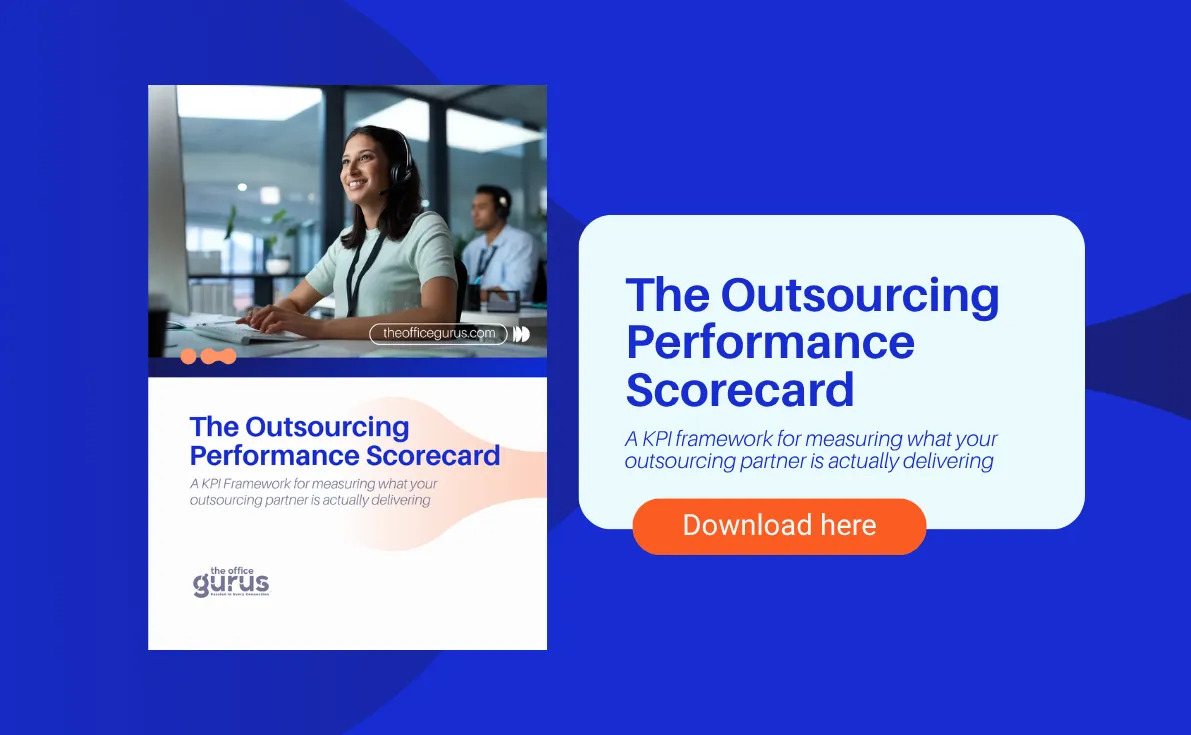
Want a ready-made way to track these across your own outsourcing relationships? Our Outsourcing Performance Scorecard breaks each metric down further, including how to set targets and act on the results.
4) What High-Performing Partnerships Do Differently
Top-performing partnerships are designed for transparency, continuous improvement, and seamless integration with your teams. These are the hallmarks of a true BPO strategic partnership. They reduce variance, accelerate learning, and convert insights into measurable gains. They also translate those metrics into action, which is what separates a reporting relationship from a performance partnership.
Proactive recommendations
- Data-led playbooks: Analyze root causes across QA, FCR, and escalation trends to refine workflows and knowledge assets. Propose experiments with clear hypotheses and success criteria.
- Capacity and coverage planning: Anticipate seasonal peaks with hiring pipelines, cross-training, and schedule optimization to protect service levels without sacrificing quality.
- Automation and deflection: Identify opportunities for guided workflows, AI-assisted responses, and knowledge improvements. These reduce handle time and error rates while keeping humans in the loop for judgment calls. At The Office Gurus, GuruAssist supports agents in real time. It doesn’t replace the judgment they bring to complex conversations.
Transparent reporting
- Shared dashboards: Real-time visibility into leading and lagging indicators eliminates interpretation gaps and speeds decisions.
- Variance narratives: Pair metrics with clear explanations and corrective actions. Leaders should see not just what changed, but why, and what happens next.
- Calibration rituals: Frequent quality calibration sessions ensure scoring consistency and reinforce the behaviors that drive results.
Deep integration with internal teams
- Structured knowledge transfer: Maintain living playbooks, SOPs, process maps, and certification paths. Keep teams updated on product roadmaps and change logs.
- Joint problem-solving: Run structured process-improvement workshops to eliminate waste, standardize best practices, and prioritize high-impact experiments. Close the loop by routing customer insights to product and policy owners.
- Secure-by-default operations: Enforce least-privilege access and encryption, both in transit and at rest. Maintain auditable change control across all environments. Validate disaster recovery through periodic testing with documented RPO/RTO.
When these elements come together, the partnership becomes a force multiplier. It improves customer outcomes, compresses time-to-value, and de-risks scale.
5) Closing Thoughts
Outsourcing smarter is about building an operating advantage. It starts with rejecting the false trade-off that “cheaper equals better”. Instead, embrace a model oriented around outcomes, resilience, and continuous improvement.
Select partners for capability, culture alignment, and scalability. Govern the relationship with shared dashboards and clear cadences. Manage leading indicators: attrition, tenure, time-to-fill, QA, FCR, and escalation rate.
Doing so lets you correct course before customer sentiment changes. Integrate teams, protect data, and turn frontline insights into product and policy enhancements. This is how high-performing partnerships deliver total value: faster ramp, steadier performance, and stronger customer experiences. They also flex for peak season without compromising standards.
See where your own partnerships stand today. Download the Outsourcing Performance Scorecard, or talk to a Guru about what your numbers are telling you.