


The CX innovation stack: CCaaS, IVA, human-centric tech support brings together cloud contact center solutions, intelligent automation, and empathetic human engagement. When these components share data and align to clear processes, companies deliver faster resolutions, lower operating costs, and more loyal customers. This article explains each layer, how they work in concert, and practical steps to build a unified customer experience that scales. Throughout, we show how a human centric approach strengthens every decision and accelerates outcomes.
Defining the CX Innovation Stack
The CX innovation stack combines technologies, processes, and teams that power every touchpoint, from self-service to live support. Three pillars sit at its core:
- Contact Center as a Service (CCaaS) for omnichannel routing, orchestration, and analytics
- Intelligent Virtual Agents (IVA) for conversational automation and data gathering
- Human-centric tech support for complex issues that require judgment, empathy, and trust
Each pillar addresses a distinct need. Contact Center as a Service unifies channels and data. Intelligent virtual agents IVA resolve routine tasks quickly and consistently. Skilled agents handle nuanced, high-stakes situations. When integrated, customers experience seamless handoffs, less friction, and outcomes personalized to their history and preferences. This is the promise of a disciplined innovation stack guided by a human centric approach.
End-to-end, the stack works like this: an IVA greets the customer, authenticates them, and attempts to resolve the request through natural language. When escalation is warranted, CCaaS routes the case to the best available agent and passes full context, transcripts, and intent. Human agents then use guided workflows and knowledge within the CCaaS platform to resolve the issue and capture feedback. That data continuously trains the IVA, refines routing logic, and improves knowledge quality over time, precisely how contact center solutions compound value across the innovation stack.
Contact Center as a Service (CCaaS): The Orchestration Layer
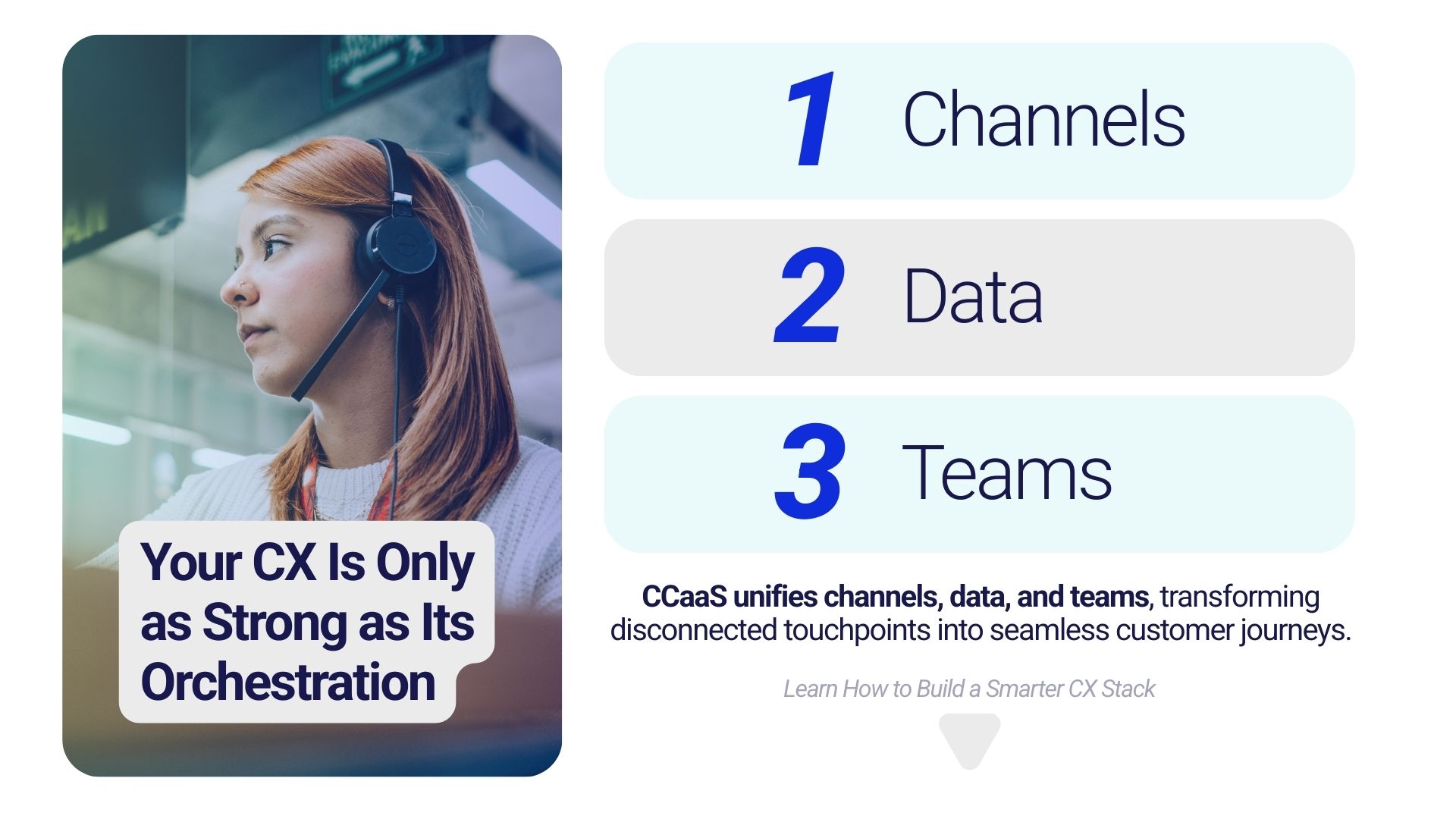
CCaaS platforms centralize voice, email, chat, SMS, social messaging, and self-service in a single cloud environment. They enable intelligent routing, unified agent desktops, workforce optimization, and analytics while integrating with CRM, data warehouses, and critical business systems. Being cloud-native, Contact Center as a Service scales elastically, supports distributed teams, and reduces the need for heavy on-premises infrastructure.
Core capabilities include:
- Omnichannel routing with skills-based, intent-based, and priority-based logic
- Unified agent desktops that consolidate tools, customer context, and next-best actions
- Real-time and historical analytics for performance, quality, and forecasting
- Quality and workforce management for coaching, adherence, and scheduling
- Native and API-based integrations with CRM, knowledge, payments, and identity providers
- AI assistance for summarization, guidance, and after-contact work
- Security, compliance, and resilience with redundancy and disaster recovery
Organizations adopt contact center as a service CCaaS to improve agility, reduce IT overhead, and deliver consistent service across channels. Benefits include faster deployments, lower total cost of ownership, improved service levels via intelligent routing, higher agent productivity through unified tooling, and clearer insights from consolidated reporting.
When framed within the broader CX innovation stack: CCaaS, IVA, human-centric tech support, the orchestration layer ensures every channel and interaction is grounded in context, enabling intelligent virtual agents and human teams to operate as one.
Intelligent Virtual Assistants (IVA): The Automation Layer
Intelligent Virtual Agents use natural language understanding, dialogue management, and system integrations to resolve common inquiries without waiting for a human. IVAs handle tasks like authentication, order status, basic troubleshooting, billing updates, and appointments. They also collect details that speed resolution when a live handoff is needed.
Intelligent virtual agents IVA improve response times by engaging instantly, 24/7, across web chat, mobile apps, messaging platforms, and voice IVR. Because they authenticate customers, validate entitlements, and pull data from CRM or ERP systems, they reduce friction and shorten time to resolution. Customers receive consistent answers and predictable flows, while agents receive well-documented, contextualized cases as evidence of contact center solutions working together in an innovation stack.
When designed around real intents and clear language, IVAs can deflect 20–40% of routine contacts. The bigger payoff is experience quality. Consider a travel company that deployed an IVA for itinerary changes. By proactively surfacing fees, loyalty benefits, and alternative flights, it achieved a double-digit increase in CSAT for self-service interactions and reduced refund requests.
Trends shaping IVA maturity:
- Multimodal experiences that blend text, voice, and images
- Retrieval augmented generation to ground responses in verified knowledge
- Proactive notifications for order status, renewals, and service updates
- Continuous learning loops using post-interaction feedback and agent annotations
Expect intelligent virtual agents to move from reactive bots to proactive assistants that anticipate needs, such as alerting customers before disruptions or recommending fixes based on device telemetry. In a well-governed CX innovation stack: CCaaS, IVA, human-centric tech support, these assistants elevate both efficiency and empathy.
Human-Centric Tech Support: The Empathy Layer
Human-centric tech support is built around people, not tickets. It emphasizes empathy, clarity, and outcomes that respect a customer’s time, context, and emotional state. This approach is vital for complex issues, vulnerable situations, or high-impact events such as outages, billing discrepancies, or security concerns. The goal is not to replace humans with technology, but to empower them with better tools and insights.
Balance automation and human interaction by clearly defining the boundary between routine and high-stakes scenarios. Rely on IVAs for predictable tasks and context gathering. Route to people when judgment, negotiation, exception handling, or reassurance is required. Escalation rules should consider sentiment, customer value, prior effort, and risk, not just intent complexity. Handoffs must be warm, passing full context and conversation summaries to agents so customers never need to repeat themselves. This human centric approach turns contact into connection.
Train and enable support teams with:
- Structured onboarding that blends product knowledge with interpersonal skills
- Role-play and simulations for difficult conversations and de-escalation
- Coaching on clarity, tone, and active listening supported by quality insights
- Knowledge tools, guided workflows, and AI assistance for summarization and notes
Reinforce a culture that values solving the whole problem and building trust, not merely closing tickets. Recognize and reward agents for outcomes that reduce future effort and improve long-term satisfaction. When human-centric tech support is amplified by contact center as a service CCaaS and intelligent virtual agents, the innovation stack becomes a force for loyalty and growth.
Bringing the Stack Together
To integrate CCaaS, IVA, and human-centric support, start with a unified data foundation. Connect CCaaS, IVA, CRM, and knowledge systems so every interaction can read and write context. Standardize customer IDs, event schemas, and metadata to track journeys across channels. Establish governance for knowledge articles, intent models, and routing rules so updates propagate reliably across the stack.
Best practices include:
- Intent-first design that maps top contact drivers to the right channels
- Progressive disclosure that asks only for necessary information at each step
- Warm transfers that include transcripts, dispositions, and authentication tokens
- Continuous tuning with analytics on containment, transfer quality, and sentiment shifts
Common challenges and how to overcome them:
- Data silos that break context: integrate real-time event streams and consolidate profiles.
- Brittle automations that miss edge cases: design fallback paths and clear exit options.
- Misaligned KPIs that optimize local metrics: balance CSAT, first contact resolution, average handle time, and customer effort score.
Form a cross-functional council spanning operations, product, data, security, and compliance to prioritize use cases, manage risk, and align targets. Treat automation and orchestration as evolving products, not static projects. With this discipline, your cx innovation stack: CCaaS, IVA, human-centric tech support will operate as one system, not a collection of tools.
Measuring Success Across the Stack
Adopt a blended scorecard that connects operational, experience, business, and automation metrics. This helps teams understand tradeoffs and focus on outcomes, not just activity.
- Operational: service levels, occupancy, adherence, handle times, queue health
- Experience: CSAT, NPS, sentiment, repeat contacts, customer effort score
- Business: retention, conversion, revenue recovery, cost to serve
- Automation: containment rate, intent accuracy, escalation quality, model drift
Go beyond top-line averages. Use cohort analysis to compare outcomes by segment, channel, intent, and complexity. Track first contact resolution across assisted and automated paths. Analyze failure points in handoffs and use those insights to refine prompts, intents, knowledge articles, and agent workflows. Feed learnings into training and coaching programs for continuous improvement, an approach that aligns with a human centric approach to performance.
Architecture Considerations and Data Design
A strong architecture accelerates innovation while maintaining governance and security. Focus on:
- Customer identity: use a consistent customer ID across CCaaS, CRM, data platforms, and IVAs.
- Event pipelines: publish interaction events to a real-time bus for routing, analytics, and personalization.
- Knowledge management: implement a single source of truth with versioning, feedback, and approval workflows.
- Integration patterns: prefer APIs and webhooks; use connectors for common systems; adopt standardized schemas.
- Security and compliance: enforce least privilege, encryption, auditing, and zero-trust principles.
- Observability: instrument the stack end-to-end with logs, metrics, traces, and alerting.
This foundation supports faster experiments, cleaner handoffs, and reliable scaling across geographies and teams. It also strengthens contact center solutions by ensuring Contact Center as a Service CCaaS and intelligent virtual agents IVA operate with the same source of truth.
Agent Experience and Enablement
The human layer succeeds when agents have the right tools and support. Focus on:
- Unified desktop with context, knowledge, and automations within the CCaaS interface
- Guided workflows that simplify complex processes and reduce variability
- Real-time assistance for summarization, next-best actions, and compliance checks
- Coaching tools that surface call snippets, quality flags, and sentiment shifts
- Career paths and recognition programs that reward problem-solving and empathy
Well-equipped agents create faster, more accurate resolutions and deliver the human connection that drives loyalty. This is where human-centric tech support proves its strength: empowered people supported by contact center as a service and intelligent virtual agents, aligned through contact center solutions that remove friction.
Governance, Risk, and Compliance
Strong governance keeps innovation aligned with legal, regulatory, and brand standards. Key practices include:
- Role-based access and audit trails across CCaaS, IVA, and data systems
- Model governance for IVA intents, prompts, and training data with approval workflows
- Data minimization and retention policies that match regulatory requirements
- Secure authentication flows, including passkeys and device-based verification
- Bias and fairness reviews for automated decisioning that could affect customers
Incorporate red teaming and scenario testing for edge cases such as outages, fraud, and privacy incidents. Document playbooks and ensure staff are trained to execute them under pressure. This discipline safeguards the cx innovation stack: CCaaS, IVA, human-centric tech support without slowing progress.
Future Trends Shaping the Stack
CCaaS is moving toward composable architectures with open APIs, native AI for forecasting and quality, and deeper ties to CRM and data clouds. Expect more robust zero-trust patterns that simplify compliance without slowing delivery. Real-time agent assistance will shift from suggestions to semi-autonomous task execution under human oversight, reducing effort on repetitive work.
IVAs will become more capable and grounded. Better speech recognition and synthesis will support natural voice experiences. Guardrails will ensure accuracy by grounding responses in verified knowledge and real-time data. Proactive service will become the norm, with intelligent virtual agents detecting potential issues from telemetry or logistics signals and offering solutions before customers reach out.
The human role will become even more strategic. As automation absorbs routine contacts, agents will focus on exception handling, account advocacy, and relationship building. New roles will emerge, including conversation designers, automation product owners, and escalation specialists who blend technical depth with empathy.
Emerging technology to watch:
- Digital identity and passkeys for frictionless, secure authentication
- Real-time translation to deliver multilingual support at scale
- Privacy-preserving analytics that extract insights without exposing sensitive data
- Customer journey orchestration for coordinated experiences across marketing, sales, and service
Together, these advances will make support more secure, personalized, and effortless. As contact center solutions evolve, the innovation stack will continue to blend contact center as a service CCaaS, intelligent virtual agents IVA, and human-centric tech support into a single, high-performing system.
Sample KPI Framework
| Category | Metric | What It Indicates |
| Operational | Service level, handle time, occupancy | Capacity, efficiency, and staffing alignment |
| Experience | CSAT, NPS, sentiment, repeat contacts | Customer perception and effort |
| Business | Retention, conversion, cost to serve | Financial impact of CX performance |
| Automation | Containment, intent accuracy, escalation quality | IVA effectiveness and handoff integrity |
Use this framework to create a balanced scorecard and align teams on the outcomes that matter. It reinforces a human centric approach while keeping the entire innovation stack accountable.
Conclusion
The CX innovation stack: CCaaS, IVA, human-centric tech support is more than a technology mix. It is an operating model that unifies orchestration, automation, and empathy. With a shared data foundation, clear governance, and a balanced scorecard, organizations can deliver faster resolutions, lower costs, and customer experiences that build lasting loyalty. Start with your highest-impact intents, design warm handoffs, and empower agents with modern tools. As you iterate, the stack will compound value, improving today’s interactions while learning how to make tomorrow’s even better. In this journey, contact center as a service CCaaS and intelligent virtual agents IVA combine with human-centric tech support to form an innovation stack that is both courageous and wise, ready to meet every challenge with clarity and care.
Ready to modernize your customer experience with a fully integrated CX innovation stack? The Office Gurus helps organizations design, implement, and optimize CCaaS platforms, intelligent virtual agents, and human-centric tech support that work as one unified system. Whether you’re upgrading legacy infrastructure, improving automation performance, or strengthening your human support layer, our experts build scalable contact center solutions that drive measurable business results. Contact us today to transform your CX strategy into a competitive advantage.
Frequently Asked Questions About the CX Innovation Stack
1. What is a CX innovation stack and why is it important?
A CX innovation stack is an integrated framework that combines Contact Center as a Service (CCaaS), Intelligent Virtual Agents (IVA), and human-centric tech support to deliver seamless, scalable customer experiences. It is important because it unifies automation, orchestration, and human empathy into one system. When these components share data and workflows, organizations achieve faster resolutions, lower operating costs, improved customer satisfaction, and stronger long-term loyalty.
2. How do CCaaS and Intelligent Virtual Agents work together?
CCaaS platforms manage omnichannel routing, analytics, and agent workflows, while Intelligent Virtual Agents automate routine interactions such as authentication, order status, and appointment scheduling. When integrated, the IVA handles initial engagement and gathers context, then CCaaS routes complex cases to the best-qualified agent with full conversation history. This integration reduces handle time, improves first contact resolution, and ensures customers do not repeat information during handoffs.
3. When should customer interactions be handled by humans instead of automation?
Customer interactions should be escalated to human agents when they involve emotional complexity, exceptions, negotiation, high financial impact, security concerns, or unresolved issues after automation attempts. A human-centric tech support model ensures that sensitive or high-stakes scenarios are handled with empathy, judgment, and personalized problem-solving. Automation works best for predictable, repeatable tasks, while humans are essential for building trust and resolving nuanced situations.