



Data privacy is a cornerstone of modern contact center operations. Every customer interaction, whether it involves account credentials, payment details, health information, or personal records, carries an expectation of protection. Strong privacy practices reduce operational risk, safeguard brand reputation, and reinforce customer trust while ensuring compliance with evolving regulations.
This guide explains why data privacy essentials for contact center solutions are critical and how The Office Gurus (TOG) embeds data protection into every program. Our approach to data security, privacy compliance, and regulatory alignment positions us as a trusted partner for organizations that view trust, performance, and resilience as inseparable.
At The Office Gurus, data privacy is both a strategic advantage and a responsibility. We design secure contact center workflows using proven technology, disciplined governance, and controls built to withstand modern threats across industries and geographies.
Understanding Data Privacy in Contact Centers
Data privacy refers to the responsible collection, use, storage, and sharing of personal information. In contact center environments, it ensures customer data is accessed only for legitimate purposes, protected from unauthorized exposure, and handled in accordance with legal and ethical standards. This is not a one-time compliance exercise, it is a continuous operational discipline.
Contact centers process high volumes of data across voice, chat, email, and digital channels. Typical workflows include identity verification, call recording, case management, analytics, and escalations. Each step touches multiple systems, like CRMs, ticketing platforms, payment gateways, and workforce tools, making governance and controls essential.
Consent is foundational. Customers must be clearly informed when data is collected, recorded, or shared. U.S.-based programs often require compliance with CCPA/CPRA, PCI DSS, and HIPAA (when healthcare data is involved), while global operations may also fall under GDPR and state-level privacy laws. Aligning to these frameworks enables lawful processing and strengthens customer confidence. The Office Gurus aligns every program to applicable data privacy, PCI, and HIPAA compliance requirements, supported by strong data security controls.
Key Risks to Data Privacy in Contact Centers
Contact centers face elevated privacy risks due to data volume, multiple channels, and human interaction. Common threats include phishing and social engineering attacks on agents, credential theft, misconfigured cloud services, insider misuse, insecure integrations, and outdated systems with excessive access permissions.
Even minor incidents, such as unredacted call recordings or misrouted transcripts, can trigger compliance violations, regulatory penalties, and reputational damage. Larger breaches can expose organizations to litigation, financial loss, and long-term erosion of customer trust.
Industry incidents might involve:
- Call recordings capturing payment card details
- Improper transcript storage or export
- Weak authentication during customer verification
- Social engineering attacks that bypass frontline controls
These risks highlight why least-privilege access, secure authentication, continuous monitoring, and modern contact center technology are essential to meeting PCI and HIPAA requirements and maintaining strong data protection.
Best Practices for Ensuring Data Privacy
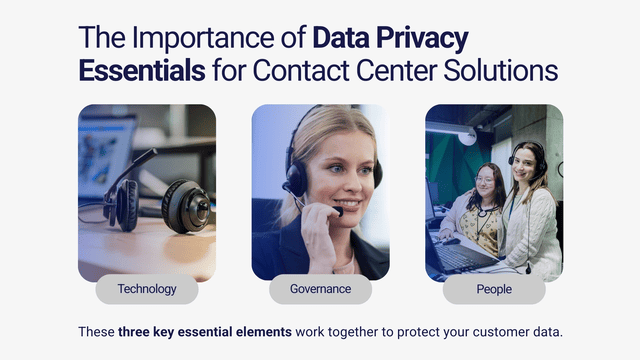
Effective data privacy requires alignment between technology, process, and culture. It is important to know what to look for in your outsourcing partner to choose the right one. The following best practices form the foundation of secure, compliant contact center operations:
Data encryption and access controls
Encrypt data in transit (TLS) and at rest (AES-256). Enforce role-based access, least-privilege permissions, and multi-factor authentication, especially for administrative roles. These controls protect customer data and support PCI compliance.
Staff training and awareness
Regular training helps agents recognize phishing attempts, handle sensitive information correctly, and report incidents quickly. Scenario-based exercises and refresher programs reinforce accountability and reduce human risk.
Privacy policies and data governance
Clear policies define data usage, retention schedules, consent capture, and data minimization. Strong vendor management and third-party agreements ensure privacy obligations extend beyond internal teams.
Secure data handling procedures
Mask sensitive data in agent desktops, redact recordings and transcripts, and restrict copy, export, and screen capture functionality. Patch management and secure configurations further reduce vulnerabilities.
Monitoring and incident response
Centralized logging, SIEM tools, and anomaly detection enable rapid response to suspicious activity. A tested incident response plan minimizes impact and ensures regulatory obligations are met.
How The Office Gurus Prioritizes Data Privacy
The Office Gurus embeds privacy-by-design into every client engagement. Our framework combines technical safeguards, operational controls, and continuous improvement to protect customer data throughout the lifecycle.
We implement:
- End-to-end encryption and secure integrations
- Strict access controls and session monitoring
- Data minimization, redaction, and compliant retention policies
Compliance is foundational. We map and operationalize requirements from PCI DSS to HIPAA (where applicable) into daily workflows. Regular audits, penetration testing, and vendor due diligence ensure controls remain effective as programs scale.
Here is an example of the attention to details we give to every client:
Transparency reinforces trust. Clients receive clear documentation, control mappings, training metrics, and ongoing reporting, ensuring visibility into how privacy is maintained.
The Role of Technology in Enhancing Data Privacy
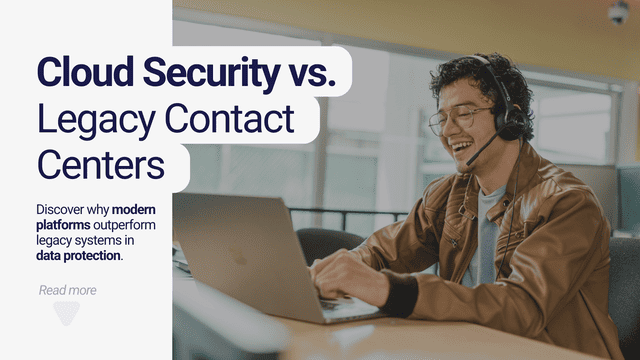
Modern contact center technology strengthens privacy when paired with proper governance. AI-driven tools can detect anomalous behavior, automate real-time redaction, and prevent sensitive data from appearing in searchable logs.
Secure communication protocols, such as TLS, SRTP, and encrypted messaging, protect data across voice and digital channels. Identity verification tools using behavioral and device signals reduce fraud and social engineering risk.
Cloud-based platforms, when configured correctly, often exceed on-premises security through centralized identity management, encryption services, and continuous compliance monitoring. With TOG’s guidance, organizations gain agility without compromising privacy or regulatory alignment.
Privacy Controls Overview
| Control Area | Objective | Common Practices |
| Access Management | Limit exposure | Role-based access, MFA, least privilege |
| Data Protection | Secure data | AES-256, TLS, tokenization, masking |
| Monitoring | Detect threats | Centralized logs, SIEM, analytics |
| Integration Security | Reduce vulnerabilities | Secure APIs, configuration baselines |
| Data Governance | Ensure lawful use | Consent tracking, retention, minimization |
| Training & Culture | Reduce human risk | Phishing simulations, privacy training |
| Incident Response | Minimize impact | Runbooks, notification, remediation |
Partner with The Office Gurus for Secure Contact Center Solutions
Choosing a privacy-first partner protects your brand while enabling high-performance service delivery. The Office Gurus combines rigorous privacy controls with operational excellence to help organizations meet regulatory demands and customer expectations.
Our approach delivers:
- Reduced risk through standardized, audit-ready controls
- Faster compliance alignment across PCI, HIPAA, and privacy frameworks
- Secure, streamlined agent workflows with minimal data exposure
- Tailored solutions for industry-specific requirements
We provide ongoing support through regular privacy reviews, policy updates, training refreshers, and strategic guidance as regulations and threats evolve.
Executive FAQ
What types of data require the highest protection in contact centers?
Personally identifiable information, payment card data, and health-related information require the strongest controls and regulatory alignment.
How does consent impact compliance risk?
Clear, documented consent reduces legal exposure and ensures lawful processing, especially for call recording and marketing communications.
How long should customer data be retained?
Only as long as necessary for business and legal purposes, with automated deletion and consistent retention policies.
What should leadership expect after a security incident?
Immediate containment, documented response actions, regulatory notifications when required, and corrective controls to prevent recurrence. With a trusted partner like The Office Gurus, the chances of security incidents are very limited and highly regulated.
Are cloud-based contact centers secure enough for regulated industries?
Yes, when configured with strong access controls, encryption, and continuous compliance monitoring under a shared responsibility model.
Next Steps
Data privacy is not a one-time initiative, it is a continuous discipline. If you are reassessing your contact center strategy or planning to scale, The Office Gurus can help evaluate your current posture, strengthen safeguards, and align operations to evolving regulations.
Together, we help you protect customer data, maintain compliance, and deliver trusted experiences without compromising performance. When privacy matters most, The Office Gurus stands ready to guide and protect your organization.
Contact our Gurus today and learn more about how we can provide you the best protection and customer experience.