


Choosing an outsourcing partner is a strategic decision that directly affects customer experience, operational resilience, and long-term growth. The right partner lowers costs while improving quality and speed. The wrong one introduces risk, delays, and brand damage. This guide walks through the questions that separate strong partners from risky ones, covering operating model fit, performance, transition, security, scalability, technology, and governance. Use them to evaluate providers objectively, cut through polished sales pitches, and make a decision grounded in evidence rather than promises.
Why the right questions matter more than the right answers
Strong providers deliver polished answers. Exceptional buyers ask the questions that reveal how a provider will actually perform for your business. The best questions probe for evidence: case studies, metrics, references, and day-to-day operating practices, rather than settling for confident claims.
Focusing on alignment, accountability, and adaptability reduces surprises after go-live and gives operations, IT, security, procurement, and finance a shared framework for evaluating proposals. That shared structure speeds up internal alignment and leads to better outcomes.
Think of these questions as a due diligence blueprint: a way to separate sales claims from operational readiness, and to surface the tradeoffs between speed, cost, quality, and control that every outsourcing decision involves.
The questions every buyer should ask
Use the following questions in discovery calls, RFPs, and workshops to pressure-test each provider’s approach, so you can apply them consistently across every vendor you evaluate.
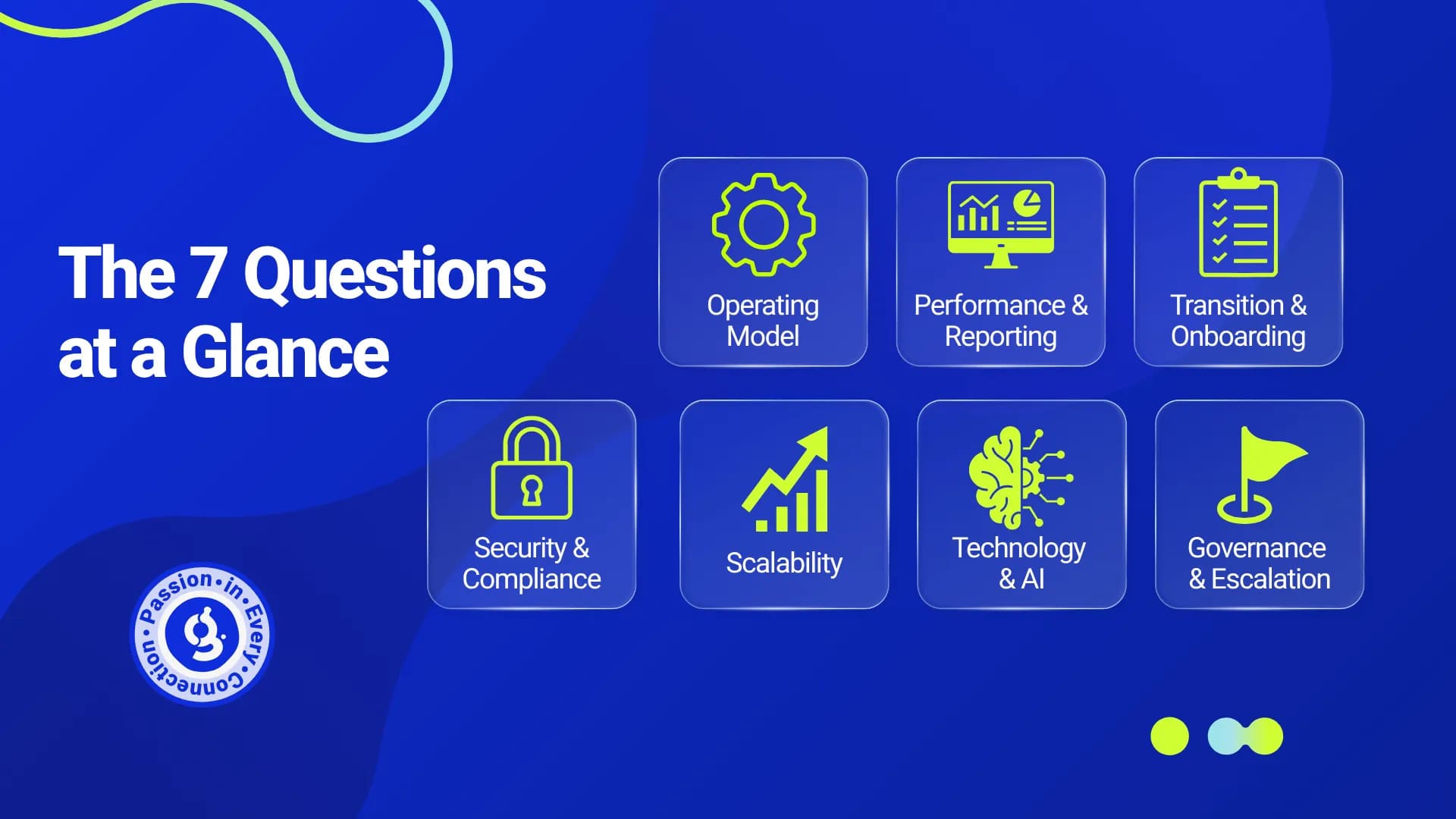
1. Which operating model best supports our goals?
Clarify whether an onshore, nearshore, offshore, or blended model best aligns with your hours of operation, language requirements, regulatory exposure, and budget. If you haven’t already narrowed this down, our Delivery Model Quiz on the Global Delivery Models page can help you clarify which model fits your business before you go further into vendor conversations. Once you know the model you need, ask how the provider tailors staffing, scheduling, and workflows to your SLAs and seasonality, and request examples of how they’ve shifted volumes, added sites, or rebalanced teams to protect continuity. Look for a clear explanation of delivery options, transparent staffing and training playbooks, and the ability to pilot a small scope before expanding.
2. How will performance and quality be measured and reported?
Ask for the exact KPIs proposed: average handle time, first-contact resolution, CSAT or NPS, QA scores, backlog, SLA adherence, and how targets are set, baselined, and forecast. Ask how quality is managed end-to-end: how calibration happens across teams, how agents are trained and certified, and how QA findings translate into coaching and content updates. Request real examples of dashboards and a description of the cadence for operational reviews, and confirm who owns variance analysis and what corrective actions kick in when metrics drift. Look for tiered scorecards, a closed-loop QA program with a defined error taxonomy, SLA governance tied to real incentives, and data definitions that align with how your own team reports results.
3. What does onboarding and transition look like?
Transitions are where many outsourcing programs stumble. Ask for a phased plan covering knowledge transfer, SOP creation, tool integration, parallel runs, and clear go-live criteria. Clarify roles, timelines, and acceptance checkpoints, and ask for a sample project plan with milestones and built-in risk mitigation. Look for a PMO-led implementation, real training assets, defined pilot criteria, and a hypercare period with closer monitoring and fast feedback loops right after go-live.
4. What security and compliance standards are in place?
Request documentation for certifications and controls relevant to your industry: SOC 2, ISO 27001, PCI DSS, or HIPAA where applicable, along with GDPR or CCPA readiness for data handling. Confirm how access management, device security, network segmentation, encryption, and secure remote work are handled in practice. Ask about third-party audits, incident response timelines, and breach communication protocols. Look for audited controls, documented access procedures, evidence of data-loss prevention in practice, and tabletop exercises that test incident readiness; verified security matters far more than verbal assurance.
5. How will the partner manage scalability during peak periods?
Seasonality, product launches, and unexpected spikes all require surge capacity. Ask about cross-training, bench capacity, flexible scheduling, and multi-site failover. Review historical examples of ramp plans, recruiting speed, training throughput, and time to proficiency, and confirm how forecasting aligns with your own demand signals. Look for documented surge playbooks, realistic capacity models, and evidence that the partner has hit aggressive ramp targets before without letting quality slip.
6. What technology and AI-assisted capabilities are included?
Clarify the technology stack: workforce management, quality management, knowledge bases, omnichannel routing, analytics, and AI-assisted capabilities such as agent assist and summarization. Ask about interoperability with your own systems, who owns the data, and how tool rollouts are managed. Look for vendor-agnostic integration experience, secure data handling, measurable results from AI-assisted pilots such as reduced handle time, and a roadmap where technology augments rather than replaces human judgment in complex interactions.
7. What does governance and escalation look like?
Ask for a governance structure spanning executive sponsorship, an operational steering committee, and regular business reviews. Clarify escalation tiers, response times, and who owns decisions when something goes wrong. Look for a clear RACI, a defined meeting cadence, documented decision rights, and a shared risk register with named owners and due dates. This is one of the clearest signals of whether a partner is built for disciplined, day-to-day execution.
Red flags to watch for
As you evaluate providers, pause when you encounter any of the following, and request evidence or renegotiate scope before moving forward:
- Vague answers with no supporting evidence: no sample reports, playbooks, or dashboards
- Promises about speed or savings with no transition plan or dependency mapping
- A thin security posture: outdated audits, unclear access controls, or weak remote-work practices
- One-size-fits-all staffing and training that ignores your brand and workflows
- Unclear governance: vague escalation tiers, unclear decision rights, or infrequent reviews
- No real approach to AI-assisted capabilities, or one that compromises data governance
- Inflexibility during surges, with no cross-training or bench capacity
- Resistance to pilots, defined success criteria, or SLAs tied to real incentives
Turn these questions into a repeatable process.
Asking the right questions once is a good start. Asking them consistently, across every vendor, is what actually protects your decision. Our Outsourcing Partner Evaluation Checklist turns these seven categories into a practical, evidence-based scorecard, complete with a pre-evaluation readiness checklist, a red-flags list, and a weighted decision framework you can use to compare finalists side by side. Use it alongside every discovery call, RFP response, and reference check to keep your evaluation structured and comparable from the first conversation through the final decision.
Closing thoughts
A good outsourcing partner won’t be intimidated by hard questions; they’ll welcome them, because they can back up their answers with evidence. Use these questions to move every conversation past the pitch and into the specifics: the metrics, the safeguards, the playbooks, and the people. The provider that can show you, not just tell you, is the one worth trusting with your operations.
Frequently asked questions
What questions should you ask before choosing an outsourcing partner?
Ask about their operating model and fit with your goals, how they measure and report performance and quality, what onboarding and transition looks like, their security and compliance posture, their ability to scale during peak periods, their technology and AI-assisted capabilities, and how governance and escalation work. These areas reveal far more than a general capabilities pitch.
What are the biggest red flags when evaluating an outsourcing partner?
Watch for vague answers without supporting evidence, promises of savings with no transition plan, thin security controls, one-size-fits-all staffing models, unclear governance or escalation paths, and resistance to piloting before a full commitment. Any of these should slow the conversation down, not speed it up.
How do you evaluate an outsourcing partner’s security and compliance practices?
Ask for documentation of relevant certifications such as SOC 2, ISO 27001, or HIPAA where applicable, along with details on access management, encryption, incident response timelines, and breach communication protocols. A credible partner can produce audited evidence, not just verbal assurance.
How do you know if an outsourcing partner can scale with your business?
Look for documented surge playbooks, cross-training and bench capacity, flexible scheduling, and multi-site failover options. Ask for real examples of past ramp-ups, recruiting speed, training throughput, and how quickly new hires reached full proficiency without quality slipping.
How do you evaluate an outsourcing partner’s experience and track record?
Ask for case studies relevant to your industry, access to the team leads who would actually run your account, and evidence of subject-matter expertise specific to your vertical. Generic references or thin domain knowledge can signal that the partner hasn’t done this kind of work before.