


AI is reshaping how contact centers onboard, coach, and support frontline teams. When implemented well, it elevates accuracy, resolution quality, and speed. When mishandled, it adds friction, increases cognitive load, and creates extra steps.
Whether you call it an artificial intelligence call center, an AI-based call center, or simply AI for call centers, the mission is the same: empower people with smart tools and wise guardrails.
This is your playbook for training contact center agents to use AI call center technology with clarity and confidence — covering how AI changes training, practical frameworks to ramp agents quickly, and the operational practices that sustain performance at scale.
Why AI Changes Contact Center Training
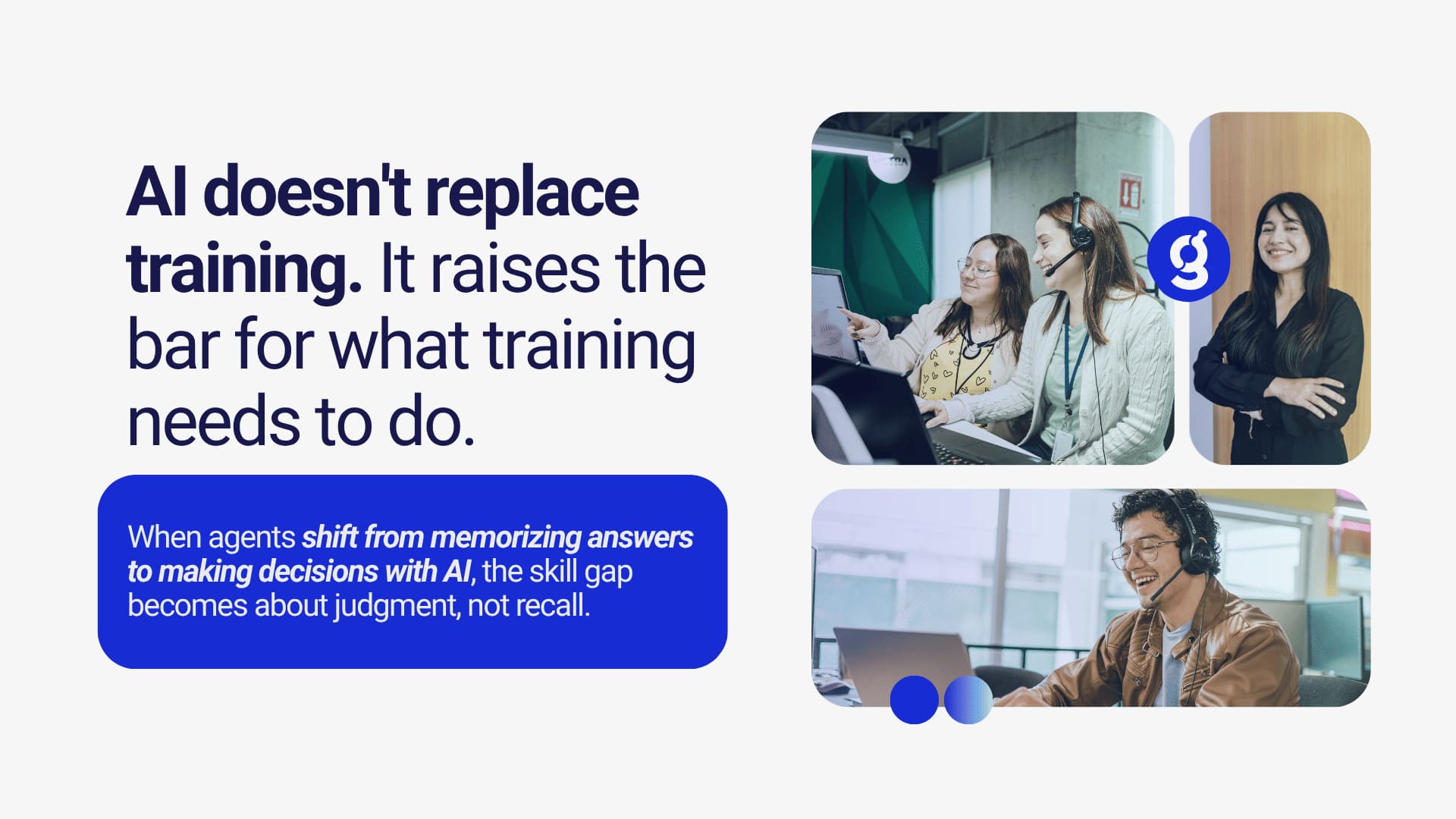
Traditional training prepared agents for fixed scripts, predictable workflows, and static knowledge bases. That model breaks down as AI introduces dynamic prompts, real-time guidance, retrieval-augmented knowledge, and automated summarization. The core competency shifts from memorizing answers to making sound decisions with machine assistance, exactly what strong teams need in an AI contact center.
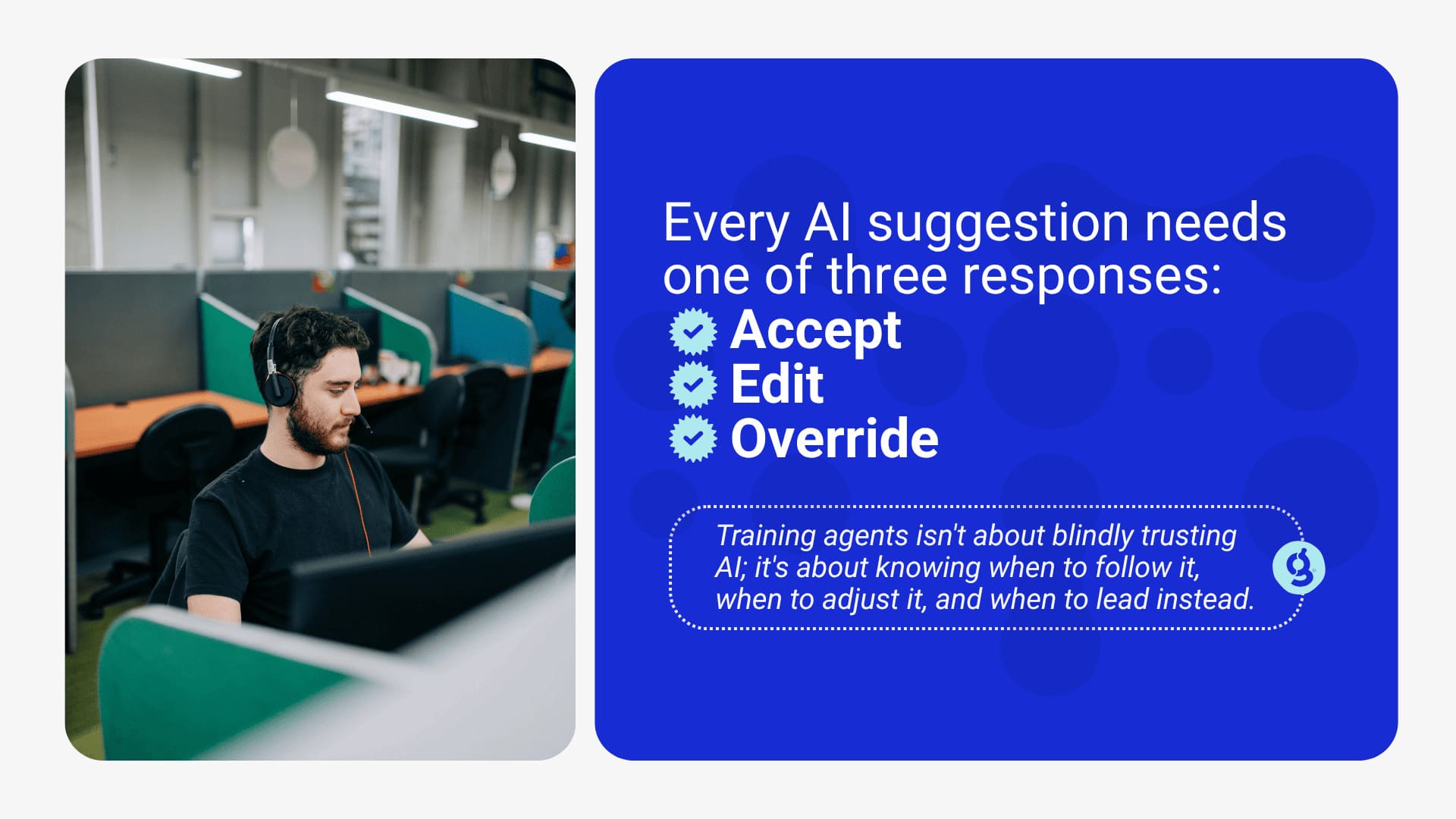
AI moves work from task execution to decision augmentation. Instead of following a linear script, agents evaluate AI suggestions, verify facts, and apply judgment based on context and risk. They must know when to accept recommendations, when to edit or tailor them, and when to override them entirely. The skill gap becomes less about recall and more about managing AI inputs, resolving ambiguity, and maintaining compliance in real time.
This shift can create a productivity paradox. AI promises faster outcomes, yet poorly designed tools can slow agents with extra clicks, toggles, and outputs that require heavy editing. Training must emphasize lightweight workflows and empower agents to make confident decisions. Position AI as a co-pilot: trust but verify, choose the quickest acceptable path to resolution, and escalate depth only when risk or complexity warrants it.
Performance metrics must evolve to reflect AI-augmented outcomes. Look beyond average handle time to how effectively AI is used. Useful indicators include:
- Time to useful suggestion: How quickly the system surfaces relevant guidance during an interaction
- Acceptance and edit rates: How often agents adopt AI recommendations, and the quality impact of edits
- First contact resolution and verified quality: Resolution accuracy validated against policies and knowledge
- After-contact work reduction: Time saved through AI-generated summaries and dispositions
- Compliance accuracy: Proper use of required disclosures and adherence to regulated steps
- Customer sentiment and effort: Experience indicators tied to AI-assisted interactions
Pair these with foundational KPIs like AHT, service level, and schedule adherence. Together, they provide a full picture of speed, quality, and responsible AI adoption. In short, AI changes what agents do, how they decide, and how performance is measured. Training must build confidence in AI, prioritize decision quality, and eliminate workflow friction in any AI-based call center environment.
Practical Training Frameworks to Onboard Agents Quickly
A staged approach helps agents build competence without being overwhelmed. Start with fundamentals, progress to supervised practice with AI tools, and transition to live coaching loops with fast feedback.
Stage 1: Fundamentals
Begin with the “why” and “how” of AI in your operation. Cover what AI does well, such as summarization, pattern matching, retrieval, and structure, and where it struggles, such as edge cases or stale information if not connected to live sources. Explain how AI fits into your workflows and what guardrails protect customers and the business. Teach a simple decision framework for when to trust, edit, or ignore AI suggestions. Introduce the agent interface so users know where to see prompts, confidence indicators, or citations, and controls. Ground the fundamentals in your AI call center technology so the learning transfers directly to the agent’s desktop.
Stage 2: Supervised Practice with AI
Run guided exercises that mirror real scenarios. Agents should practice:
- Writing clear prompts or selecting the right prompt templates
- Choosing the best AI suggestion among options
- Validating outputs against policies and trusted knowledge sources
- Scanning citations and checking customer identifiers
- Logging exceptions and flagging ambiguous cases
Trainer-led debriefs reinforce good habits, highlight common pitfalls, and calibrate expectations around speed versus diligence. This is the hands-on discipline at the core of training agents for AI-powered contact centers (without slowing them down): practice with purpose and feedback that sharpens judgment.
Stage 3: Live Coaching Loops
Move to production with safety nets. Whisper coaching, real-time QA prompts, and targeted post-interaction reviews quickly close skill gaps. Tight feedback cycles prevent overreliance on AI and reduce slowdowns from second-guessing. In an AI contact center, these loops boost confidence and protect quality.
Hands-On Simulation
Simulation accelerates skill acquisition without touching live customers. Build a scenario library that reflects real AI-assisted interactions, including:
- Multi-product troubleshooting
- High-emotion conversations
- Compliance-sensitive cases requiring disclosures or authentication
Include both strong and flawed AI outputs so agents learn to spot gaps. Pair simulation with shadowing sessions where new agents watch experienced peers use AI in the wild, paying attention to how they verify facts, adjust tone, and keep the conversation moving. This is practical wisdom for training contact center agents to effectively command AI in call centers.
Microlearning in the Flow of Work
Prevent cognitive overload with short, focused lessons on single skills such as prompting techniques, summarization checks, knowledge retrieval, sentiment coaching, and disposition accuracy. Offer just-in-time support inside the agent desktop with tooltips, inline guides, and reference cards that appear based on interaction type. Reveal advanced features only after agents demonstrate proficiency in the basics, keeping handle times stable during ramp. This approach pays dividends for any AI deployment in a call center.
Clear Graduation Path
Define thresholds for progression from simulation to supervised live work, and from supervision to full autonomy. Typical criteria include:
- Minimum accuracy on knowledge checks and policy questions
- Consistent adherence to compliance prompts
- Stable first contact resolution on a defined case mix
Set the bar clearly and celebrate each step forward. Confidence grows when expectations are explicit, and progress is visible.
Operational Best Practices and Change Management
To operationalize AI training, treat curricula and workflows as living products. Measure, iterate, and communicate changes clearly to sustain performance gains over time. This is where strategy meets action in an AI-based call center.
Measure What Matters
Use A/B tests to refine training elements such as the module sequence, simulation depth, and the presence or placement of inline prompts. Track the impact on handle time, acceptance, and edit rates for AI suggestions, QA scores, and post-interaction work. Integrate training completion data with operational dashboards to spot patterns. If a new feature rollout correlates with slower handle times or quality dips, trigger targeted refreshers instead of broad retraining. This disciplined measurement is essential for any artificial intelligence call center operating at scale.
Build Frontline Feedback Loops
Encourage agents to flag unclear AI outputs, missing knowledge articles, and confusing prompts. Establish a rapid response routine:
- Daily triage of reported issues
- Weekly updates to prompts, knowledge, and guidance language
- On-demand microlearning pushes for high-impact changes
Recognize agents who model effective AI use and invite them to mentor peers or contribute to scenario libraries. In an AI for call centers setting, these loops transform frontline insight into better prompts and faster resolutions.
Prioritize Trust and Transparency
Adoption hinges on clarity. Explain in plain language how the AI works, what data it uses, and what is recorded. Where feasible, show the rationale or citations behind recommendations and make it easy to report inaccuracies. Share guardrails such as privacy protections, redaction rules, and compliance checks. Reinforce that agents make the final call and that the system is an assistant, not a supervisor. Trust is the foundation for strong performance in any AI in a call center deployment.
Provide Continuous Support
Offer office hours with enablement teams, a searchable knowledge base for AI features, and fast support channels during shifts. Align incentives and QA scorecards with decision quality and customer outcomes, not just speed. Credit agents for validating facts, catching AI misses, and maintaining a human connection while using automated assistance. This is training contact center agents to be both fast and thoughtful.
Communicate Changes Clearly
Share updates succinctly: what changed, why it changed, and how it helps agents and customers. Keep release notes short and link to microlearning for deeper dives. Clarity reduces confusion, speeds adoption, and keeps teams aligned. Precise communication is a force multiplier for AI call center technology.
The Impact of AI in Agent Training
With the right training design, AI accelerates skill acquisition, improves consistency, and reduces after-contact work. Teams shorten ramp time as simulations and real-time guidance reduce the need for memorization. Quality improves as AI standardizes responses and surfaces policy checks at the moment of need. Agents can take on a broader case mix earlier in tenure, supported by retrieval-augmented knowledge and next-best-action prompts in an AI contact center.
Performance gains appear across multiple dimensions:
- Handle time stabilizes or decreases as agents use AI-generated summaries, checklists, and disposition suggestions
- First contact resolution increases with better troubleshooting guides and contextual knowledge surfacing
- Customer sentiment improves as AI provides tone and empathy cues while agents focus on listening and solving
- Compliance errors drop when required disclosures and risk signals are highlighted proactively
- Supervisor effectiveness rises as automated QA sampling and interaction summaries direct coaching to the moments that matter
The result is faster, more reliable outcomes. Training that teaches agents when to lean on AI and when to lead ensures speed never comes at the expense of accuracy or trust. That is the promise of AI for call centers when paired with disciplined enablement and strong leadership.
Quick Reference: Training Focus Areas
| Focus Area | What to Teach | How to Measure |
| Decision Framework | When to accept, edit, or override AI recommendations | Acceptance/edit rates, QA scores, error rates |
| Prompting & Retrieval | Clear prompts, use of templates, and verifying citations | Time to useful suggestion, re-prompt frequency |
| Compliance Discipline | Required disclosures, authentication, redaction | Compliance adherence, audit findings |
| Summarization & Disposition | Editing summaries, accurate tagging, and ACW reduction | After-contact work time, summary accuracy |
| Customer Experience | Tone coaching, empathy cues, and clear communication | CSAT/NPS, sentiment, effort scores |
| Continuous Improvement | Flagging gaps, contributing feedback, and peer mentoring | Issue resolution time, training update cadence |
Use this table as a checklist when training contact center agents in any AI call center technology environment. It keeps teams focused on the skills that move the needle.
Frequently Asked Questions
How long should AI-focused onboarding take?
Many teams target two to four weeks from hire to independent handling of core interaction types. Emphasize simulations in week one, supervised live work in week two, and progressive autonomy in weeks three and four. More complex lines of business may need longer, but microlearning and real-time guidance help maintain productivity during the ramp in an AI-based call center.
What skills matter most for agents in AI-enabled environments?
Decision-making, verification discipline, and communication. Agents should quickly evaluate suggestions, verify sources, and clearly explain solutions. Basics in prompting, comfort with dashboards, and attention to compliance cues are also critical when training contact center agents.
Which KPIs demonstrate that the training is working?
Track first contact resolution, verified quality scores, acceptance/edit rates of AI suggestions, after-contact work time, and customer sentiment. Monitor handle time alongside these quality metrics to ensure speed improves without sacrificing accuracy in your artificial intelligence call center.
How do we handle compliance and data privacy in training?
Use synthetic or redacted data in simulations. Teach what data AI can access, how it is stored, and how redaction works. Bake required disclosures and consent steps into training scenarios and the prompts used in production. Transparency builds trust in any AI in a call center deployment.
Key Takeaways
- Shift training from memorization to decision-making with AI as a co-pilot across any AI contact center
- Use staged onboarding with simulations, supervised practice, and live coaching loops to keep momentum high
- Measure AI effectiveness with metrics that complement traditional KPIs for AI in call centers
- Build trust through transparency, clear guardrails, and agent accountability in your artificial intelligence call center
- Maintain momentum with continuous support, rapid feedback loops, and concise change communication when training contact center agents
When AI training emphasizes decision quality, light-touch workflows, and continuous improvement, agents get faster without getting sloppy. That is how to train agents for AI-powered contact centers (without slowing them down). Lead with courage, teach with wisdom, and your AI call center technology will amplify every person on your team.
Ready to build a training strategy that works with AI, not against it? The Office Gurus helps leaders design smarter onboarding frameworks that reduce ramp time and drive measurable performance gains. Let’s talk about what that looks like for your operation. Schedule a conversation with a Guru here.