

Deciding between Business Process Outsourcing (BPO) and building an in-house operation directly affects cost, performance, and resilience. This cost breakdown BPO vs. in-house services analysis explains how each model impacts budgets, where cost savings and hidden expenses arise, and how to align operations with growth objectives.
Use this cost breakdown BPO vs. in-house services overview to compare direct and indirect call center costs, understand trade-offs, and select the approach that best supports customer service, back-office functions, or sales operations.
The Office Gurus, a trusted provider of outsourced customer experience and back-office solutions, brings proven cost reduction strategies to help you achieve predictable outcomes with lower risk.
What BPO and In-House Services Entail
BPO engages a third-party provider to run defined processes such as customer service, technical support, sales, collections, finance and accounting, HR administration, and data entry. Providers operate at scale with trained talent, mature workflows, and technology stacks optimized for high volumes and consistent outcomes. Engagements span full process ownership to co-sourced models where responsibilities are shared with your internal team. The Office Gurus delivers BPO cost transparency with rate structures and governance that simplify budgeting and accelerate value.
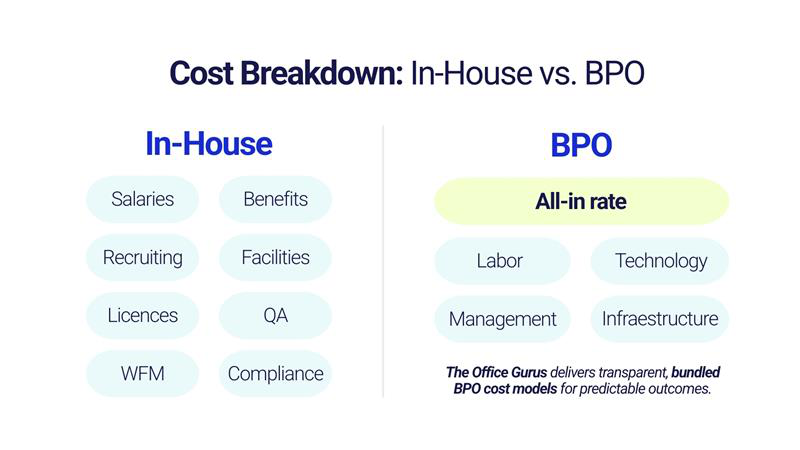
In-house models keep work within your organization, leveraging direct employees, owned infrastructure, and proprietary systems. Your leadership manages hiring, training, quality, compliance, and the entire technology stack. This model suits organizations that require strict control over brand-sensitive interactions, niche processes, or heavily regulated workflows. However, call center costs accumulate quickly with recruiting, facilities, licenses, and ongoing training, making cost saving strategies essential for sustainability.
BPO is widespread in telecommunications, e-commerce, banking and financial services, healthcare, travel, utilities, and software/SaaS. In-house operations are common where data governance is stringent or domain expertise is unique, including defense, life sciences, and certain enterprise software functions. Many companies adopt a hybrid strategy, which consists in retaining critical tasks internally while outsourcing high-volume or scalable processes to capture cost savings, reduce risk, and improve speed to scale.
Cost Structure of In-House Services
In-house operations blend fixed and variable call center costs. Fixed costs cover facilities, furniture, IT hardware, networking, contact center platforms, security tools, and management overhead. Variable costs scale with headcount and volume, including salaries, benefits, training, overtime, consumables, and software seat licenses. As you expand, both cost types increase and create a higher baseline, demanding disciplined cost reduction strategies to preserve margins.
Employee compensation is typically the largest expense. Beyond base pay, budget for payroll taxes, health insurance, retirement plans, paid time off, and shift differentials. Training includes onboarding, ongoing upskilling, quality assurance coaching, and leadership development. Expect productivity dips in the first 60–90 days and factor in attrition costs tied to recruiting, background checks, and ramp time. Effective cost saving strategies such as optimizing workforce management, improving knowledge bases, and refining coaching can trim the call center costs curve.
Overhead includes rent, utilities, security, insurance, HR administration, IT support, and compliance management. Technology costs span contact center platforms, CRM, workforce management (WFM), QA tools, knowledge bases, analytics, call recording, and speech or chat AI. Operating in multiple geographies adds local compliance, data privacy controls, and regional management costs. Business cost reduction strategies often target consolidating platforms, renegotiating licenses, and automating repetitive tasks to lower total ownership costs.
Long-term implications involve capital expenditures for expansions, multi-year software contracts, higher fixed overhead during demand troughs, and ongoing investment in technology upgrades. While full control can strengthen brand consistency and data governance, you absorb hiring cycles, seasonal scaling pressures, and resilience planning for disruptions. Balancing these realities against call center outsourcing cost benchmarks helps determine if and when outsourcing can deliver material cost savings.
Cost Structure of BPO Services
BPO providers tailor pricing to workload and outcomes. Common structures include per full-time equivalent (FTE) rates, per transaction or per interaction fees, hourly time-and-materials, and fixed monthly retainers with defined service levels. Many providers bundle technology, management, QA, reporting, and facilities into their rates, reducing the need for separate licenses and internal headcount. The Office Gurus emphasizes BPO cost clarity, offering rate cards that include robust management layers, QA, WFM, and analytics to streamline budgeting.
Economies of scale drive cost savings through centralized recruiting, training, and shared infrastructure. Providers distribute technology investments across multiple clients, lowering unit costs for platforms, telephony, and security. Standardized playbooks and continuous improvement programs improve efficiency, often decreasing handle time and error rates compared with newly formed internal teams. These cost reduction strategies deliver sustained business efforts without compromising customer experience.
Hidden or overlooked costs may include transition and knowledge transfer, process documentation, integration effort, vendor onboarding, and change management. Additional fees can arise for after-hours coverage, language premiums, peak season surge support, custom reporting, specialized compliance, or dedicated IT builds. Clarify what the BPO cost rate includes, what triggers overages, and how pricing adjusts with volume and SLA changes to ensure the call center outsourcing cost aligns with your forecast.
When reviewing proposals, request transparent breakdowns: labor by role and seniority, management layers, QA and WFM coverage, technology inclusions, training, and contingency buffers. Ensure rate cards align with demand patterns and incorporate risk-sharing incentives for performance improvements or cost reductions. Trustable partners, like The Office Gurus, collaborate on cost saving strategies that tie incentives to SLA attainment, CSAT, and efficiency metrics.
Direct Cost Comparison: BPO vs. In-House
To bring this cost comparison to life, check out the following video with key industry data to break down real-world financial impacts of in-house operations versus outsourcing:
This visual walkthrough illustrates how BPO models shift budget pressures away from fixed in-house overhead into scalable, predictable cost units, resulting in a reinforcement of key concepts like time-to-value, variable versus fixed cost structures, and indirect drivers that affect total cost of ownership.
Standardize assumptions before comparing: workload volume, hours of operation, required languages, service level targets, technology stack, and attrition rates. The following outlines are typical cost drivers and differences for an in-depth and thorough cost breakdown BPO vs. in-house services review.
- In-House Costs: salaries and benefits, recruiting and background checks, onboarding and training, facilities and utilities; IT hardware and licenses, management and HR, QA and WFM, insurance and compliance; overtime and surge staffing, depreciation on capital assets. These call center costs require consistent business cost reduction strategies to avoid margin erosion.
- BPO Costs: per-FTE or per-transaction rate covering labor, supervision, facilities, telephony, security, and standard technology; implementation and transition fees, optional language or premium skill add-ons, surge and after-hours premiums, custom reporting or integration work. This BPO cost structure consolidates spend into predictable units, supporting cost savings when volumes fluctuate.
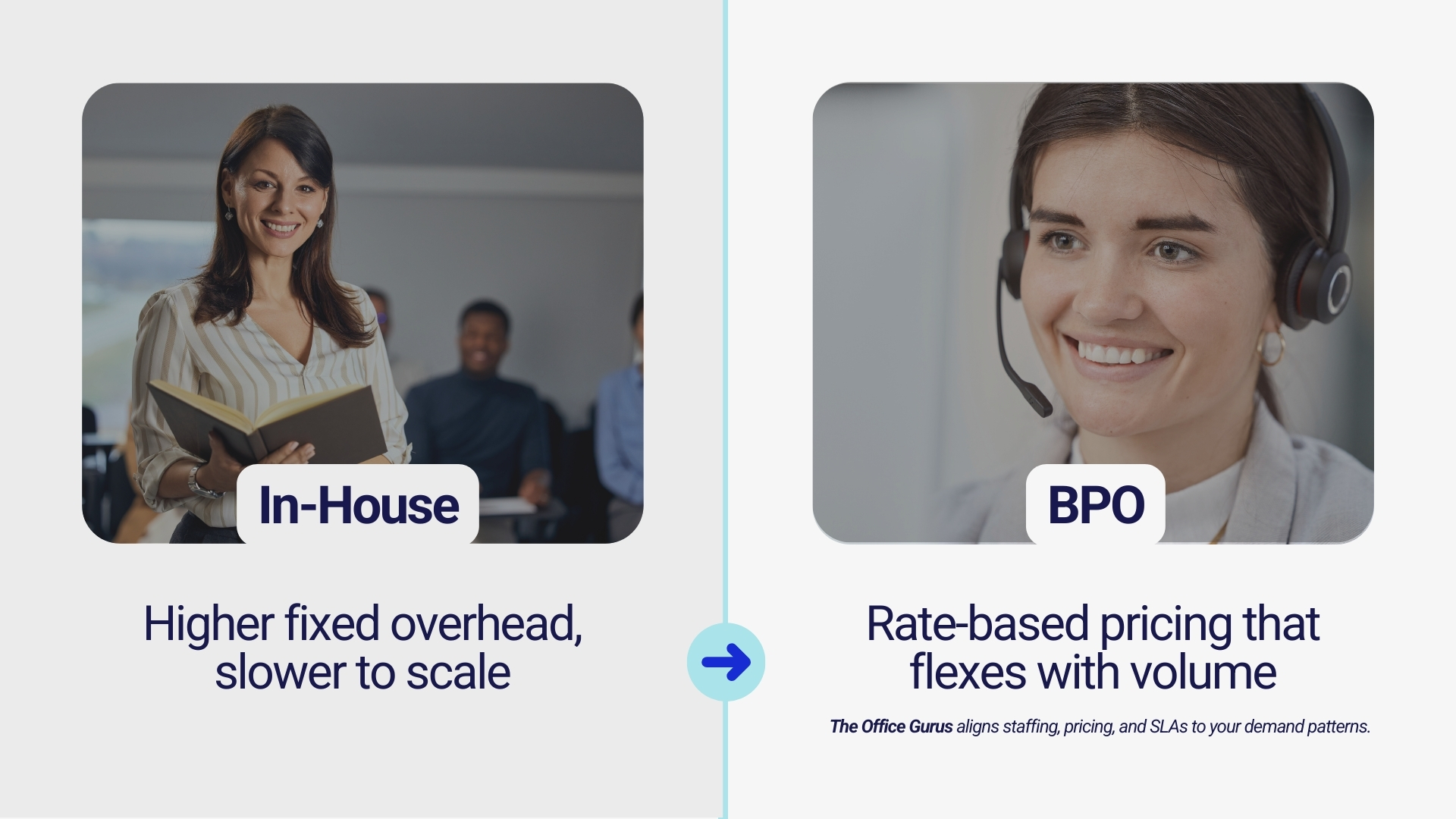
These costs can also be compared and contrasted under the following criteria:
Initial Setup vs. Ongoing Costs: In-house setup costs are front-loaded: hiring, equipment, workspace, and software procurement. Ongoing call center costs include salaries, maintenance, renewals, and continuous training. BPO setup typically includes discovery, process mapping, knowledge transfer, and integrations. Ongoing BPO cost is predictable via rate cards and volume tiers. Over a multi-year horizon, BPO models can compress unit costs as productivity improves and technology is shared across clients.
Factors Influencing Overall Costs: volume volatility, time-to-hire, attrition, skill complexity, required certifications, compliance, multilingual support, and automation opportunities. Where demand is seasonal or volatile, BPOs often deliver lower call center outsourcing costs per unit by flexing staffing faster and limiting fixed overhead exposure.
Take a look at this illustrative comparison:
For a 50-seat customer support operation, in-house monthly costs would include salaries and benefits, facilities, licenses, and management overhead. A BPO might quote an all-in per-FTE rate bundling many of these line items, with separate fees for surge coverage or specialty language support. The BPO scenario typically reduces capital outlay and improves cost predictability, while the in-house model offers full control with higher fixed costs and slower scale-up. The Office Gurus demonstrates cost saving strategies through optimized staffing models and AI-enabled knowledge tools that shorten handle times.
Indirect Costs and Hidden Budget Drivers
Direct costs tell only part of the story. Indirect and opportunity costs significantly influence total cost of ownership and ROI. Accounting for these factors is central to any cost breakdown BPO vs. in-house services model.
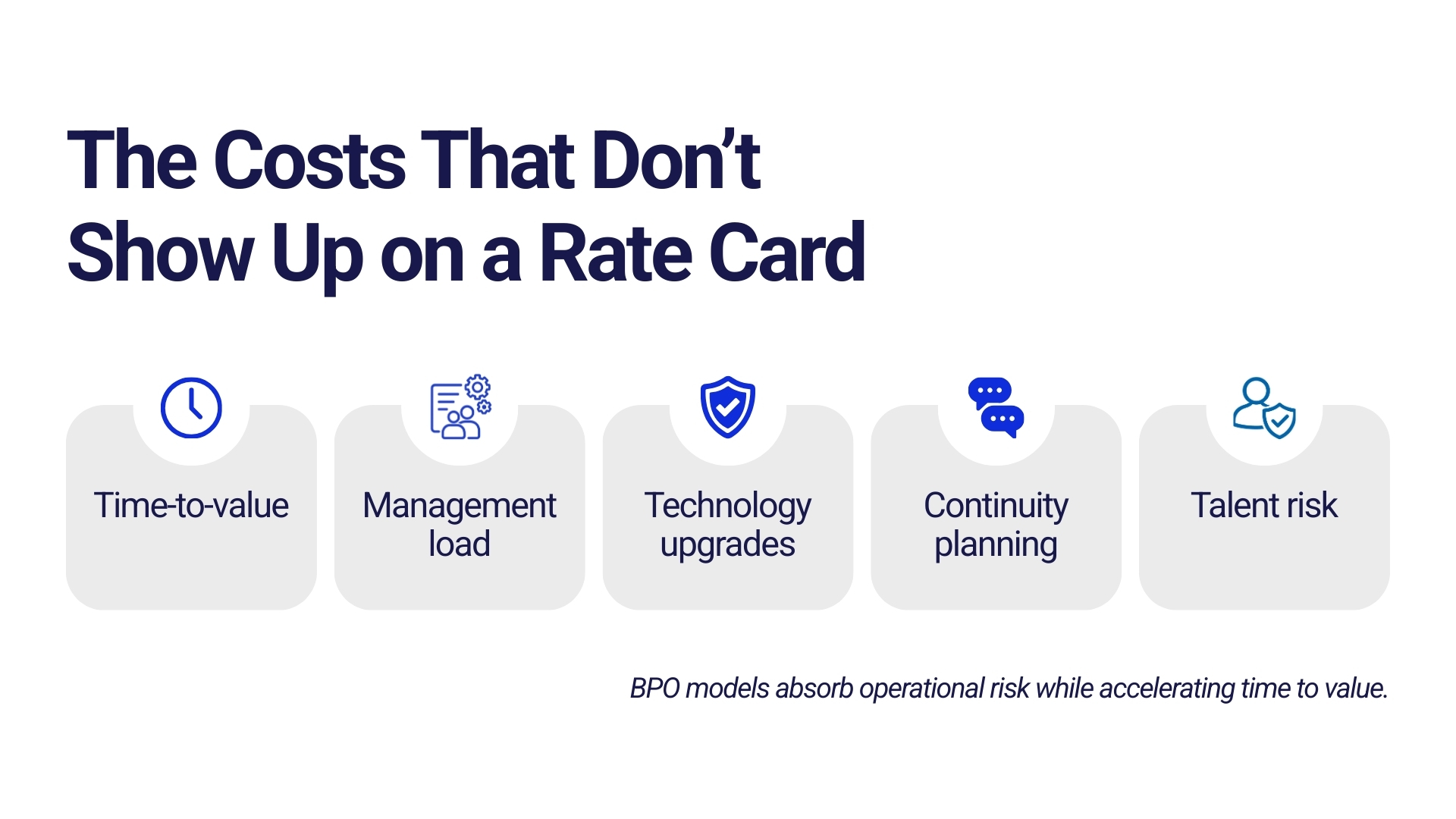
- Time-to-Value: In-house teams require hiring cycles, training programs, and system provisioning. BPOs can ramp faster with established recruiting pipelines and ready infrastructure, reducing the window to stable performance and lowering call center outsourcing cost during launch.
- Management Bandwidth: In-house operations demand ongoing attention to scheduling, QA, coaching, and compliance. Outsourcing shifts these responsibilities to specialists, freeing leaders to focus on growth initiatives and customer experience strategy. This shift frequently yields business cost reductions strategies through reallocation of management resources.
- Technology Upkeep: Internal teams bear upgrade planning, license negotiations, and integration maintenance. BPOs often include platform investments within their pricing and spread costs across clients, creating structural cost savings over time.
- Resilience and Continuity: Building redundancy across sites, shifts, and tools is expensive internally. BPOs typically offer multi-site coverage and disaster recovery capabilities as part of their operating model, stabilizing service and reducing unexpected call center costs.
- Talent Risk: Tight labor markets drive wage pressure and attrition. Providers mitigate talent risk through diversified locations, multilingual pools, and established training curricula, which helps contain bpo cost variability and supports cost reduction strategies.
Beyond Costs: Benefits That Influence Value
While cost is critical, performance, agility, and customer outcomes ultimately determine the value of each approach. The Office Gurus blends operational maturity with innovative technology to deliver measurable cost savings and quality improvements.
- Scalability: BPOs ramp up quickly for product launches, marketing campaigns, or seasonal peaks, then flex down without unused space or stranded licenses. Elasticity reduces service disruptions when demand fluctuates and improves call center outsourcing cost efficiency.
- Specialized Expertise: Providers maintain industry playbooks, invest in best-in-class platforms, and deploy analytics, AI, and automation to cut handling time and boost customer satisfaction. These capabilities underpin cost saving strategies that compound over time.
- Operational Maturity: Established QA frameworks, calibrated scoring, workforce management discipline, and continuous improvement programs stabilize outcomes and drive sustained efficiency gains. The Office Gurus applies business cost reductions strategies without sacrificing first contact resolution or CSAT.
- Focus on Core: Outsourcing routine, volume-driven tasks allows internal teams to concentrate on product innovation, market expansion, and high-touch customer journeys, furthering overall cost reduction strategies and competitive differentiation.
Risk, Control, and Governance Considerations
Choosing the right model requires careful assessment of risks and controls. A robust governance framework ensures cost savings do not come at the expense of brand standards or compliance.
- Outsourcing Risks: Reduced direct control over interactions, potential brand tone misalignment, data security concerns, and vendor dependency. Mitigate these with detailed playbooks, joint governance, robust data controls, and clear SLAs and KPIs (e.g., first contact resolution, customer satisfaction, quality scores, compliance). The Office Gurus includes governance checkpoints within our BPO cost proposals to protect outcomes and budgets. Learn more about what differentiates us as a partner.
- In-House Risks: Higher fixed costs, slower scaling, and exposure to talent shortages. Reduce risk by cross-training, automating repetitive tasks, and investing in WFM and QA to stabilize performance during peaks, which are core elements of effective cost reduction strategies.
- Compliance and Privacy: Ensure providers hold relevant certifications and align with your data handling policies, encryption standards, access controls, and audit practices. Internal teams must budget for the same controls and ongoing compliance oversight. Compliance-readiness affects call center costs and should be factored into the cost breakdown BPO vs. in-house services decision.
- Hybrid Strategies: Combine models to balance control and elasticity. Keep brand-critical or complex tasks in-house, and outsource volume-driven or routine interactions to a BPO under shared KPIs and governance. This approach enables targeted cost saving strategies while retaining oversight of sensitive journeys.
Cost Breakdown Table: Key Line Items
| Cost Category | In-House | BPO |
| Labor | Base pay, benefits, payroll taxes, overtime, shift differentials | Included in per-FTE/interaction rate; premiums for languages or specialized skills |
| Recruiting & Onboarding | Job ads, sourcing, background checks, onboarding programs | Typically included; implementation and transition fees may apply |
| Facilities & Utilities | Rent, furniture, security, utilities | Bundled within provider’s rate |
| Technology | Contact center platform, CRM, WFM, QA tools, analytics, call recording, AI | Often bundled; custom integrations may be scoped and priced |
| Management & Support | Supervisors, team leads, HR, IT support, compliance | Included in rate with defined management ratios |
| Quality & WFM | QA analysts, WFM planners, calibration sessions | Included; shared frameworks and reporting |
| Compliance & Security | Policies, audits, certifications, insurance | Provider certifications and controls included; audit support available |
| Surge & After-Hours | Overtime, temporary staff, scheduling complexity | Premiums for surge or off-hours; faster flexing capacity |
| Capital Expenditure | Hardware, buildouts, expansions | Minimal; provider invests and amortizes across clients |
| Ongoing Upgrades | License renewals, upgrades, maintenance | Shared upgrade roadmap included in rates |
Use this table as a baseline for comparing internal call center costs and BPO cost structures. When combined with business cost reductions strategies, such as channel deflection, self-service, and knowledge management, both models can improve unit economics, though outsourcing typically reduces call center outsourcing cost variability.
How to Model Total Cost of Ownership
To make a sound decision, build a multi-year view of cost and performance. Start with a baseline forecast and incorporate realistic operational assumptions for an apples-to-apples cost breakdown BPO vs. in-house services comparison.
- Volume and Complexity: Forecast interactions or transactions, average handle time, channels, and languages. Note certification and compliance requirements.
- Operating Hours: Define hours of operation, coverage windows, and after-hours needs.
- Staffing Dynamics: Include time-to-hire, ramp periods, attrition, coaching cadence, and productivity curves.
- Technology: Account for platforms, integrations, licenses, and upgrade cycles.
- Risk and Resilience: Add buffers for surge capacity, business continuity, site redundancy, and security investments.
Compare three-year totals across both models, reflecting setup, steady-state operations, and expected improvements from process optimization and automation. For outsourcing, examine bpo cost rate cards, implementation fees, and surge pricing. For in-house, detailed salaries, benefits, facilities, licenses, recruiting, training, QA, WFM, and management. Evaluate not only call center costs but also time-to-value and operational risk. The Office Gurus provides TCO modeling support and cost saving strategies that quantify ROI and highlight cost reduction opportunities across channels.
Decision Framework: Matching Model to Business Goals
Select the model that best supports your priorities and constraints. Consider the following alignment criteria to maximize cost savings without compromising service quality.
- Brand Control: If interaction tone and specialized knowledge are mission-critical, in-house control may be preferable.
- Speed and Flexibility: If you need rapid scaling and predictable unit costs, BPO often fits better. The Office Gurus scales globally and locally, reducing call center outsourcing cost during peaks.
- Compliance: Highly regulated use cases can succeed in either model with proper governance; ensure certification coverage and audit readiness.
- Technology Strategy: If internal platforms lag or are costly to upgrade, a provider’s shared technology can accelerate modernization and drive bpo cost efficiencies.
- Cost Predictability: Outsourcing offers rate-based predictability. In-house costs give control but carry higher fixed exposure.
- Hybrid Potential: Blend models to optimize for cost and quality, retain complex journeys and escalate paths internally; outsource routine volume to a scalable partner.
Frequently Asked Questions
What is typically included in a BPO rate? Most providers bundle labor, supervision, facilities, telephony, security, and standard platforms into the per-FTE or per-interaction rate. Training, QA, reporting, and WFM are often included but confirm line-by-line. Specialized skills, premium languages, after-hours coverage, or custom integrations may be priced separately. The Office Gurus documents inclusions clearly to avoid surprises and control BPO cost and call center outsourcing cost across phases.
How do I estimate the total cost of outsourcing versus in-house? Start with a volume forecast, average handle time, operating hours, required languages, and SLA targets. For in-house, model salaries, benefits, facilities, licenses, recruiting, training, QA, WFM, and management. For BPO, request detailed rate cards, implementation fees, and surge pricing. Compare three-year totals with ramp and attrition assumptions. Incorporate cost saving strategies such as self-service and automation to capture additional cost savings in both scenarios.
Can BPOs support compliance and data privacy requirements? Yes. Leading providers hold certifications such as SOC 2, ISO 27001, PCI DSS for payments, and HIPAA for healthcare. Align data handling policies, encryption standards, and access controls within contracts and conduct regular audits. This diligence reduces risk and prevents unexpected call center costs due to compliance gaps. Trustable partners as The Office Gurus are certified to ensure data compliance and security.
What is the best way to manage quality with a BPO? Establish a shared QA framework with calibrated scoring, coaching routines, and continuous improvement targets. Use joint dashboards tracking CSAT, NPS, QA scores, AHT, and compliance. Schedule weekly operations reviews and quarterly business reviews to align on trends and action plans. The Office Gurus embeds business cost reduction strategies into QA programs, targeting defects and rework that inflate bpo cost.
How quickly can a BPO ramp? Timelines depend on complexity and talent availability. Many providers can launch within 4–8 weeks for straightforward programs. Regulated or multilingual operations may require longer for knowledge transfer, certification, and integrations. Clear documentation accelerates setup and stabilizes early performance, supporting call center outsourcing cost control in the ramp period.
When does a hybrid model make sense? If you require tight control for specific journeys but need elasticity for seasonal spikes or off-hours, a hybrid strategy works well. Keep brand-critical or complex tasks in-house and outsource volume-driven or routine interactions to a BPO, aligning both under shared KPIs and governance. This approach blends cost reduction strategies with consistent quality.
Why The Office Gurus
The Office Gurus is a trusted leader in contact center outsourcing and back-office services. We partner with high-growth brands and enterprises to deliver scalable operations, predictable BPO cost structures, and measurable cost savings. Our global footprint, rigorous training, and data-driven management ensure high-quality outcomes across voice, chat, email, and back-office workflows.
- Transparent rate cards and governance that minimize call center outsourcing cost variability.
- Proven cost saving strategies: workforce optimization, AI-assisted knowledge search, intelligent routing, and automation.
- Operational maturity with QA, WFM, analytics, and continuous improvement aligned to your KPIs.
- Compliance-ready operations with certifications to back transparent and responsible expertise.
- Flexible engagement models, like dedicated teams, hybrid, or co-sourced, to fit your cost breakdown BPO vs. in-house services goals.
Our clients achieve business cost reductions strategies through streamlined processes, reduced handle time, and fewer escalations, lowering call center costs while improving customer satisfaction. If you are evaluating the call center outsourcing cost versus building internally, we will model both options and define a roadmap that balances cost reduction strategies with brand control. Contact our Gurus today and let’s start building a strategy together.
Key Takeaways
- In-house operations deliver control but carry higher fixed call center costs and slower scale; ensure you budget for recruiting, training, technology, and compliance, and apply business cost reductions strategies to maintain margins.
- BPO models provide predictable bpo cost, faster ramping, and shared technology benefits; clarify inclusions, premiums, and performance incentives to maximize cost savings.
- Indirect costs, such as management bandwidth, resilience, and time-to-value, often tip the balance toward outsourcing for volume-driven processes, lowering call center outsourcing cost and improving agility.
- Hybrid approaches frequently optimize cost, quality, and risk by assigning each process to the model best suited to its requirements, combining cost saving strategies with governance.
Ready to compare options? The Office Gurus will build a customized cost breakdown BPO vs. in-house services model, quantify costs, and design cost reduction strategies to meet your growth and customer experience objectives. Contact our Gurus today.