


Average Handle Time (AHT) and Customer Satisfaction (CSAT) still matter, but they no longer capture the full picture when human agents and AI work side by side. Modern contact centers need a broader lens, one that evaluates how well teams resolve intent, reduce customer effort, and deliver outcomes that hold up over time. This is especially true for outsourced and multi-client operations, where the same AI-assisted framework must hold up across different programs, client policies, and agent teams spread across sites and time zones. This guide builds on what AI-assisted agents actually look like in practice to offer a practical framework for measuring their performance beyond AHT and CSAT with clear definitions, example calculations, and steps you can implement quickly.
Redefining Success: Metrics That Fit AI-Assisted Work
AI can suggest next steps, draft responses, surface knowledge, and automate routine processes. Success, therefore, is less about speed alone and more about accuracy, durability, and customer effort. The metrics below form the foundation for measuring how well agents and AI actually work together, not just how fast they work. Together, they represent the customer outcomes metrics for AI-assisted agents that matter most in this new model.
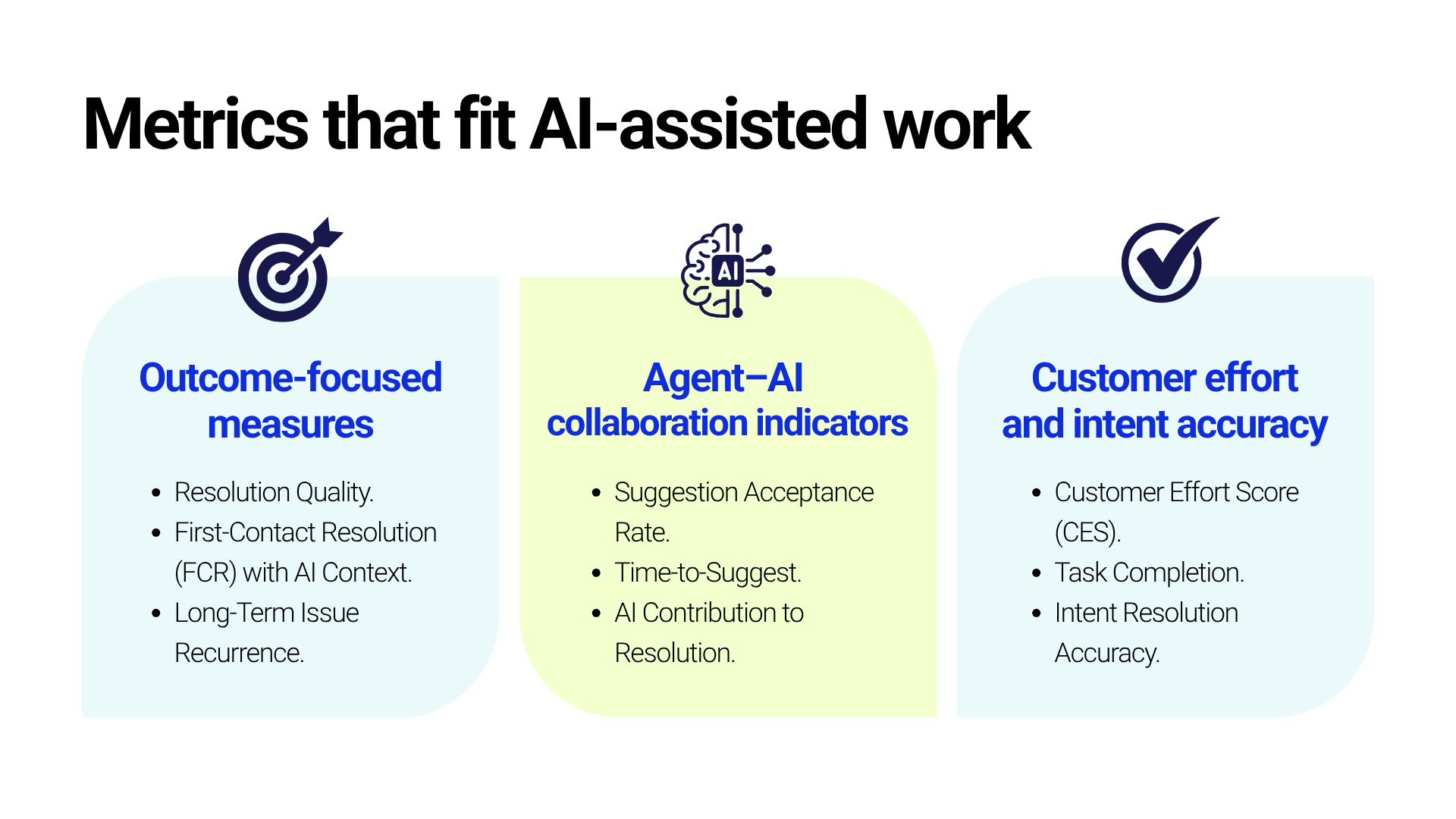
Outcome-focused measures
- Resolution Quality: A composite score that confirms the issue was fully resolved at the root cause, aligned with policy, and delivered through the correct steps. Build a calibrated QA rubric with weighted dimensions, including accuracy, completeness, tone, and policy adherence. The result is a resolution, not a quick fix that resurfaces as a repeat contact.
- First-Contact Resolution (FCR) with AI Context: Track FCR for interactions that used AI guidance. Compare against non-assisted baselines to quantify AI’s contribution. Segment by channel (voice, chat, email) and by intent to see where AI creates the most lift.
- Long-Term Issue Recurrence: Measure repeat contacts on the same intent at 7, 14, and 30 days. A falling recurrence rate indicates that AI-assisted resolutions are addressing root causes rather than creating temporary workarounds. It’s a check against declaring victory too early; a case can look resolved today and still come back next week.
Agent–AI collaboration indicators
- Suggestion Acceptance Rate: Accepted or partially adopted suggestions divided by the total number of suggestions shown (count partial adoption when key steps are used or when content is edited and sent). Low acceptance can signal poor relevance or timing. High acceptance paired with strong outcomes indicates effective guidance. Track it alongside outcome data; acceptance alone doesn’t tell you whether the guidance was actually good.
- Time-to-Suggest: The time from case open to the first meaningful AI suggestion. The goal is not the earliest possible suggestion but timely, context-rich support after intent verification and authentication.
- AI Contribution to Resolution: The share of steps influenced or executed by AI, such as suggested troubleshooting flows, auto-generated macros, or surfaced knowledge. Capture via event logs and tagged actions within the agent desktop. This step-level view credits AI for the specific work it did, not for the whole interaction.
Customer effort and intent accuracy
These are the AI customer service metrics that reveal whether AI assistance is actually making things easier for the customer, not just faster for the agent.
- Customer Effort Score (CES): Ask customers how easy it was to resolve their issue. When AI streamlines steps and reduces friction, CES should improve. Track CES by intent and by AI assist level to see exactly where AI is reducing or adding friction.
- Task Completion Across Journeys: Measure whether customers complete tasks (returns, cancellations, password resets) without having to repeat information or start over across channels. Attribute drop-offs and hand-offs to specific friction points so you know exactly where to intervene.
- Intent Resolution Accuracy: Interactions in which the predicted intent matches the final resolved intent, divided by the total number of interactions with a confirmed resolution. Use a mix of automated labeling and periodic human audits to validate accuracy; this catches drift before it shows up in customer complaints.
How AI Assistance Actually Moves These Numbers
None of the metrics above improve just because an AI tool exists in the tech stack. Understanding what AI actually changes in a contact center and what it doesn’t is what separates a dashboard full of numbers from a program you can actually manage.
- Real-time guidance during the interaction: surfacing the next best action, relevant policy, or a suggested response while the agent is still on the call or chat, not after, in a post-call summary, is what moves Suggestion Acceptance Rate and Time-to-Suggest.
- Faster knowledge retrieval: pulling the right article or policy from a fragmented knowledge base in seconds, rather than having agents search manually, drives down Complexity-Adjusted Handle Time without cutting corners on Resolution Quality.
- Consistency across agents and programs: AI-assisted guidance applies the same standard regardless of agent tenure, shift, or site, which is exactly what keeps Escalation Appropriateness and Compliance in AI-Assisted Replies stable across a distributed, multi-program workforce.
- Reduced after-call work: Auto-generated summaries and case notes free up the seconds and minutes that would otherwise be spent on documentation, allowing the next customer to show up directly in Time-to-Resolution for Escalations and Interruption/Hand-Off Quality.
This is the operating logic behind GuruAssist: it’s built around these specific mechanisms, not around automation for its own sake, because the metrics above are only meaningful if you can trace them back to something an agent actually did differently.
Operational and Quality Signals That Matter
Operational excellence in AI-assisted environments comes down to correctness, fit-for-purpose process efficiency, and the ability to route the right work to self-service versus assisted channels. Getting there also depends on a layer that rarely gets credit when AI improves a metric: workforce management is often the hidden lever behind profitable CX, determining whether the right agents are even available to act on what AI puts in front of them.
Quality of response
- Accuracy and Factual Consistency: validate that AI-assisted replies reflect current policy and knowledge. Combine automated checks (content versioning, policy links) with human sampling to catch hallucinations or outdated guidance. A single hallucinated policy detail can cost more than any efficiency gain gives back.
- Escalation Appropriateness: assess whether agents escalate at the right time and with the right level of detail. Expect fewer unnecessary escalations and faster, well-justified escalations when experts are required.
- Compliance in AI-Assisted Replies: scan for prohibited language, data exposure, and regulatory violations. Use a rules engine to flag risky phrases and ensure required disclosures are present. Together with Accuracy and Factual Consistency above, this is what assessing accuracy and compliance of AI suggestions looks like in practice, not a one-time audit, but a standing check.
Process and efficiency beyond AHT
AHT itself needs a new interpretation once AI enters the mix. Once AI resolves the simple, repetitive cases, the human agents left in the queue are, by definition, handling only the hardest ones, so a rising human AHT can actually be a sign that the operating model is working, not a red flag. The metrics below help you tell the difference.
- Complexity-Adjusted Handle Time: Sum of handle time divided by a complexity weight (define weights by intent tier, for example, Tier 1 = 1.0, Tier 2 = 1.5, Tier 3 = 2.0, and compare within tiers). Compare like-for-like cases (for example, billing adjustments versus password resets) to avoid penalizing teams that take on hard problems where AI is most helpful.
- Time-to-Resolution for Escalations: Measure the end-to-end resolution time for cases involving Tier 2 or back-office support. Expect reductions when AI improves case notes, summaries, and data readiness at hand-off.
- Interruption and Hand-Off Quality: Track transitions across self-service, AI chat, live agent, and back office, focusing on count and quality. Fewer, higher-quality hand-offs correlate with better experiences and lower rework.
Self-service lift versus assisted resolution
- Successful Deflection Rate: Count interactions completed in self-service that do not result in a later contact for the same issue. Attribute deflection to AI-guided flows, richer FAQs, or proactive notifications.
- False Deflection: Self-service sessions marked complete that lead to a support contact for the same intent within X days, divided by the total number of self-service completions. Monitor the time gap between “completion” and contact to isolate broken steps.
- Re-open Rate: Track the percentage of tickets re-opened after closure. Correlate re-opens with AI usage patterns to refine prompts, content, or workflows that produce quick but unstable fixes.
Measuring Business Impact and Driving Continuous Improvement
Executive stakeholders need a direct line between AI-assisted operations and business outcomes. Cost-to-serve, revenue lift, and retention are the metrics that determine whether AI investment expands or gets cut, so the framework has to connect cleanly to those metrics, not just to operational dashboards.
Tie performance to financial outcomes
- Cost-to-Serve per Resolved Issue: Agent labor + AI platform + QA + rework + overhead, divided by the number of resolved cases with verified closure. Segment by intent and AI-assist level; this is the breakdown executives will ask for first, so get the segmentation right from day one.
- Revenue and Retention Signals: For sales, expansion, or save-a-customer use cases, keep an eye on conversion and churn reduction tied to AI-assisted engagements. For a deeper breakdown of how to calculate the ROI of AI-assisted agents, separating productivity gains from deflection savings matters more than most teams assume.
Feedback loops and experimentation
Continuous improvement doesn’t happen by accident; it requires a deliberate testing discipline behind the scenes. This is worth asking about in a partner conversation or deliberately building if this stays in-house.
- A/B Testing of Prompts and Workflows: prompt variants, suggestion timing, and knowledge snippets should be tested against each other on an ongoing basis, with lifts measured in FCR, CES, and error rates, not just speed.
- Model Performance Monitoring: precision and recall for intent classification, suggestion relevance scores, and drift indicators need continuous tracking, with alerts when confidence falls below thresholds or content changes invalidate prompts.
- Automated Quality Sampling: risk or complexity should automatically pre-score interactions, routing a stratified sample to human QA enough to maintain broad coverage without overwhelming reviewers.
Governance, explainability, and risk readiness
If you’re evaluating an outsourced partner for this work, this is exactly where to press them: ask how they handle governance across multiple client programs. A single blanket policy or compliance standard applied the same way to every client is a red flag, since each client may have its own disclosure language, regulatory requirements, and risk tolerance. Governance metrics should be sliceable by client program, not just by site or team.
- Traceability of AI Suggestions: Log the models, prompts, and knowledge versions used. Store references to source documents so QA and auditors can verify the basis of replies, and retain these logs as your audit trail for internal risk teams and external regulators.
- Confidence Calibration: Display calibrated confidence scores and require human confirmation for low-confidence or high-risk scenarios. Track override rates and outcomes to tune thresholds.
- Policy Citation and Access Control: Require AI suggestions to cite the policy or knowledge sources they rely on, enforce minimum citation rules for regulated content, and ensure recommendations respect role-based permissions and data minimization.
- PII and Redaction Controls: Automatically redact sensitive data from training corpora and logs, and monitor for PII exposure in AI-assisted replies and escalations.
Quality Assurance and Coaching for Human–AI Teams
QA programs should evolve from evaluating agent behavior alone to assessing how effectively agents and AI work together. The emphasis shifts to judgment, oversight, and appropriate use of AI-generated guidance.
- Evaluate collaboration: Score how effectively agents leverage suggestions, correct AI errors, and use summaries to accelerate escalations without losing context.
- Coach with evidence: Provide side-by-side comparisons of accepted versus ignored suggestions, and link them to outcomes such as CES and reopen rates. Recognize smart overrides that prevented errors.
- Close the loop with content teams: When QA finds errors or friction, route actionable updates to prompts, knowledge articles, and workflows. Track adoption of fixes and their impact on metrics.
Turning This Framework Into a Routine
None of this works as a one-time audit. The sequence matters: establish your baseline before adding guardrails, add guardrails before you start experimenting, and don’t scale until acceptance, quality, and compliance are all holding steady. Teams that skip ahead usually end up scaling something that wasn’t ready. The Office Gurus’ AI-Assisted Agent Performance Workbook turns this into a repeatable operating rhythm, with ready-to-use templates for KPI planning, coaching sessions, dashboards, and monthly reviews.
At The Office Gurus, we help CX and operations leaders move beyond deploying AI to managing it by combining GuruAssist with experienced teams and operational discipline, so that every metric in this framework traces back to something an agent actually did differently.
If you’re ready to put this measurement framework to work, talk to a CX specialist and let’s build the AI-assisted performance program your teams need to scale with confidence.
Frequently Asked Questions
Here are the questions we hear most often from teams starting this journey.
What KPIs should be used to measure AI-assisted agent performance beyond AHT and CSAT?
Look beyond speed and satisfaction to outcome-based metrics (resolution quality, long-term issue recurrence), collaboration indicators (suggestion acceptance rate, AI contribution to resolution), and quality signals (accuracy, compliance, escalation appropriateness). Together, these paint a fuller picture of whether AI is actually helping agents resolve issues well, not just quickly.
Is AHT still a reliable metric for AI-assisted contact centers?
It’s still worth tracking, but the interpretation changes. Once AI absorbs the simplest, most repetitive contacts, the agents left to handle live interactions are working the harder cases by definition, so a rising human AHT can be a sign that the model is working as intended, not a sign of declining efficiency. Pair it with complexity-adjusted handle time to see the real picture.
How do we measure AI’s real contribution to agent performance, not just overall team performance?
Log which specific steps in an interaction were AI-influenced a suggestion accepted, a knowledge article surfaced, a summary auto-generated and compare like-for-like outcomes for AI-assisted versus non-assisted interactions handling the same intent. This step-level attribution is what separates “AI was present” from “AI actually helped.”
How can CX leaders prove AI assistance is improving agent performance, not just changing it?
Improvement, not just change, shows up in outcomes that hold over time: reduced recurrence of long-term issues, rising first-contact resolution specifically for AI-assisted interactions, and stable or improving customer effort scores. A metric that moves in the short term but doesn’t hold at 30 days is a signal AI changed the interaction without actually improving it.
What are early indicators that an AI-assisted program is ready to scale?
Watch for stable or improving customer effort scores, a falling recurrence rate, a compliance error rate trending toward zero, and a suggestion acceptance rate that has stabilized above your own baseline for your highest-volume intents. The key word is stabilized; a metric that’s still moving in either direction means the program needs more time before scaling.