


Shifting from an internal support team to an outsourced partner is a strategic move that can accelerate growth, elevate the customer experience, and optimize costs when executed rigorously. This guide explains how to transition from in-house support to outsourcing (step-by-step), outlining how to assess needs, choose the right provider, craft a robust transition plan, and embed continuous improvement to protect your brand and customers. If you are exploring customer service outsourcing or call center services, use this as your blueprint to act with confidence and clarity.
Why Consider Outsourcing Now
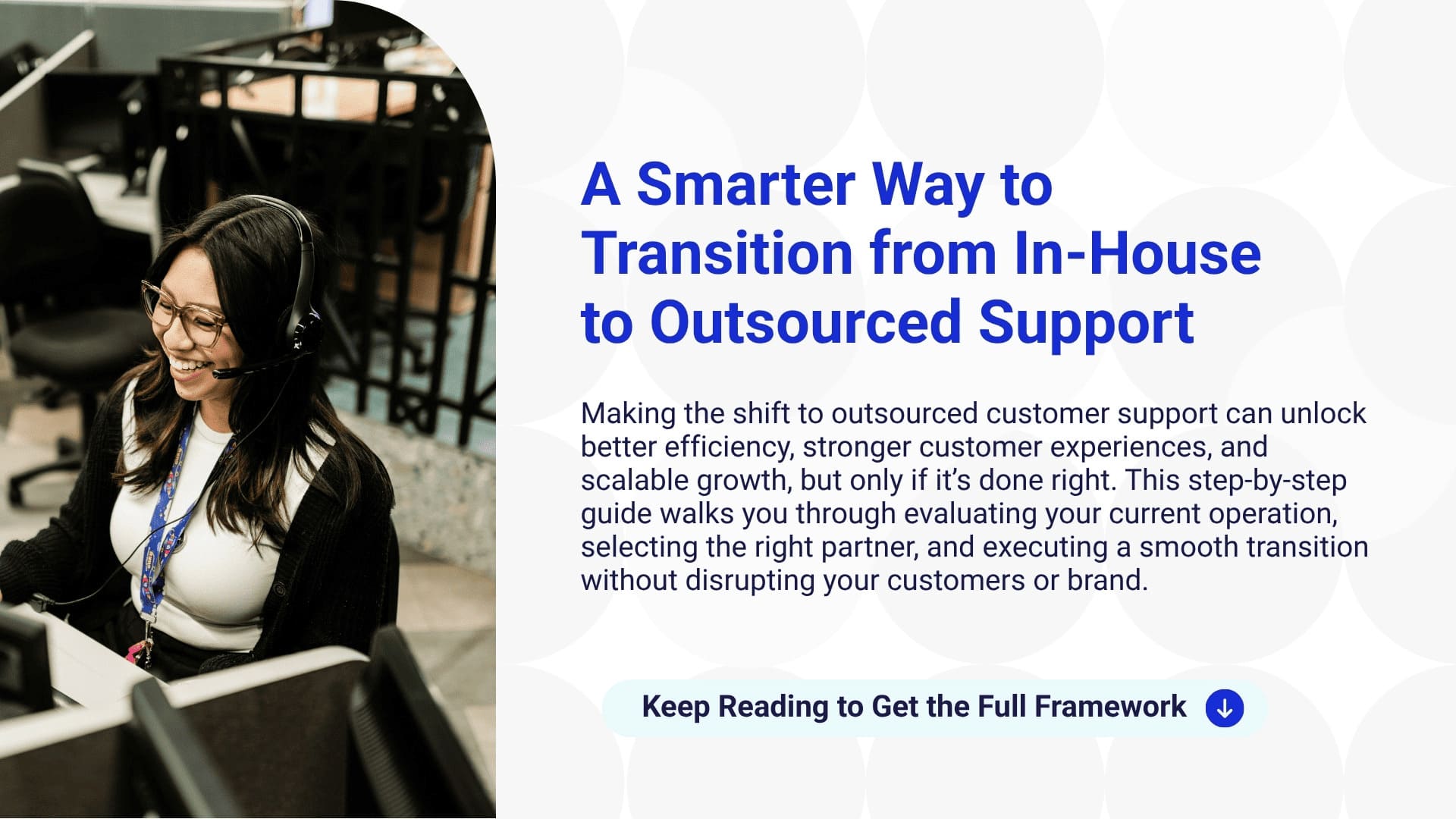
Outsourcing brings operational discipline through proven playbooks in forecasting, workforce management, quality assurance, and training. Experienced business process outsourcing partners deliver standardized processes, specialized expertise, and round-the-clock coverage that many internal teams struggle to build quickly. This is the practical foundation of call center outsourcing done well.
Cost advantages come from flexible staffing, global talent pools, and economies of scale that reduce cost per contact without sacrificing service quality. The ability to flex up or down for seasonality, promotions, or product launches removes long hiring and training cycles from your critical path. For leaders evaluating how to outsource customer service, these levers create measurable, defendable ROI.
Customer experience often improves when a partner alleviates bandwidth constraints, introduces channel expertise, and enforces consistency. If you face unpredictable volumes, after-hours gaps, inconsistent processes, limited QA, tool sprawl, or knowledge debt, and those issues are driving backlogs, long handle times, or burnout, outsourcing can be the catalyst for meaningful change. This is where customer service outsourcing becomes a force multiplier.
Assess Business Needs and Customer Expectations
Begin with a clear-eyed assessment of your current operation. Map the end-to-end experience across channels to identify bottlenecks such as long wait times, low first-contact resolution, repeat contacts, or inconsistent outcomes by team or region. Prioritize issues with the highest customer and financial impact to guide how to transition from in-house support to outsourcing (step-by-step) with focus and discipline.
Gather input from customers (surveys, reviews, social), frontline teams, managers, product and engineering, and finance. Pair this feedback with data: reasons for contact, hourly and channel volumes, SLAs, QA results, escalations, refunds, and churn drivers. This triangulation reveals where an external partner can deliver the fastest improvement through call center outsourcing.
Define clear objectives tied to business outcomes, such as lifting CSAT by 5 points, reducing average handle time by 15%, achieving 24/7 coverage, or lowering cost per contact by 10% while maintaining quality. Decide what must remain in-house (for example, complex escalations or fraud investigations) and what can transition in phases. This clarity empowers your customer support outsourcing strategy from the start.
Build a Comprehensive Transition Plan
Step 1: Set Objectives and KPIs.
Translate goals into measurable metrics: response time, first contact resolution, CSAT, QA pass rate, schedule adherence, and backlog thresholds. Establish guardrails to ensure cost savings never erode quality or the customer experience. These metrics will anchor your approach to customer service outsourcing.
Step 2: Audit the Current Operation.
Document channels (email, chat, voice, social), interval-level volumes, top intents, SLAs, tools and integrations, knowledge base content, and workflows. Capture dependencies with billing, logistics, or engineering. Inventory training assets, macros, and escalation paths. Note compliance and data privacy requirements that your call center services partner must meet.
Step 3: Select the Right BPO Partner.
Build evaluation criteria covering domain expertise, channel capabilities, language and hours of operation, QA methodology, workforce management maturity, technology stack, security posture, compliance experience, training approach, reporting cadence, and references. Red flags include vague QA processes, opaque pricing, high attrition, weak reporting, or overpromising without discovery. Favor partners who challenge assumptions and articulate how they will safeguard your brand voice across outsourcing customer service programs.
Step 4: Define the Transition Timeline.
Choose a phased rollout over a big-bang approach to reduce risk. Start with one channel, a subset of intents, or after-hours coverage. Set milestones for knowledge transfer, sandbox access, tool provisioning, training, shadowing, go/no-go gates, and success criteria for each phase. This is the pragmatic core of transitioning from in-house support to outsourcing (step by step).
Step 5: Execute Knowledge Transfer and Training.
Develop a structured curriculum with role definitions, workflows, system tours, and product FAQs. Create a single source of truth with version control and named owners. Use recorded sessions, process maps, and scenario-based practice. Include two-way shadowing: the partner observes your team, and your subject matter experts observe the partner in a lab environment. Formalize an approval process for macros and knowledge articles to strengthen customer support outsourcing outcomes.
Step 6: Pilot and Soft Launch.
Pilot with a small cohort handling low-risk intents or limited hours. Compare performance to baselines for speed, quality, and customer satisfaction. Review interactions weekly, calibrate QA, and tune workflows. Expand gradually through a soft launch with checkpoints and rollback criteria, a standard practice in call center outsourcing to protect experience and brand.
Step 7: Optimize and Scale.
After stabilizing the pilot, scale volume, and channels. Implement continuous improvement with weekly calibrations, monthly business reviews, root cause analysis of drivers, and iterative updates to knowledge and training. Introduce automation (deflection, macros, guided workflows) where it improves both CX and efficiency, advancing precision in outsourcing customer service.
Train and Integrate Your Outsourced Support Team
A successful customer service outsourcing strategy depends on how well you train and integrate your outsourced team. Start by establishing a clear governance and communication model. Assign key roles, such as a program manager, training lead, and QA lead, on both your internal team and your outsourcing partner’s side. Set up shared communication channels for daily coordination, escalation management, and ongoing collaboration with subject matter experts.
To ensure a smooth transition, provide sandbox environments and test accounts so agents can practice workflows before handling live customer interactions. This structured onboarding process is critical for customer support outsourcing, helping maintain consistency and reduce risk from day one.
Build a strong quality assurance (QA) framework aligned with your core KPIs, including accuracy, tone of voice, compliance, and resolution rates. Conduct regular QA calibrations between your in-house and outsourced teams to ensure scoring consistency and alignment. Use proven methods like side-by-side evaluations, random sampling, and targeted audits, especially for new or complex workflows, to maintain high service standards across your outsourced call center operations.
Continuous improvement is key to long-term success in outsourcing customer service. Close the feedback loop by linking QA insights to updated training materials and knowledge base improvements. Run regular voice-of-customer reviews to identify trends, friction points, and opportunities to enhance the customer experience.
Maintain a clear and visible change log so agents understand updates to processes, tools, or messaging. Most importantly, tie every improvement back to measurable KPIs to ensure your outsourced support team consistently delivers better performance, stronger customer satisfaction, and scalable results.
How to Evaluate and Choose Your Partner
Choosing the right provider is critical to the success of your customer service outsourcing strategy. Start by evaluating each partner’s experience in your industry, supported channels, and proven results. Look for demonstrated performance improvements in key metrics such as CSAT, first contact resolution (FCR), and cost per contact. A strong call center outsourcing partner should also offer multilingual, 24/7, omnichannel support to meet evolving customer expectations.
Operational excellence is equally important. Assess their forecasting accuracy, schedule adherence, and workforce management capabilities, core pillars that directly impact the efficiency and scalability of your outsourced customer support operations. These capabilities ensure your partner can handle fluctuating volumes while maintaining consistent service quality.
Cultural alignment plays a major role in long-term success. The best customer support outsourcing providers share your commitment to customer-centricity, transparency, and continuous improvement. Evaluate agent profiles, hiring standards, and training methodologies to ensure they can represent your brand effectively. Collaborative discovery sessions and workshops are valuable tools to assess how well the partner communicates, solves problems, and aligns with your internal teams.
Finally, verify reliability and risk management. Review client references, industry certifications (such as SOC 2 or ISO standards), and their approach to business continuity and disaster recovery. Analyze attrition rates, as high turnover can affect service consistency in call centers.
Establish clear expectations through well-defined SLAs, reporting cadences, and governance structures, including weekly operational reviews and quarterly business reviews. The right outsourcing partner will be proactive, transparent about risks, and focused on delivering measurable outcomes that align with your business goals, hallmarks of high-performing customer service outsourcing solutions.
Typical Transition Timeline
| Phase | Duration | Key Activities |
| Discovery & Planning | 2–4 weeks | Operational audit, KPI alignment, success criteria, timeline, governance |
| Knowledge Transfer & Training | 2–4 weeks | Curriculum, tool access, shadowing, QA scorecard, go-live readiness |
| Pilot & Ramp | 4–8 weeks | Pilot launch, QA calibration, soft launch expansion, performance tuning |
Many organizations that follow best practices for outsourcing customer service will see variations in this timeline depending on scope, channels, and compliance requirements. Treat these phases as checkpoints, not just dates.
Frequently Asked Questions
What should remain in-house versus outsourced?
Keep highly specialized, high-risk, or low-volume work that relies on deep institutional knowledge (for example, complex escalations, legal matters, fraud). Outsource repeatable, high-volume interactions with clear procedures and measurable outcomes through call center services and customer support outsourcing.
How long does the transition take?
Many phased transitions run 8 to 16 weeks: 2 to 4 weeks for discovery and planning, 2 to 4 weeks for knowledge transfer and training, and 4 to 8 weeks for pilot and ramp. Complexity, tooling, and channel scope can reduce or extend timelines for customer service outsourcing programs.
How do we protect customer data and compliance?
Require security certifications such as SOC 2, complete vendor assessments, enforce role-based access, use secure VPNs or virtual desktops, and follow least-privilege principles. Document compliance training and audit trails, and include data processing agreements and incident response SLAs for any call center outsourcing arrangement.
Which KPIs should we prioritize at launch?
Emphasize quality and experience first: accuracy, first contact resolution, CSAT, and SLA adherence. Once stable, expand into efficiency metrics like average handle time and cost per contact to strengthen outsourcing customer service performance.
How do we keep brand voice consistent?
Provide tone guidelines, exemplar interactions, and approved macros. Train using real scenarios and run frequent QA calibrations. Use side-by-sides and targeted coaching to reinforce empathy and voice standards across customer support outsourcing teams.
Key Takeaways for a Smooth Transition
- Anchor your customer service outsourcing strategy in clear, outcome-based KPIs, with non-negotiable guardrails to protect customer experience (CX) and service quality.
- Choose a call center outsourcing partner with proven results, operational maturity, and strong cultural alignment with your brand and values.
- Reduce risk by implementing a phased rollout, including defined go/no-go checkpoints, structured training, and two-way shadowing between internal and outsourced teams.
- Establish robust QA frameworks, governance models, and continuous feedback loops to drive ongoing improvement in your outsourced customer support operations.
- Safeguard customer data with strict security protocols, role-based access controls, and audited compliance processes, especially when scaling customer support outsourcing services.
With the right strategy and partner, outsourcing customer service becomes a true force multiplier, enabling 24/7 coverage, improving customer satisfaction, and optimizing operational costs while freeing your internal teams to focus on high-impact initiatives.
Ready to transition from in-house support to a high-performing outsourced model?
Partner with The Office Gurus to build a tailored customer service outsourcing solution that aligns with your goals, protects your brand, and delivers measurable results.
Contact us today to start your outsourcing strategy.