



Customer experience leaders have invested significant time and budget in AI, promising faster resolutions, lower costs, and happier customers. Yet a simple question remains: Is the AI actually working? The disconnect between expectations and verifiable so you can prove AI ROI, improve quality, and sustain adoption. We address the realities of AI for CX and the discipline required outcomes is the AI performance gap. This piece unpacks what drives the gap, why measurement is difficult, and which operational, data, and governance practices close it to deliver durable results in customer service. Closing that gap is what separates teams that can defend their AI budget from teams that can’t.
Understanding the AI Performance Gap in Customer Experience
The AI performance gap is the distance between what AI is expected to deliver and what teams can confidently measure in production. In customer experience, it often looks like bots that ace a demo but stumble in real-world scenarios, or analytics that show deflection without demonstrating true resolution or benefit to the customer. This is the core tension behind most AI rollouts in customer service today.
Several misconceptions fuel the gap:
- Equating high intent classification accuracy with successful automation: understanding a request is not the same as completing the task.
- Assuming a fluent generative response is correct, compliant, or aligned with policy.
- Expecting AI to mirror seasoned agent judgment without the context, knowledge, and guardrails agents use to make decisions.
Understanding what AI actually changes in a contact center is the first step toward setting expectations that measurement can validate.
Common failure modes compound the problem:
- Data quality gaps: training data is incomplete, outdated, or inconsistently labeled.
- Model and environment drift: customer behavior, products, and policies change faster than models are refreshed.
- Missing context: models lack access to order history, entitlements, or current knowledge base content.
These issues degrade accuracy, trigger escalations, and undermine trust. Misaligned expectations make matters worse. Technical teams may optimize model metrics such as precision or hallucination rate; operations care about resolution, handle time, and consistency; executives emphasize cost or deflection. Without a shared definition of success and a plan to measure it, programs end up being judged by conflicting or siloed metrics. Closing this gap requires aligning AI initiatives with the operational realities and customer experience KPIs that actually drive the business.
Measurement, Metrics, and Validation Challenges
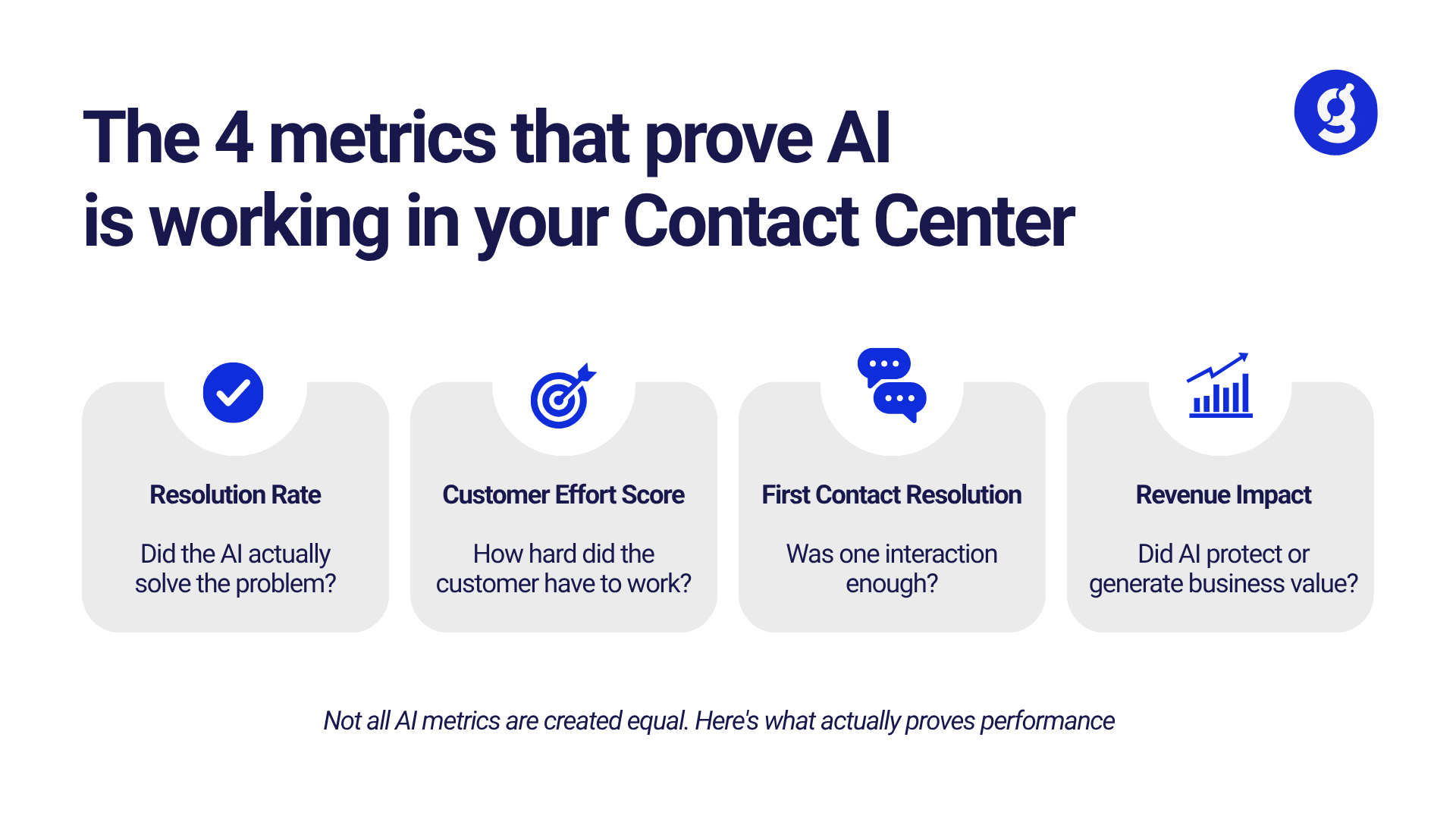
Choosing the right KPIs is critical. Core categories and examples include:
- Understanding: intent recognition accuracy and entity extraction accuracy.
- Resolution: first contact resolution (FCR) and task completion rate.
- Experience: customer Effort Score (CES), CSAT, and complaint rate.
- Business outcomes: refund accuracy, revenue recovery, churn reduction, and cost-to-serve.
No single metric tells the whole story. Increases in bot containment can hide silent failures if customers drop off or switch channels out of frustration. High accuracy on a static test set can mask regression on long-tail intents. This is part of a broader pattern: most CX teams are already measuring the wrong things, even before AI enters the equation. A compact scorecard should balance experience, quality, and economics, making room for both customer value and business value. The goal is to balance precision with customer experience and let every measure ladder up to a defensible AI ROI.
Practical obstacles make attribution difficult
- No pre-AI baseline: without a clean baseline, it is hard to isolate AI impact from seasonality, promotions, or policy changes.
- Noisy labels: overlapping intents and inconsistent dispositions distort accuracy and resolution measures.
- Blended outcomes: agent-plus-AI experiences blur causality. Did the AI lower handle time by surfacing policy, or did the agent solve it regardless?
These gaps don’t appear because AI fails. They appear because AI exposes the weak points that already existed in data, processes, and measurement systems.
Robust validation helps cut through this noise:
- A/B testing and holdouts: compare AI-assisted versus control experiences in the same time window.
- Segmented rollouts: release by intent, channel, or region to isolate effects and reduce variability.
- Offline simulation: use historical transcripts to test prompts, policies, and flows before production.
- Continuous monitoring: enable canary checks, drift detection, and alerts tied to quality thresholds rather than just activity volume.
When these practices are in place, AI shifts from promise to proof, and leaders can finally connect their efforts directly to AI ROI.
Operational and Organizational Solutions to Close the Gap
Data hygiene is the foundation of trustworthy AI. Establish clear standards and keep knowledge up to date so models act on the right information at the right time. This is how customer AI earns the right to scale instead of remaining a novelty
- Standardize how customer interactions are categorized across teams so that AI and agents are working from the same definitions of success.
- Keep your knowledge base, pricing information, and product policies up to date. AI can only perform as well as the information it has access to.
- Track how every interaction ends: resolved, escalated, or incomplete. Without that data, there is no way to know whether AI is actually closing the loop for customers.
Create a closed-loop feedback system that continuously improves performance:
- Feed agent corrections, customer clarifications, and survey feedback back into training and tuning.
- Prioritize fixes by business impact, starting with high-frequency and high-friction intents.
- Schedule periodic refreshes to address drift and document before-and-after results to confirm gains.
AI performance doesn’t improve on its own; it requires clear ownership across the organization. Define who is responsible for each part of the AI lifecycle:
- Operations leaders: define what AI should and should not handle, and set the service standards it must meet.
- Technology teams: ensure the AI is performing as designed and flag any unexpected behavior changes.
- Compliance and legal: confirm that data handling, customer privacy, and retention practices meet regulatory requirements.
- CX and support leadership: set the customer experience targets and make the call when efficiency and quality trade-offs arise.
Establish clear response protocols for when AI performance drops. Define how quickly the team will detect an issue, who decides to pause automation, and how agents are notified when a policy change affects how AI responds. Having these agreements in place before a problem occurs is what keeps a quality dip from becoming a customer experience crisis.
At the interaction level, your team should be able to answer a basic question: why did the AI respond the way it did? If that answer isn’t accessible, it becomes impossible to improve performance or defend decisions to customers and leadership. At the program level, deliver dashboards that tie AI activity to business outcomes such as:
- Resolution rate uplift and task completion improvements.
- Average handle time reduction in AI-assisted flows.
- Savings from accurate deflection and containment.
- Quality measures like compliance, adherence, and sentiment shifts.
Share both wins and gaps with frontline teams and executives to preserve trust and guide investments. Organizations that have deployed automated QA alongside agent assist are already closing this loop by auditing 100% of interactions rather than relying on randomized sampling.
How to Design a CX AI Scorecard That Leaders Trust
A credible scorecard translates complex model behavior into management-ready insights. Keep it consistent over time, causal where possible, and segmented by intent, channel, and customer segment. Recommended categories and example metrics:
| Category | Example Metrics | Why It Matters |
| Understanding | Intent accuracy; entity extraction accuracy; coverage of top intents | Assesses whether AI correctly interprets requests and has enough coverage to be useful |
| Resolution | Task completion rate; FCR; escalation rate to human agents | Shows whether the AI actually solves problems rather than just responding. |
| Experience | CSAT; CES; complaint rate for AI-led interactions | Balances efficiency with customer perception and effort |
| Quality & Risk | Policy compliance; hallucination rate; PII handling success | Protects brand, mitigates regulatory risk, and ensures safety |
| Economics | Cost per contact; deflection savings; revenue protection or incremental sales | Quantifies AI ROI and supports investment decisions |
For teams deploying agent-assist models specifically, calculating the ROI of agent-assist AI requires separating productivity gains from deflection savings, two metrics that often get collapsed into one.
Tips for credibility and adoption:
- Anchor metrics to baselines and control groups to demonstrate causality.
- Annotate with context such as policy changes, promotions, or peak periods.
- Highlight confidence intervals when sample sizes are small.
- Separate leading indicators (knowledge freshness, automation coverage) from lagging outcomes (churn, repeat contacts).
This disciplined scorecard links customer experience KPIs to outcomes executives trust, making the path from pilot to AI ROI visible.
Playbook for Proving AI Works in Your CX
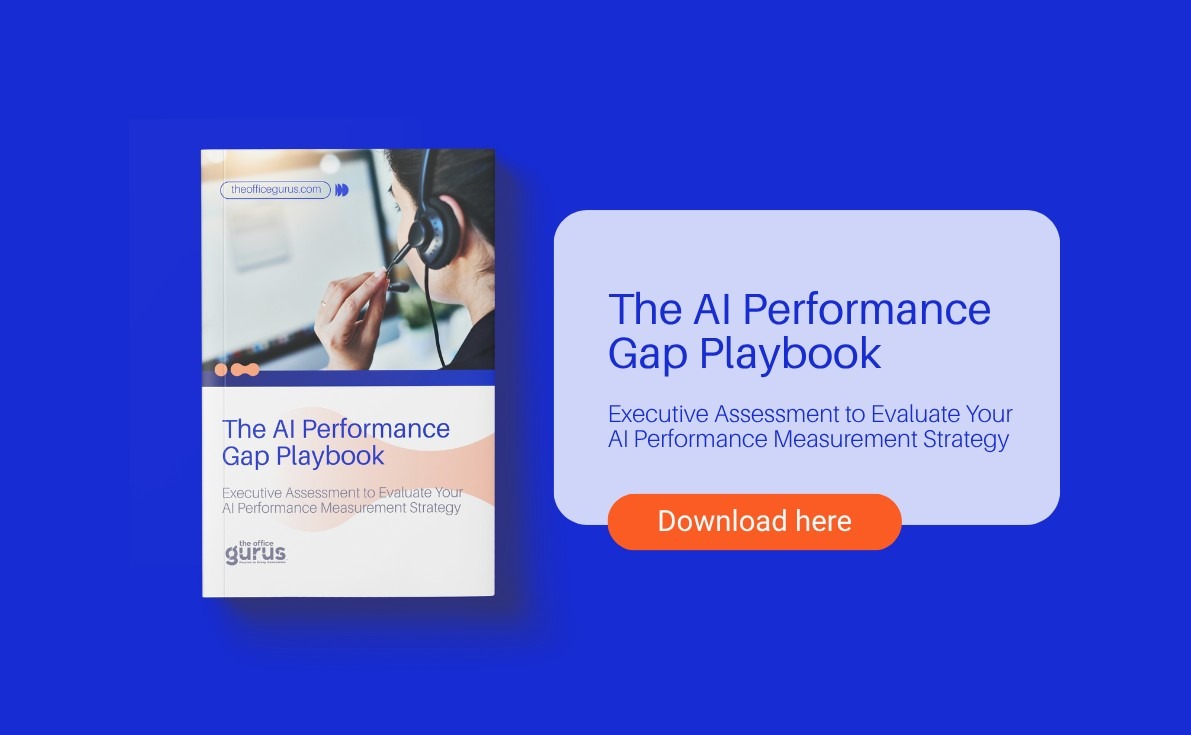
Knowing where to start is often the hardest part. To help you move from diagnosis to action, The Office Gurus developed The AI Performance Gap Playbook, an executive assessment designed specifically for CX and operations leaders who need to evaluate how effectively their organizations measure AI performance today.
The Playbook guides you through five practical tools:
- A self-scoring scorecard to assess your current measurement maturity.
- A balanced KPI framework across customer experience, operations, agent performance, and business outcomes.
- A measurement maturity ladder to pinpoint where your organization stands today.
- An executive dashboard checklist with the five questions every AI performance review should answer.
- A readiness checklist to validate your organization before scaling AI further.
Bridging the Gap: From Pilot to Proven Program
Closing the AI performance gap is less about a single model and more about disciplined operations. Start with clear goals and reliable baselines. Invest in data hygiene and knowledge freshness. Validate with control groups, monitor continuously, and govern with shared accountability. When AI decisions are explainable and connected to measurable outcomes, leaders gain the confidence to scale. The result is a customer experience program that not only adopts AI but also demonstrates that it works safely, efficiently, and profitably. That shift from cost center to growth driver only happens when CX is treated as a measurable business strategy rather than a support function.
Treat AI for CX as an enterprise capability, not a point solution. Anchor every initiative to customer experience KPIs and prove the case for AI ROI with integrity. With the right measurement infrastructure and organizational alignment, you can turn AI’s potential into proven, scalable performance.
At The Office Gurus, we help CX and operations leaders move beyond AI deployment and into AI performance, combining experienced teams, operational expertise, and technology to deliver measurable customer experience outcomes you can actually prove.
If you’re ready to close the gap between what your AI is doing and what it should be delivering, talk to a CX specialist and let’s build the measurement foundation your program needs to scale with confidence.