


Uncover the real ROI of outsourcing customer support with insights on costs, scalability, and strategic advantages
Outsourcing customer support is often framed as a cost-cutting move, but the strongest returns come from increased productivity, customer loyalty, and agility, as well as hard-dollar savings. When executed with the right partner, it turns a fixed cost center into a flexible, performance-driven capability.
This guide clarifies the full cost picture, the outcomes that matter, and a pragmatic way to calculate the real ROI of outsourcing customer support so you can build a business case grounded in evidence, not assumptions. If you’re asking what ROI is in this context, we’ll show you how outsourcing customer support makes ROI tangible through disciplined measurement and strong governance.
With confidence and clarity, we’ll help you connect ROI to customer experience, operational excellence, and revenue growth. You’ll learn where the true gains come from, how customer service outsourcing models deliver value, and how an ROI calculator translates improvements into financial results. Consider this your pathfinder to ROI CX solutions and to partnering with customer support outsourcing companies that act as true extensions of your brand.
Understand the Full Cost of Customer Support
Support operations carry a mix of direct and indirect expenses that can be easy to underestimate. To accurately compare in-house and outsourced models, evaluate the total cost of ownership, and the opportunity costs of managing a non-core function. This perspective is foundational to the real ROI of outsourcing customer support because it exposes the hidden expenditure that an ROI calculator must capture to reflect true revenue.
Direct vs. indirect costs
- Direct costs (in-house): Salaries and benefits, technology subscriptions (CRM, telephony, QA, WFM, knowledge base, AI tools), telecom, and frontline management overhead.
- Indirect costs (in-house): Recruiting and background checks, onboarding and training, real estate and utilities, workforce management, attrition and backfill, compliance and security programs, analytics infrastructure, and IT support.
- Outsourced model: Many of these inputs are consolidated into a predictable hourly or per-contact rate. The provider typically absorbs recruiting, training, technology stack, facilities, and a portion of management overhead. This consolidation is central to ROI in outsourcing, especially when comparing customer service outsourcing models by cost per contact.
Hidden costs of running in-house teams
- Seasonal overtime and short-notice staffing to cover peaks and special events.
- Higher attrition leads to frequent retraining and productivity loss.
- Hardware refresh cycles and fragmented tooling across teams and sites.
- Leadership time is spent on scheduling, QA, and day-to-day performance management rather than on strategic initiatives.
Compare on a cost-per-contact basis
Baseline true cost by calculating fully loaded cost per contact, not just hourly wages. Include the full technology stack, people-related costs, and facilities. Outsourcing partners spread these investments across multiple clients and geographies, unlocking economies of scale that typically reduce all-in cost while maintaining or improving service levels. This view anchors outsourcing customer support ROI and ensures your ROI CX solutions are built on complete, comparable data.
Quantify ROI with Operational and Financial Metrics
ROI should be linked to operational improvements and financial outcomes. Establish baselines prior to transition, set targets with your partner, and track changes through steady-state operations and seasonal cycles. When you quantify ROI, the real benefit of outsourcing customer support becomes visible in both dollars and customer sentiment.
Core customer experience and productivity KPIs
- Cost per contact by channel
- Average handle time
- First contact resolution
- Service level and average speed of answer
- Occupancy and utilization
- Schedule adherence and shrinkage
- Quality scores (calibration-based)
- Customer satisfaction (CSAT), Customer Effort Score (CES), and Net Promoter Score (NPS)
Financial levers
- Hard savings: Lower labor rates, fewer management layers, shared technology costs, and eliminated facility overhead.
- Soft-to-hard savings: Improved productivity per agent, higher FCR, reducing rework, lower attrition, curbing retraining costs, and higher self-service containment powered by better knowledge and automation.
- Revenue upside: Higher conversion rates on sales-assisted interactions, improved retention from faster, more effective resolution, and increased lifetime value through consistent omnichannel experiences.
Customer satisfaction as a financial predictor
Increases in CSAT and FCR correlate with lower churn and higher repeat purchases. Treat these as leading indicators in your ROI model and link them to measurable outcomes such as renewal rates, average order value, and complaint reduction.
The Building Blocks of Outsourcing ROI
Outsourcing delivers returns across four interlocking areas: cost, efficiency, scalability, and performance. These pillars define how outsourced customer support becomes a strategic advantage and why customer support outsourcing companies that invest in people, process, and technology consistently outperform ad hoc internal builds.
1. Cost savings
- Labor arbitrage with quality guardrails: Access competitive talent across locations with fully loaded cost advantages without compromising standards.
- Infrastructure consolidation: Providers shoulder the cost of facilities, connectivity, data security, telephony, QA platforms, WFM, and analytics.
- Training at scale: Structured onboarding and continuous learning programs reduce time-to-proficiency and lower retraining costs via better retention.
2. Operational efficiency
- Advanced workforce management: Accurate forecasting, scheduling, and real-time management align staffing to demand.
- Optimized staffing models: Multi-client flexing supports higher occupancy without erosion in service quality.
- Reduced idle time: Real-time dashboards, cross-skilling, and smart routing increase utilization while meeting service levels.
3. Scalability
- Speed to ramp: Dedicated recruiting pipelines and training academies compress the timeline for seasonal spikes, product launches, and geographic expansion.
- Capacity without hiring delays: Access to broad talent pools ensures you meet SLAs during growth spurts and cyclical demand.
4. Performance improvement
- Quality systems: Calibrated QA scorecards, targeted coaching, and speech/text analytics drive consistency and compliance.
- Better CX metrics: Gains in CSAT, FCR, and AHT emerge from applied best practices, disciplined knowledge management, and targeted automation.
These building blocks reinforce the real ROI of outsourcing customer support by elevating service while driving down cost. They also reflect customer support outsourcing trends: integrated analytics, outcome-focused contracts, and hybrid delivery models that blend onshore leadership with nearshore and offshore execution.
Strategic Advantages Beyond Bottom-Line Savings
The strongest ROI extends past cost reduction into capability building and risk management. Inspired action paired with wise governance transforms outsourced customer support from a tactical decision into a strategic lever.
- Elasticity and coverage: Extend hours of operation, add languages, and stand up new channels with minimal lead time. This reduces risk during market entries, campaigns, or incident response.
- Access to advanced technology and expertise: Leverage agent-assist, conversational AI, automated QA, real-time sentiment analysis, and omnichannel routing without large upfront investments.
- Focus on core priorities: Free internal leaders from day-to-day operational management so they can drive product, go-to-market, and innovation initiatives.
These advantages align with customer support outsourcing trends that prioritize agility, resilience, and measurable outcomes. As you evaluate customer service outsourcing models, look for ROI CX solutions that link operational excellence to growth and for customer support outsourcing companies ready to act as partners, not just vendors.
How to Calculate the ROI of Outsourcing
Use a structured, comparable approach that translates operational improvements into financial results. A clear, actionable ROI calculator turns data into decisions and helps quantify customer support outsourcing ROI before, during, and after the transition.
Step 1: Calculate current cost per contact
- Sum all fully loaded in-house costs for a representative period: labor and benefits, facilities, technology, recruiting, training, management overhead, QA, WFM, attrition and backfill, IT support, and compliance.
- Divide by total contacts handled across all channels. Segment by channel to capture differences in complexity and cost.
Step 2: Estimate outsourced cost
- Collect a detailed proposal with hourly or per-contact rates by channel, launch fees, and training costs.
- Clarify inclusions such as telephony, QA tools, WFM, analytics, and security to ensure apples-to-apples comparisons across customer service outsourcing models.
Step 3: Model efficiency gains
- Project improvements in AHT, FCR, schedule adherence, and shrinkage based on provider benchmarks and case studies.
- Convert improvements into hours saved per volume or per contact to refine the expected run-rate.
Step 4: Map KPI changes to business outcomes
- Connect lower cost per contact to direct savings.
- Tie CSAT and FCR improvements to churn reduction, repeat purchase rates, and conversion uplift.
- Track baseline and post-migration performance for at least two cycles, including a peak period, to validate sustainability.
The Gurus’ simple formula
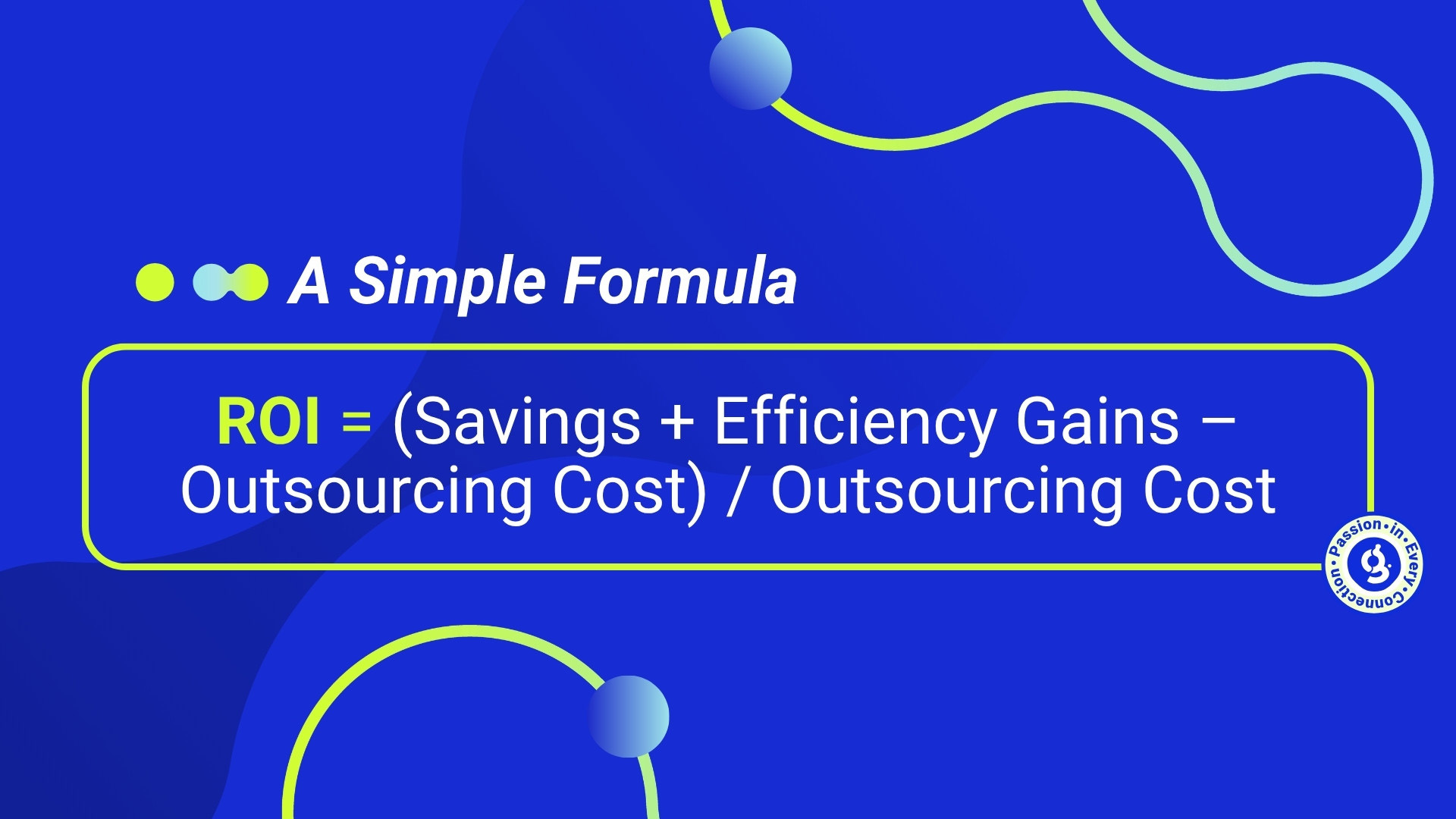
For a fuller picture, add revenue impacts from higher retention and conversion and subtract transitional costs such as knowledge transfer, parallel runs, and system integration. This formula helps determine your program’s ROI and highlights how to strengthen it through disciplined measurement.
Illustrative inputs for an ROI model
| Metric | In-House Baseline | Outsourced Target | Impact |
| Cost per contact | $6.50 | $4.75 | Direct savings per contact |
| Average handle time | 7.0 min | 6.0 min | ~14% productivity improvement |
| First contact resolution | 68% | 78% | Fewer repeat contacts |
| CSAT | 82% | 88% | Retention and LTV impact |
| Shrinkage | 32% | 26% | Higher agent availability |
Make Outsourcing Work: Governance and Culture
The best outcomes come from treating your provider as a strategic partner accountable for customer outcomes, not just volumes handled.
Align on customer experience
- Define brand voice, escalation paths, and customer promises. Embed these standards in training and QA.
- Measure what matters to your customers, not only operational throughput. Balance efficiency with resolution quality.
Invest in people and knowledge
- Develop comprehensive onboarding, product certifications, and ongoing upskilling linked to new features and policies.
- Use microlearning, call listening, and knowledge base feedback loops to keep content current and reduce knowledge gaps.
Set clear SLAs and incentives
- Establish targets for service level, ASA, AHT, FCR, QA scores, CSAT/CES, adherence, and attrition.
- Conduct monthly business reviews, share voice-of-customer insights, and align incentives to outcomes that signal customer value and financial performance.
When governance is strong, outsourced customer support delivers reliable ROI. This is how ROI outsourcing becomes durable: with clear accountability, transparent reporting, and customer-first decision-making at every level.
What the Next Wave of Outsourcing Looks Like
Customer expectations are shifting quickly, and outsourcing models are evolving to keep pace while reducing risk. Customer support outsourcing trends point to more flexible footprints, smarter automation, and pricing anchored to outcomes rather than effort.
- Nearshore and hybrid strategies: Combining onshore leadership with nearshore and offshore delivery balances proximity, time zone alignment, multilingual support, and cost structure.
- Outcome-linked pricing: Gainshare and shared-risk models are increasingly common, aligning provider incentives with measurable business results.
- AI and automation as force multipliers: Intelligent self-service, agent-assist, automated QA, and AI-powered forecasting elevate productivity and consistency without sacrificing empathy or judgment.
- Proactive support: Using product or service analytics to anticipate issues and reach out before customers contact you, improving satisfaction and reducing inbound volume.
The future is a blend of skilled humans, smart automation, and robust analytics. The ROI belongs to organizations that integrate these capabilities seamlessly with strong governance and a customer-first culture. Look for customer support outsourcing companies that offer ROI CX solutions designed to accelerate learning curves, reduce risk, and scale with confidence.
Frequently Asked Questions
How soon will we see ROI after outsourcing?
Early efficiency gains typically appear within 60–90 days of go-live as teams reach proficiency. Full financial ROI, including stabilized KPIs and optimized staffing, generally materializes within two to three quarters, depending on volumes, complexity, and the breadth of transition. These timelines align with customer support outsourcing trends and reflect how outsourced customer support matures into steady-state performance.
Which KPIs should be contracted?
Include cost per contact, service level, average speed of answer, average handle time, first contact resolution, QA scores, CSAT or CES, schedule adherence, shrinkage, and attrition. For eligible programs, add outcome-based measures such as retention, upsell conversion, and complaint rates that the provider can directly influence. These measures feed into your ROI calculator and clarify your business’s ROI.
How do we maintain brand voice with an outsourced team?
Provide a detailed brand playbook, tone and style guidelines, exemplar transcripts, and a current knowledge base. Run regular QA calibration sessions, build brand immersion into onboarding, and review interactions to ensure alignment with your standards. This is how outsourcing customer support protects ROI as you scale.
What pitfalls should we avoid?
Common missteps include underestimating the time required for knowledge transfer, misaligned KPIs, weak tools and data integration, and a lack of governance. Establish clear escalation paths, define change management protocols, and set a recurring performance review cadence from day one. These practices are essential to achieving a stronger ROI in outsourcing.
Is outsourcing suitable for complex or technical products?
Yes, with the right partner. Prioritize domain experience, structured certification paths, tight collaboration with product and engineering, and access to subject-matter experts. Start with a focused pilot on defined queues and expand as capability and confidence grow. Many customer support outsourcing companies specialize in complex workflows and can prove ROI through targeted CX improvements.
Putting It All Together
The real ROI of outsourcing customer support goes beyond cost savings; it’s about building a more agile, efficient, and customer-centric operation that drives measurable business impact. When you account for the total cost of ownership, track the right KPIs, and implement strong governance, support transforms from a cost center into a strategic growth engine. But realizing that value requires the right strategy and the right partner.
If you’re ready to uncover your true cost per contact, identify immediate efficiency gains, and build a clear ROI model tailored to your business, now is the time to act. The right outsourcing partner won’t just reduce costs, they’ll help you elevate CX, scale faster, and unlock long-term growth.
Let’s build your ROI together.
Connect with our team to evaluate your current support operation, model your potential savings, and design a solution that delivers measurable results from day one.