


Most CX improvement initiatives force a trade-off. Reduce average handle time, and you risk rushing agents through conversations that require care. Improve conversion, and calls often run longer, adding cost. The assumption that efficiency and quality pull in opposite directions is so common that it rarely gets questioned.
Two recent contact center deployments by The Office Gurus proved that the assumption that efficiency and quality pull in opposite directions is wrong.
In the first one, a childcare and early education provider saw same- or next-day appointment conversions rise by 9% and average handle time fall by 18% simultaneously. In the second, a residential property management company achieved an 80% first-contact resolution rate on maintenance issues that previously required a technician visit.
Both results trace back to the same operational discipline: aligning the right technology with a precisely defined problem, supporting it with targeted training, and measuring from day one. This article breaks down what drove those outcomes and what CX and contact center leaders can take from them.
What Are CX Operations and Why Do They Drive Conversions?
Customer experience operations, commonly called CX operations, encompass the systems, processes, technologies, and staffing practices that deliver customer experience at scale. Where CX strategy sets the vision and customer service resolves individual issues, CX operations are the execution engine that ensures the right steps, tools, and roles are in place across every channel and touchpoint.
The link between CX operations and conversion rates is direct: operational consistency removes friction. When information is accurate, next steps are clear, and agents are equipped to handle objections confidently, customers move forward. Each removed friction point increases the probability that an inquiry becomes an appointment, a conversation becomes a close, and a customer buys again.
An operations-first approach also makes performance scalable. By defining playbooks, standardizing agent behaviors, and building repeatable decision logic into operations, contact centers can deliver consistent, contextual treatment at scale for every customer, not just those who happen to reach the best agent on the floor.
Three Pillars of Conversion-Focused CX Operations
High-performing CX operations rest on three pillars that directly influence conversion rates. When these pillars are aligned, operational improvements compound rather than cancel each other out.
Process Design and Workflow Optimization
Map the agent-handled journey from first contact to resolution and identify the micro-frictions that slow decisions or introduce doubt: unclear next steps during calls, inconsistent messaging across the agent team, internal escalation paths that create delays, or policies that agents cannot explain confidently. Standardize workflows to eliminate unnecessary steps, surface key information earlier in the conversation, and ensure every agent handles the same scenario consistently.
Quality Management and Continuous Coaching
Consistent conversion does not come from onboarding alone; it comes from a system that continues to improve after go-live. That means QA scorecards aligned to conversion-leading behaviors, not just compliance: confident objection handling, first-contact resolution, and clear next steps. Conversation analytics, like those surfaced by GuruAssist, identify the exact moments where agents lose conversions across hundreds of call patterns that no supervisor could catch manually. Those patterns feed targeted coaching cycles that close specific gaps, creating a feedback loop that compounds week over week.
Staffing, Training, and Role Design
Conversion-friendly operations depend on people equipped to execute consistently and adapt with context. Define roles aligned to the customer journey: pre-sales advisors, retention specialists, video-enabled support agents, and train them to specific scenarios, not just general skills. Align quality assurance to what high-performing contact centers do differently: first-contact resolution, confident objection handling, proactive next steps, and accurate expectation setting.
Case Study: AI-Powered Guidance That Converts A Childcare Provider
The Challenge:
A childcare and early education provider with a growing national footprint was experiencing a familiar pattern: good engagement, weak conversion. Agents connected well with parents during enrollment calls, but when conversations reached the difficult moments, objections about pricing, program comparisons, or enrollment policies, agents hesitated. They struggled to present alternatives that matched each family’s situation. Confidence broke down precisely where it mattered most.
The problem was not effort or attitude. It was infrastructure. Agents were navigating high-stakes sales conversations in which a parent was deciding where to enroll their child, without in-call decision support to guide them through those moments.
The Solution: GuruAssist Real-Time Agent Guidance
The Office Gurus deployed GuruAssist, its proprietary AI-powered agent assistance platform, to address the gap at the source. GuruAssist operates during the live call, not as a post-call scoring tool, but as a real-time co-pilot that surfaces guidance when it is needed.
When a parent raised a pricing objection, GuruAssist prompted the agent with the most effective rebuttal for that specific scenario. When a conversation was trending toward drop-off, the platform directed the agent toward a structured path to re-engage. Compliance gaps were flagged in real time, before they became QA issues. Dynamic scripting adapted to the conversation as it unfolded, not a static script, but a responsive decision support layer.
The Outcome:
Agents did not need to recall training under pressure. The right response appeared when needed, based on what was actually happening in the conversation.
| +9% Increase in same/next-day appointment conversions | −18% Reduction in average handle time |
The result of improving both conversion and efficiency simultaneously reflects how structured guidance works. When agents know exactly what to say at each inflection point, calls become more confident and more focused. The hesitation that inflates AHT and kills conversion is the same hesitation GuruAssist removes. Both metrics improved together because they share the same root cause.
Leadership gained equally from the deployment. GuruAssist provided managers with conversation-level analytics that surfaced recurring objection patterns, performance gaps, and account trends. That data powered targeted coaching cycles and continuous operational improvement, turning individual call insights into a systematic feedback loop that kept performance improving week over week.
AI guidance is most effective when it operates inside the conversation, not after it. Surfacing the right response at the moment of hesitation is the difference between a lost conversion and a booked appointment.
This outcome isn’t isolated to one industry. In a separate deployment, a customer service team that had been optimizing purely for speed, at the expense of accuracy and empathy, applied the same operational principle. The results followed the same pattern.
With that foundation established, the second case study takes the conversation in a different direction: not AI-powered conversion, but technology-enabled resolution.
Case Study: Video Support That Resolves A Property Management Company
The Challenge:
A residential property management company tasked The Office Gurus with reducing technician dispatch costs and improving first-call resolution on maintenance requests. When residents called about HVAC or other unit issues, agents could document the problem, but they had no way to visually assess the situation before escalating. Without that visual information, every unclear case was dispatched.
The Solution: RingCX Video-Assisted Support
The Office Gurus implemented RingCX as a structured AI-powered communications platform within the existing contact center operation.When a resident contacts the team about a maintenance issue, the agent sends an SMS link. The resident clicks it and connects via live video. The agent sees the situation directly and can assess whether dispatch is genuinely necessary.
The technical implementation was straightforward. The operational foundation was not. Before a single video call was taken, The Office Gurus’ training and operations team developed specialized HVAC content in collaboration with the client’s maintenance providers. Agents were trained not just to operate a video interface, but to diagnose what they were seeing, have a structured conversation about what the issue likely was, and what could be attempted before sending a technician.
The Outcome:
An 80% resolution rate on cases where residents accepted the video option. Four out of five video interactions led to the issue being addressed without a technician visit.
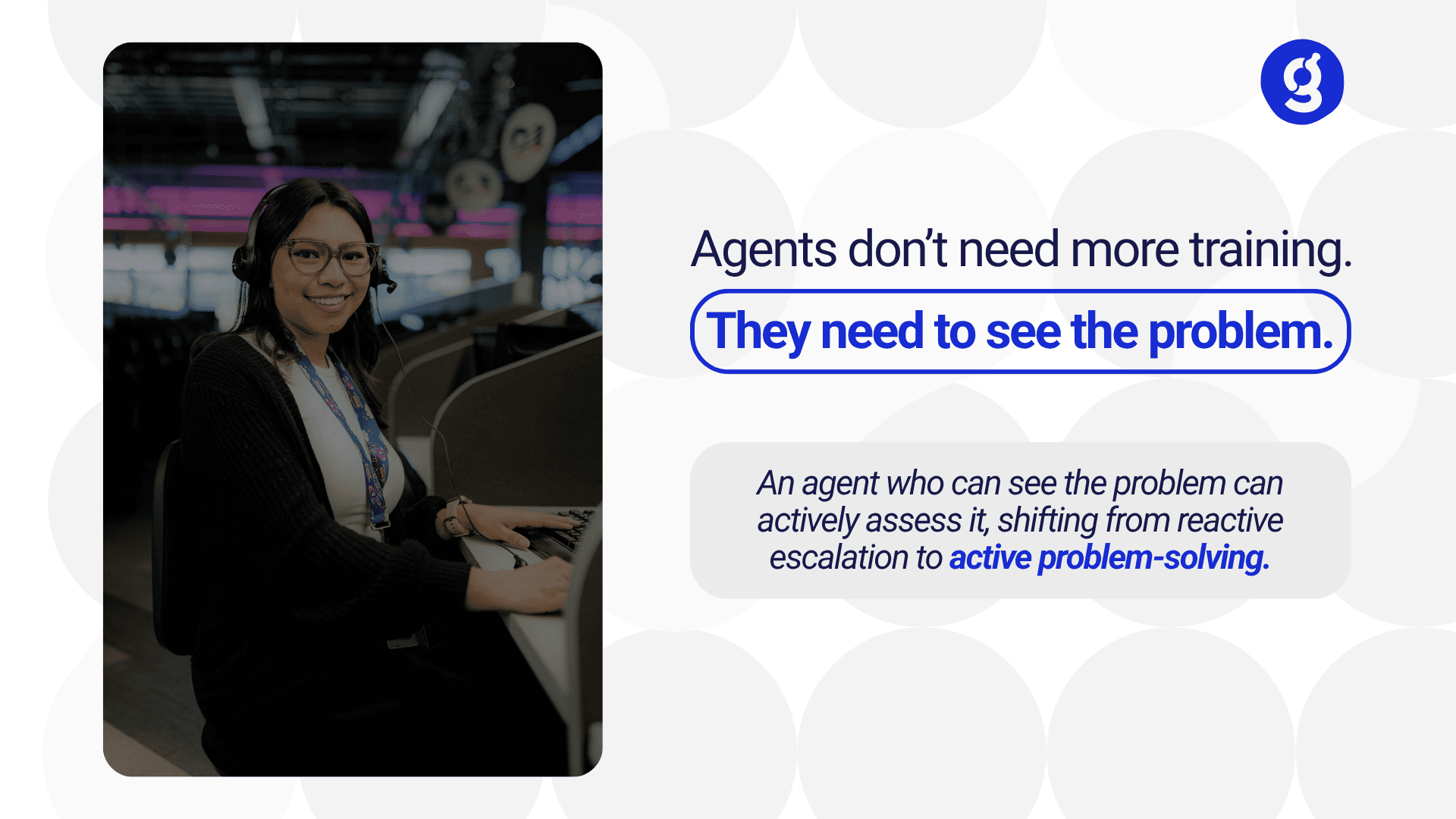
This initiative continues to develop. Future applications, such as plumbing diagnostics, common area assessments, and other unit-level issues, are already in scope. The early results demonstrate the model’s validity: a trained agent with the right visual channel can do what previously required a physical dispatch. The economics of maintenance resolution shift significantly when that capability becomes operational.
Technology and Automation: Tools That Convert
Technology multiplies the impact of CX operations by enabling the right action at the right moment while keeping a human option available for complex decisions. The objective is not automation for its own sake, but interactions that resolve faster and more accurately without sacrificing the customer relationship.
The two deployments in this article illustrate a key selection principle: effectiveness comes from matching the tool to the specific operational gap, not from deploying a broad platform upgrade.
GuruAssist addressed a conversion problem rooted in real-time agent decision-making, a gap that post-call coaching cannot close. RingCX video addressed a resolution problem rooted in the limits of voice-only communication, a gap that documentation alone cannot bridge. Both tools were deployed with precision, which is why both produced measurable results.
High-Impact Use Cases in Contact Center Operations
- Real-time agent guidance (GuruAssist) that surfaces rebuttals, compliance prompts, and next-best-action during live calls
- Video-assisted support (RingCX) that expands the channel toolkit beyond voice for diagnostic and visual assessment scenarios
- Automated QA flagging that identifies compliance gaps and coaching opportunities at scale across the entire call volume
- Intelligent call routing that connects the right customer to the right agent based on inquiry type and agent skill set
Measuring Technology Impact
Establish baselines for conversion rate, AHT, and resolution rate before deploying any new tool. Compare performance before and after at the call level, not just in aggregate. Use conversation analytics to confirm that improvements are behavioral rather than statistical noise. Monitor quality scores alongside efficiency metrics to confirm the tool is supporting agent performance rather than creating new friction.
Measurement and KPIs: Proving the Conversion Impact
Effective CX operations are measurable. Build a KPI framework that ties operational improvements to conversion outcomes. Both case studies in this article produced credible results because success was defined before the initiative began, not after the data came in.
Essential Metrics to Track
- Conversion rate at each funnel stage: inquiry-to-appointment, appointment-to-close, quote-to-signature
- Average Handle Time (AHT) is tracked before and after each operational change, with agent-level and call-type breakdowns.
- First-Contact Resolution (FCR) is critical for support-assisted sales and service efficiency.
- CSAT and NPS paired with conversion data by score segment
- Speed-to-lead and time-to-resolution for sales-assisted journeys
- Agent adherence to playbook and QA scores aligned to conversion-leading behaviors
Measurement Discipline and the Improvement Loop
Define metrics before launch, establish baselines, and review results on a fixed cadence. When performance data reveals a gap, a drop in conversion at a specific objection type, an AHT spike in a particular call category, the response is operational: update the playbook, adjust the guidance logic in GuruAssist, run a targeted coaching session. Confirm the lift before scaling the change. That discipline is what keeps a contact center improving after go-live rather than plateauing at initial performance levels.
Why The Office Gurus
The Office Gurus specializes in contact center operations that translate customer intent into measurable business outcomes. The Office Gurus’ approach combines proprietary AI technology, including the GuruAssist real-time agent guidance platform, with precision training design and a measurement-first deployment methodology.
Rather than deploying broad platform upgrades, The Office Gurus identifies the specific operational gap, selects the right tool for that gap, trains to a defined standard, and measures against pre-set KPIs. The results from the two case studies in this article: 9% conversion lift, 18% AHT reduction, and 80% video resolution rate are a direct example of how tech-enabled outsourcing improves CX performance.
Ready to Improve Your Contact Center Performance?
Whether your goal is higher conversion rates, reduced average handle time, or improved first-contact resolution, The Office Gurus combines AI-powered tools, proven training methodology, and operational expertise to get you there.
Frequently Asked Questions
What is CX operations optimization?
CX operations optimization is the practice of systematically improving contact center processes, agent tools, and performance management to achieve better business outcomes, typically measured by conversion rates, average handle time, first-contact resolution, and customer satisfaction. It requires aligning training, technology, and measurement to specific operational gaps rather than deploying generic improvements.
How can AI improve contact center conversion rates?
AI improves contact center conversion rates by providing agents with real-time guidance during live calls, surfacing the right rebuttal when an objection arises, flagging compliance gaps, and directing agents toward structured paths to close. The Office Gurus’ GuruAssist platform demonstrated a 9% increase in same/next-day appointment conversions by removing the in-call hesitation that was blocking enrollments for a childcare and early education provider.
How do you reduce average handle time without hurting customer experience?
The most effective way to reduce AHT without degrading experience is to remove the friction that inflates it: agent hesitation, off-script recoveries, and repeated explanations. Real-time AI guidance structures conversations so agents know exactly what to say at each stage. The result, as demonstrated in a TOG deployment, was an 18% reduction in AHT alongside a simultaneous improvement in conversion rate because both share the same root cause.
What role does video play in contact center support?
Video allows contact center agents to visually assess customer situations that cannot be accurately diagnosed through voice alone. In property management, RingCX video calling enables agents to see maintenance issues in real time and determine whether a technician dispatch is necessary, achieving an 80% resolution rate on video-assisted cases. Video shifts agents from passive documentation to active problem-solving, changing both the customer experience and the cost economics of service operations.
How does contact center performance improvement impact revenue?
Contact center improvements drive revenue in two directions: by increasing conversion rates on inbound opportunities and by reducing the cost per interaction. A 9% increase in appointment conversions means more enrollments and more closed deals. An 18% reduction in AHT means more interactions handled within the same cost structure. Together, these create measurable ROI from operational change, the kind that justifies continued investment in the operation.