


What Retail Customers Expect in 2026
(And Why Most Brands Aren’t Ready)
Retail customer expectations in 2026 extend far beyond fast shipping and polite service. Shoppers now demand effortless experiences across channels, transparent use of their data, and proactive support that fixes issues before they become problems. The stumbling block for most brands is not understanding these needs; it is delivering on them consistently and at scale across every program, every channel, and every peak-season surge.
At The Office Gurus, we work across dozens of retail and eCommerce programs, and the pattern is consistent: the brands that win aren’t the ones with the boldest CX vision, but the ones who’ve built the operational backbone to deliver scalable retail and eCommerce support. This guide distills what customers expect, where operations commonly break down, and how high-performing retailers prepare before peak season pressure hits.
Why Expectations Keep Climbing
Three forces are raising the bar quarter after quarter: a lasting shift toward value, a higher baseline for speed and personalization, and an execution gap that many organizations cannot close without rethinking processes.
Value-seeking is permanent: after years of economic uncertainty and price fluctuations, shoppers have adopted durable habits around deal hunting, price comparison, and clarity on total cost. They expect value across the entire journey: fair pricing, meaningful loyalty benefits, and easy returns. Discounts alone no longer win; perceived value now blends convenience, reliability, and quality of support.
Speed and personalization are table stakes: two-day shipping sets the floor. Today, customers expect same-day options in many markets, curbside pickup, and real-time inventory visibility. Personalization must be subtle and contextual: recommendations that reflect size and preferences, service that recognizes history across channels, and communications that respect frequency and channel choice. Generic experiences feel broken.
The expectation-to-delivery gap is widening: marketing and product teams often promise what operations cannot fulfill due to fragmented systems, outdated policies, and rigid staffing. Customers notice when promotions do not match availability, when agents lack visibility into orders placed on another channel, or when simple issues require multiple escalations. In our experience supporting retail programs through consecutive peak seasons, this gap, not a lack of strategy, is the leading cause of churn.
Trends Redefining Retail CX in 2026
The following shifts have moved from differentiators to standard expectations for top-performing retail brands.
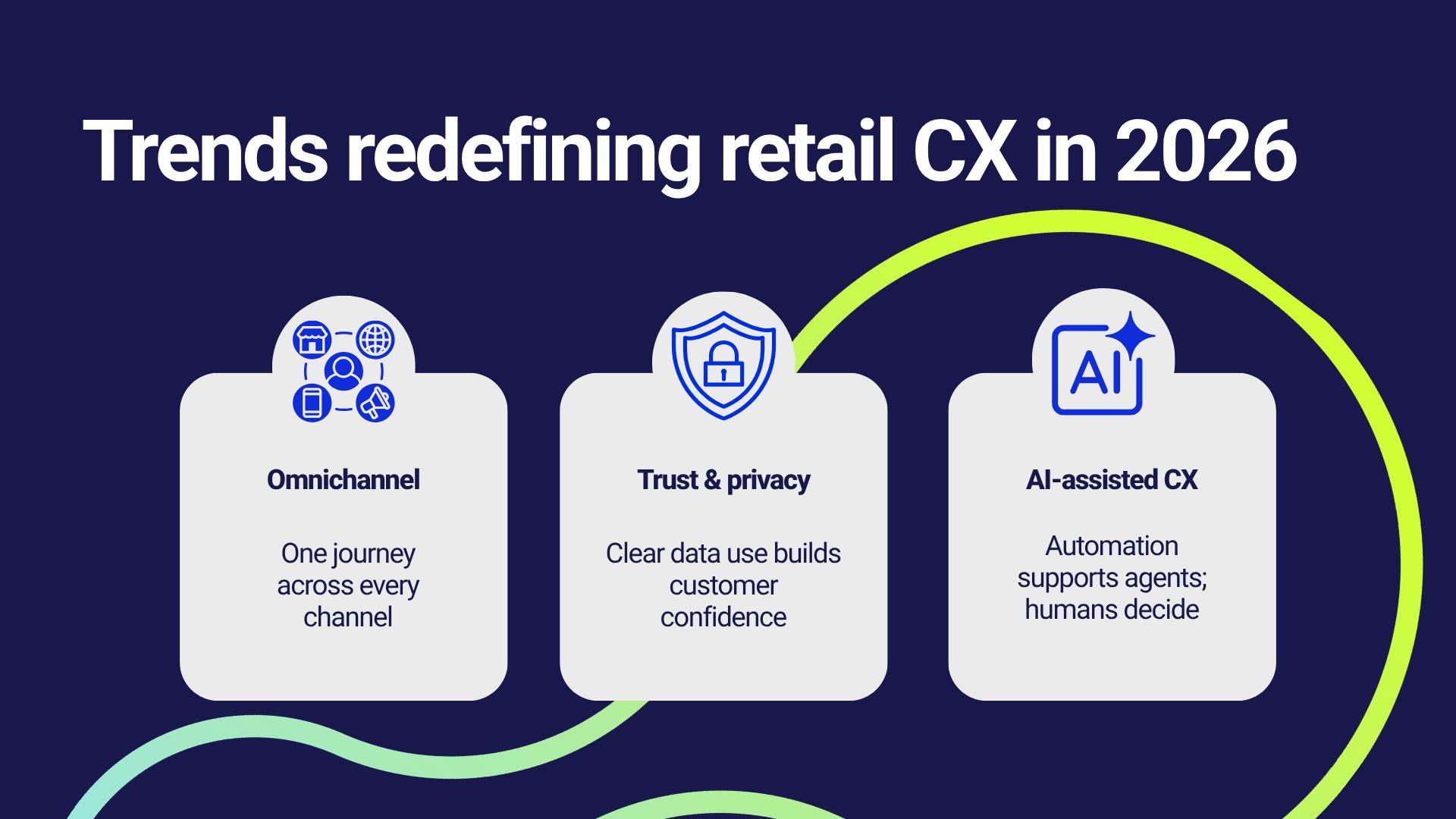
Omnichannel without friction: shoppers do not think in channels. They start on mobile, continue in-store, and finish via chat. They expect carts, preferences, promotions, and order status to follow them. Buy online, pick up in store (BOPIS), reserve online and try in store, and cross-channel returns are now baseline. If customers must repeat information or lose progress when switching channels, they encounter a friction point that has turned omnichannel support from a nice-to-have into a baseline requirement.
AI-assisted service with human oversight: the winning model pairs automation with empathy. AI handles repetitive tasks and knowledge retrieval; human agents take on complex or emotionally sensitive cases. Properly deployed, AI drafts responses, summarizes customer history, verifies policies, and surfaces next best actions, delivering faster, more consistent outcomes without sacrificing human judgment. Customers expect clear disclosure when they are interacting with AI and an easy path to a person.
Trust and data transparency as revenue drivers: consumers are increasingly privacy-aware and reward brands that earn trust. Clear explanations of what data is used and why, simple controls over communication frequency and channels, and visible security cues influence conversion. Personalization works best when customers see tangible benefits: better sizing guidance, more relevant offers, and confidence that their data is handled responsibly. That trust becomes especially fragile at moments like curbside or in-store pickup, where fraud-prevention tactics designed for click-and-collect can make or break the customer’s confidence in the transaction.
Where Retail Operations Typically Break Down
Even strong brands struggle with the operational backbone needed to meet 2026 expectations. Across the retail programs we support, the same pitfalls surface again and again, and they’re addressable.
Channel silos and poor real-time visibility: inventory, order management, customer profiles, and service interactions often live in separate systems. Without a unified, up-to-date view, agents cannot see store stock to fulfill backorders, marketing cannot target accurately, and customers get contradictory answers. Real-time synchronization, not batch updates, is essential during high-traffic periods.
Seasonal staffing gaps during predictable peaks: holidays, back-to-school, and tentpole promotions expose brittle staffing models. Hiring late, rushing training, and leaning on overtime lead to slow responses, higher error rates, and burnout. Demand surges are predictable; the failure lies in treating them as surprises rather than planned events.
Slow, reactive escalations: many teams rely on tiered handoffs and email queues for exceptions such as fraud checks, address changes, or split shipments. Customers feel the delays. Proactive triggers, clear ownership, and real-time collaboration reduce escalations and raise first-contact resolution.
Proactive triggers, clear ownership, and real-time collaboration reduce escalations and raise first-contact resolution. Returns are one of the clearest examples of this: handled reactively, they erode loyalty; handled well, they can become a driver of loyalty rather than a cost center.
How Top Retailers Prepare for Peak Seasons
Leaders do not merely survive Q4; they build resilience year-round and treat peak season like an orchestrated performance. The playbook focuses on workforce, technology, and metrics that tie CX to business outcomes.
Scale workforce capacity ahead of demand: capacity planning should begin well before major events, typically 90 to 120 days out, though the right window depends on program complexity and hiring lead times. Use historical performance, real-time signals, site traffic, marketing calendars, and pre-order velocity to forecast by channel, intent, and skill. Build flexible staffing pools with trained brand advocates, not just temp labor. Preboard seasonal agents with microlearning, product immersion, and shadowing so they are productive on day one. Deploy smart routing to match skills to intents, and flex specialists to high-risk areas like returns, sizing, and fulfillment exceptions.
Equip agents with AI copilots and targeted automation: give teams AI tools that auto-summarize customer history, propose policy-compliant resolutions, pre-fill forms, and draft personalized responses. Use AI-assisted self-service to handle FAQs, order status, address updates, and proactive alerts, with a clear, fast path to a human agent for anything more complex. Reserve human expertise for high-value or emotionally charged situations: damaged orders, fraud disputes, VIP outreach. This division lowers handle time, increases consistency, and improves satisfaction and lifetime value.
Measure what predicts loyalty, not just speed: average Handle Time and CSAT alone do not capture customer reality. High performers track:
- First Contact Resolution by intent
- Time to refund or replacement
- Resolution quality audits
- Agent effort (system hops per case)
- Customer Effort Score
- Promise Kept Rate (did we do what we said, on time)
- Revenue impact (save rates, assisted conversions, repeat purchase after service)
These metrics link CX to financial outcomes and encourage smarter trade-offs than shaving seconds off calls.
Practical Steps to Close the Expectation Gap
Translating strategy into execution requires concrete moves that improve visibility, responsiveness, and customer trust before the next surge.
- Unify order, inventory, and customer data for real-time visibility across channels.
- Standardize top intents with AI-assisted macros and guided workflows to reduce variability.
- Tighten escalation paths with clear ownership, service levels, and live collaboration tools.
- Preboard seasonal teams with targeted microlearning and sandbox practice using real scenarios.
- Run live-fire rehearsals using last year’s peak events and adjust staffing by intent and channel.
- Publish transparent policies for shipping, returns, and data use, then enforce them consistently.
Lessons from Real Retail Operations
Frameworks only prove their value when they hold up under real pressure. One fast-scaling eCommerce brand offers a clear example of what happens when staffing, training, and quality come together under strain and what changes when they don’t.
The challenge: as the brand’s support volume grew quickly, its entire model depended on live agents, leaving little room for inconsistency. New agents took up to two months to ramp up, performance gaps widened, and the delay was starting to show up in customer satisfaction scores.
The approach: rather than adding headcount and hoping ramp-up would sort itself out, the team introduced a unified approach to quality and training built specifically for speed and consistency: agents received real-time feedback during live interactions, leadership gained clear visibility through weekly and monthly dashboards, and refresher training targeted the exact areas where performance gaps kept resurfacing.
The result: the shift was fast, and it held. Support tickets dropped by 66%. Quality scores held strong at 97%. Customer satisfaction consistently exceeded target.
The lesson mirrors the framework above: scaling support doesn’t have to come at the cost of quality; with the right visibility and training in place, it can actually improve it.
Watch how this approach played out in practice in this video:
Peak Season Readiness Checklist
| Area | Must-Have Capability | Proof It Works |
| Data & Systems | Unified profiles, orders, and inventory with real-time sync | Agents can see store and DC availability and complete cross-channel returns |
| Workforce | Forecasting by intent and channel; flexible staffing pools | Service levels hold during surges without overtime spikes |
| Automation | AI copilots for agents; virtual agents for routine tasks | Higher FCR and lower handle time for top intents |
| Escalations | Real-time collaboration and clear ownership paths | Reduced handoffs and faster exception resolution |
| Trust & Compliance | Transparent data practices and preference controls | Higher opt-in rates and improved conversion for personalized offers |
Use this checklist to guide your peak-season readiness, whatever the season ahead brings.
The checklist above is a snapshot; a fuller picture takes a closer look across all six operational areas that determine peak-season readiness. Download the Retail CX Readiness Checklist for a complete self-assessment you can run with your team in under five minutes, plus a scoring guide to help you prioritize what to fix first.
Final Thoughts: Prepare Before Peak Begins
Peak readiness is not a Q4 scramble; it is an operating posture. Brands that win in 2026 invest early in unified data, scalable staffing, and AI that augments people. They make trust visible, manage demand proactively, and measure what truly drives loyalty. The payoff is not just lower cost to serve. It is customer confidence that compounds into repeat purchases, higher lifetime value, and stronger word-of-mouth. That confidence doesn’t end at checkout; it carries through fulfillment and post-purchase support, where turning logistics friction into customer loyalty becomes its own competitive advantage.
Start now, test often, and treat every peak as a rehearsal for the next one. At The Office Gurus, we help retail and eCommerce brands build the operational backbone behind these expectations, combining experienced, AI-assisted agents with the workforce flexibility and real-time visibility that peak seasons demand. Whether you’re evaluating your current CX operation or preparing for the next major demand spike, our team can help you identify gaps before your customers do. Connect with The Office Gurus to start the conversation.
Frequently Asked Questions
What drives retail customer expectations in 2026?
Shoppers expect frictionless omnichannel experiences, personalized assistance, fast fulfillment with accurate inventory, and transparent data practices. They also value proactive support that prevents issues, not just reactive fixes.
How should retailers balance AI and human support without eroding trust?
Disclose when AI is used, provide an easy path to a person, and ensure AI recommendations follow policy and reflect context. Use automation to accelerate routine work so humans can focus on complex, emotional, or high-value interactions.
Which metrics best predict loyalty during peak seasons?
First Contact Resolution by intent, Promise Kept Rate, Customer Effort Score, time to refund or replacement, and assisted conversion rate are strong predictors. Track them alongside CSAT and operational metrics for a complete view.
What quick wins can teams deliver before the next big event?
Unite order and inventory data for real-time visibility, deploy AI-assisted macros for top intents, streamline escalations, preboard seasonal agents with targeted microlearning, and run a live-fire rehearsal using last year’s peak scenarios.