


Customer support leaders are heading into 2026 balancing tighter budgets, wage inflation, and rapid adoption of AI-enabled operations. This guide presents practical customer support cost benchmarks for 2026 by channel, industry, and region, and explains the drivers behind those costs. You will also find strategies to optimize spend without diminishing the customer experience, along with a clear framework for measuring ROI. Use these insights to calibrate plans, build defensible budgets, and align stakeholders around data-driven targets.
Understanding Customer Support Costs
Customer support costs are the fully loaded expenses required to deliver service across every customer-facing channel. This includes far more than hourly wages. A complete view enables apples-to-apples comparisons across teams, channels, and providers and provides a reliable foundation for any customer service cost-per-contact or call center cost benchmark you plan to use in 2026.
Core cost components:
- Labor: Wages, benefits, incentives, overtime, payroll taxes.
- Technology: Contact center platform, CRM, telephony, AI/automation, analytics, knowledge tools, licenses.
- Training and onboarding: Initial training, nesting, certification, and ongoing enablement.
- Management and operations: Team leads, workforce management, scheduling, reporting, planning.
- Quality assurance: QA analysts, scorecards, calibrations, and coaching time.
- Shrinkage: Paid time off, holidays, absenteeism, coaching, meetings, system downtime.
- Facilities and equipment: Office space, where applicable; WFH stipends; devices; security and compliance controls.
Common ways to track and benchmark costs:
- Cost per contact: Total cost divided by the number of interactions within a specific channel.
- Cost per ticket or case: Total cost divided by the number of cases resolved, often spanning multiple contacts.
- Cost per FTE or agent: Fully loaded monthly or annual cost per support representative, including overhead and benefits.
A precise definition of the cost of customer support ensures realistic staffing and service levels, informed channel-mix decisions, credible ROI analysis for automation and training, and direct comparability with peers and prior years. Strong customer service reporting metrics help you benchmark customer service accurately and maintain alignment as you scale.
2026 Customer Support Cost Benchmarks

Support economics differ across sectors, channels, geographies, and issue complexity. The following ranges reflect customer support cost benchmarks for 2026 planning targets observed across mid-market and enterprise operations in North America, with notes on variability by service level and industry. Use these ranges as a customer service cost-per-contact benchmark and to cross-check call center cost benchmarks when setting targets.
Industry Averages (Cost per Contact, Fully Loaded)
| Industry | Voice | Chat | Self-service | |
| E-commerce and Retail | $7–$12 | $4–$7 | $5–$9 | $0.10–$0.40 |
| SaaS and B2B Software | $12–$20 | $6–$10 | $8–$14 | $0.20–$0.60 |
| Fintech and Financial Services | $10–$18 | $6–$10 | $7–$12 | $0.20–$0.50 |
| Telecommunications | $8–$14 | $5–$8 | $6–$10 | $0.15–$0.50 |
| Healthcare and Insurance | $12–$22 | $7–$11 | $8–$15 | $0.20–$0.70 |
| Travel and Hospitality | $9–$16 | $5–$9 | $6–$11 | $0.15–$0.50 |
Benchmarks by Channel (Cross-Industry, Blended)
- Voice: $9–$16 per contact. Wide variance due to handle time, compliance, authentication, and language coverage. White-glove or technical queues can exceed $20.
- Live chat and messaging: $5–$9 per contact. Concurrency and automated triage drive the lower end.
- Email or ticket: $6–$11 per case. Influenced by first-response quality, back-and-forth, and knowledge maturity.
- Social and messaging apps: $5–$10 per thread. Moderation and brand risk management can add overhead.
- Self-service (help center, bots, IVR containment): $0.10–$0.60 per successful resolution. Requires ongoing investment in content, training data, and analytics.
Regional Cost Differences
Geography shapes customer support costs through wage levels, language expertise, compliance requirements, and automation maturity.
- United States and Canada: Higher fully loaded labor and benefits. Voice contacts often run 10–25 percent above global averages.
- Nearshore (e.g., El Salvador, Belize, Dominican Republic): Typically 15–35 percent lower cost per contact than U.S. domestic, with strong English skills and time zone alignment.
- Offshore (e.g., Philippines, India, parts of Eastern Europe): Often 35–60 percent lower than U.S. domestic for chat and email. Savings can be compressed for complex technical or regulated support due to additional training, QA, and compliance requirements.
How 2026 Compares to Prior Years
- Labor: 3–7 percent year-over-year increases from wage inflation and competition for experienced agents.
- AI impact: 10–25 percent reductions in cost per contact in channels with effective triage and agent-assist, especially chat and email.
- Channel mix: Voice share down 3–8 percentage points in mature programs, lowering blended cost per contact by 5–12 percent despite wage pressure.
These customer support cost benchmarks for 2026 reflect a market in which cost-effective customer support strategies increasingly rely on automation and precision staffing. Treat them as directional guides, then validate them against your customer service reporting metrics to ensure they fit your operation.
Factors Influencing Customer Support Costs
Several levers determine where your costs land within the ranges above. The most powerful drivers relate to technology, customer expectations, and workforce dynamics. Understanding these inputs transforms customer service costs from a fixed burden into a controllable set of investments.
Technology Adoption
- AI routing and triage classify intents, gather context, and deflect simple requests, reducing agent-handled volume.
- Agent-assist tools shorten handle time by suggesting replies, surfacing knowledge, and automating wrap-up tasks.
- Knowledge management raises self-service success and decreases repeat contacts when content is centralized, maintained, and measured.
Results depend on execution quality. Well-tuned AI lowers customer support costs while preserving satisfaction; poor tuning increases escalations and repeat contacts, eroding savings. As you benchmark customer service, examine intent-level performance and validate to spot gaps early.
Customer Expectations and Policies
- Customers expect fast response, channel choice, and first-contact resolution.
- Higher expectations raise training and quality costs, but improved first-contact resolution lowers total cost to serve.
- Unclear policies and exceptions lead to rework, longer cycles, and higher unit costs.
Workforce and Market Trends
- Labor markets in major metros can lift wages, pushing hiring to nearshore and offshore hubs for specific workloads.
- Hybrid work reduces facilities expense but increases investment in security, tooling, and performance monitoring.
- Seasonality and promotions reward flexible staffing, cross-training, and proactive capacity planning.
These forces shape call center cost benchmarks and should be reflected in your customer service reporting metrics so leaders can act quickly as conditions change.
In-House vs. Outsourced Support: Cost Comparison
Choosing between internal teams and an outsourcing partner comes down to fully loaded cost, flexibility, quality control, and the complexity of your operations. A side-by-side look helps determine where each model fits best and how it affects your customer service cost-per-contact benchmark.
Typical Fully Loaded Cost per FTE per Year (2026)
| Model | Annual Cost per FTE | Notes |
| In-house (U.S. domestic) | $55,000–$80,000 | Includes wages, benefits, payroll taxes, equipment, licenses, training time, and management overhead. |
| Outsourced nearshore | $35,000–$55,000 | Varies by country, skill, and language. Often strong value for chat and email, with favorable time zones. |
| Outsourced offshore | $28,000–$45,000 | Greater savings in written channels and structured work; additional oversight may be required for regulated flows. |
Where Outsourcing Reduces Cost
- Elastic coverage for peaks, promotions, and seasonality reduces overtime and idle time.
- Shared infrastructure and tooling lower per-agent technology expense.
- Established training and QA frameworks accelerate time-to-competency and reduce early attrition.
- Multilingual and 24/7 coverage at scale is more economical through specialized providers.
Many programs achieve 15–40 percent lower cost per contact via outsourcing, particularly in chat and email. This can materially reduce customer support costs while maintaining quality when guided by strong customer-experience benchmarking and disciplined governance.
When In-House May Be Preferable
- Deep technical support requiring extensive product context and rapid iteration.
- Heavy compliance and security requirements that increase vendor oversight costs.
- Small volumes or frequent policy changes that reduce efficiency gains from scaling.
A hybrid model is common: maintain a core internal team for complex, high-context issues and feedback loops, while using a trusted partner for scale, after-hours, and multilingual coverage. This blend often delivers cost-effective customer support strategies that align with call center cost benchmarks without sacrificing control.
Measuring the ROI of Customer Support Investments
To justify investments and prioritize initiatives, connect spend to measurable outcomes. Establish baselines, set targets, and track impact over time to quantify returns. Your customer service reporting metrics are the compass that ensures customer support costs translate into real-world results.
Key Performance Indicators
- Cost per contact by channel and intent.
- Average handle time (AHT) and time to resolution.
- First-contact resolution (FCR) and reopen/repeat-contact rates.
- Deflection and containment for self-service and automation.
- Service level and response-time adherence.
- Customer satisfaction and NPS impact on retention and revenue.
- Shrinkage, occupancy, and schedule adherence to understand staffing efficiency.
How to Calculate ROI
- Automation and AI: Calculate reduced agent-handled contacts multiplied by pre-automation cost per contact, plus handle time reductions on remaining contacts, minus technology and implementation costs.
- Training and quality: Quantify improvements in FCR and AHT, convert to labor hours saved, and account for lower rework and escalations.
- Channel shift: Multiply shifts in mix (e.g., moving 5 percent of voice to chat) by the cost delta per contact to show blended savings.
Always include change management, governance, and maintenance to avoid overstating benefits. Tie improvements directly to your customer service cost per contact benchmark and validate them against customer support cost benchmarks 2026 to maintain credibility with finance and operations teams.
Illustrative Example
If chat AHT drops from 9 to 7 minutes across 300,000 annual chats and labor costs run $0.60 per minute, labor savings approximate $360,000 annually before tool costs. If deflection rises by 6 percent, eliminating 100,000 agent-handled contacts at $6.50 each yields $650,000 in avoided costs, net of platform and content operations spend. Document these gains in your customer service reporting metrics to reinforce the link between customer support costs and targeted, cost-effective strategies.
Strategies to Optimize Customer Support Costs
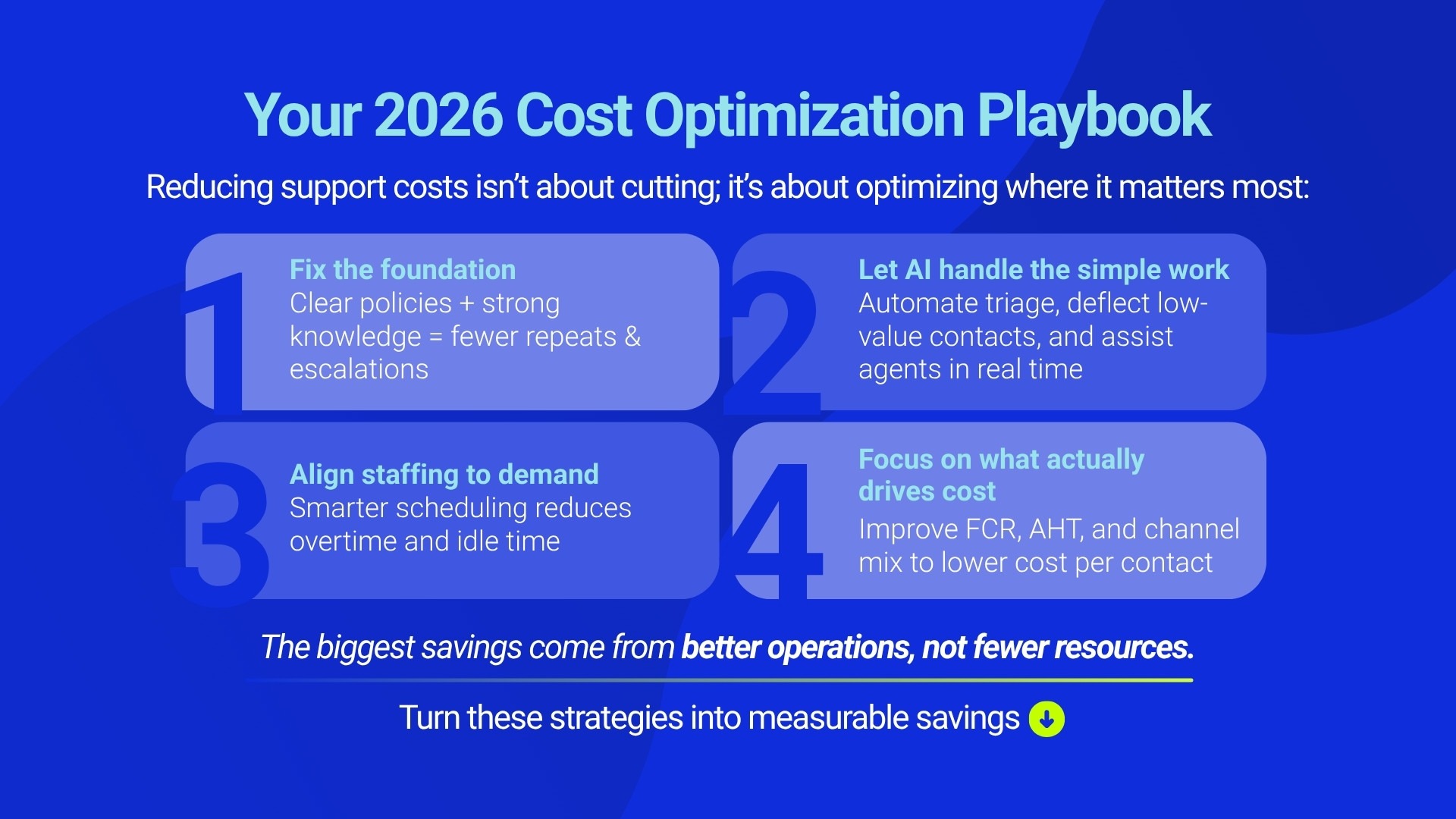
Reducing spend while maintaining or improving customer experience requires process discipline, targeted technology, and strong workforce practices. The right sequence is to stabilize processes, elevate knowledge, introduce AI where it delivers clear value, and align staffing to demand.
Operational Best Practices
- Simplify policies and empower agents for one-touch resolution to cut repeats and escalations.
- Standardize case categorization and dispositioning to improve forecasting, staffing, and content prioritization.
- Strengthen knowledge management with single-source content, clear ownership, and regular review cycles.
- Optimize schedules using workforce management to align staffing to interval-level demand and reduce overtime.
Technology for Cost Efficiency
- AI triage and routing to classify intents, capture context up front, and guide customers to the right path.
- Agent-assist for next-best actions, suggested replies, and knowledge surfacing to reduce handle time and errors.
- High-quality self-service content and conversational automation with seamless handoff to agents when needed.
- Systems integration to minimize swivel-chair work, cut wrap time, and boost accuracy.
Balancing Cost and Customer Experience
- Set channel-specific service levels based on issue value and urgency, prioritizing revenue-impacting contacts.
- Track both cost per contact and FCR to avoid shortcuts that harm satisfaction.
- Monitor repeat-contact and escalation rates to validate that automation is resolving problems rather than deflecting them.
These are cost-effective customer support strategies that keep costs under control while strengthening trust. Reinforce them through customer experience benchmarking to ensure that changes deliver real value for customers.
Training and Retention
- Structured onboarding with clear skill progression and competency checkpoints.
- Nesting and ongoing coaching to accelerate proficiency and quality.
- Soft skills training for de-escalation and clear written communication.
- Career paths and recognition programs to reduce attrition.
Turnover is a hidden cost driver. Every 10 percent reduction in annual attrition can save thousands per FTE in recruiting, training, and productivity losses. Make these savings visible in your customer service reporting metrics and compare them against call center cost benchmarks to emphasize the impact.
Future Trends Shaping Support Costs
By late 2026, cost structures will diverge based on how effectively organizations operationalize AI and analytics. Those that succeed will see blended cost per contact fall even amid wage pressure. Those that lag will face rising costs and inconsistency as expectations outpace capacity. The most resilient teams will marry customer support cost benchmarks with practical execution and relentless measurement.
Projected Expense Patterns
- Higher investment in AI tooling, model governance, prompt and content operations, offset by lower agent-handled volume and faster handle times.
- Moderate wage increases, especially for experienced agents who handle complex escalations and supervise AI-assisted workflows.
- Expanded analytics and intent-level cost modeling to inform precise channel and policy decisions.
Technologies Reshaping Cost
- Retrieval-augmented generation for accurate, grounded responses in self-service and agent-assist.
- Real-time summarization and automated disposition to reduce after-call work and errors.
- Proactive outreach and alerts that prevent inbound contacts by addressing known issues.
- Voice AI handling narrow intents and augmenting agents with live guidance in high-volume environments.
Regulatory Considerations
- Data privacy requirements drive stricter controls, audit trails, and role-based access in AI workflows.
- Accessibility standards may mandate inclusive self-service design and alternative contact methods.
- Industry-specific compliance elevates training and QA needs, adding cost but reducing risk and rework when embedded in processes.
As these trends mature, revisit your customer service cost-per-contact benchmark to reflect new realities and stress-test it against customer support cost benchmarks for 2026 in your sector.
Frequently Asked Questions
Q: What is a good cost per contact?
For blended support across channels, a common 2026 target is $5–$9 per contact. Channel-level benchmarks typically fall at voice $9–$16, chat $5–$9, email $6–$11, and self-service $0.10–$0.60 per successful resolution. Calibrate for issue complexity, languages, compliance, and service-level commitments. Use these figures as a working customer service cost-per-contact benchmark and validate against your own customer service reporting metrics.
Q: How do I reduce support costs without hurting CX?
- Lift first-contact resolution with cleaner policies, improved knowledge, and agent-assist to cut repeats and escalations.
- Deploy AI triage and routing to direct simple intents to automation and ensure complex issues reach the right experts.
- Adopt channel strategies that match urgency and value, prioritizing live support for high-impact issues.
- Track FCR, repeat-contact rate, and CSAT, alongside cost per contact, to verify that savings do not come at the expense of the experience.
Q: How much should a SaaS company spend on support?
In 2026, many SaaS teams see cost per contact at $12–$20 for voice, $6–$10 for chat, $8–$14 for email, and $0.20–$0.60 for self-service. As a share of revenue, support operating expense varies widely by product complexity and growth stage, but a common planning range is 4–8 percent of ARR for mid-market SaaS with a mix of assisted and self-service. Mature SaaS companies with effective knowledge, community, and AI-enabled support often trend toward the lower end by shifting volume to deflection and improving FCR. Align these targets with call center cost benchmarks and your internal customer service reporting metrics to avoid over- or under-investing.
Q: How do I benchmark my team if our issues are more complex?
Segment your contacts by intent complexity (simple, moderate, complex), then compare cost per contact, FCR, and AHT within each band. This normalizes differences in product and customer mix and provides a fair comparison against peers or outsourcers. Pair this with customer experience benchmarking to ensure your customer service targets account for quality, not just speed.
Q: What is the most reliable way to lower the cost per contact without hurting CSAT?
Focus on FCR with strong knowledge management, clear policies, and agent-assist. Then apply AI triage to route the right work to the right channel. Monitor repeat and escalation rates to validate quality. Record improvements in your customer service reporting metrics to demonstrate sustained reductions in the cost of customer support.
Q: How should I calculate the fully loaded cost per agent?
Include wages, benefits, payroll taxes, equipment, telephony, and software licenses, training time, QA and management overhead, facilities or WFH stipends, and expected shrinkage. Divide the total monthly cost by productive hours to get an effective hourly rate, then map to cost per contact by channel based on AHT and concurrency. These inputs ensure that your customer service cost-per-contact benchmark remains credible over time.
Pulling It All Together

Customer support cost benchmarks for 2026 reflect two truths: labor remains the largest expense, and AI-driven operations are reshaping the unit economics of service. With clear definitions, channel and industry benchmarks, and a plan to measure ROI, leaders can target the right mix of in-house and outsourced resources, modernize processes, and deploy automation that reduces cost while protecting customer experience. The winners will combine disciplined operations with targeted technology and flexible staffing to deliver lower cost per contact and higher satisfaction at scale.
Anchor your planning in customer service reporting metrics, validate against customer experience benchmarking, and treat call center cost benchmarks as guideposts rather than limits. When you benchmark customer service rigorously and act with purpose, you build a resilient operation that controls customer support costs and advances the customer experience.
Turning benchmarks into results requires more than insight; it takes the right strategy, tools, and execution model. If you’re looking to reduce costs while maintaining (or improving) customer experience, aligning your operation with proven benchmarks and best practices is critical. The right partner can help you accelerate that transformation while minimizing risk.
Ready to optimize your customer support costs? Let’s talk.