


Outsourcing customer experience is rarely just an operational decision; it’s a transition that directly affects customer trust, brand perception, and business continuity.
And contrary to what many companies expect, success is not determined by contract signing. It’s determined in the first 90 days.
This is the period where systems are integrated, teams are trained, workflows are tested, and service stability is either protected or disrupted. Companies that approach the transition strategically often achieve faster response times, higher customer satisfaction, and more scalable support operations. Companies that typically don’t struggle with inconsistent service, internal misalignment, or longer ramp times.
In most successful transitions, the first 90 days follow three clear phases:
- Onboarding and knowledge transfer
- Operational stabilization
- Optimization and performance improvement
Here’s what that process really looks like and what separates successful CX outsourcing partnerships from failed ones.
The First 90 Days of CX Outsourcing
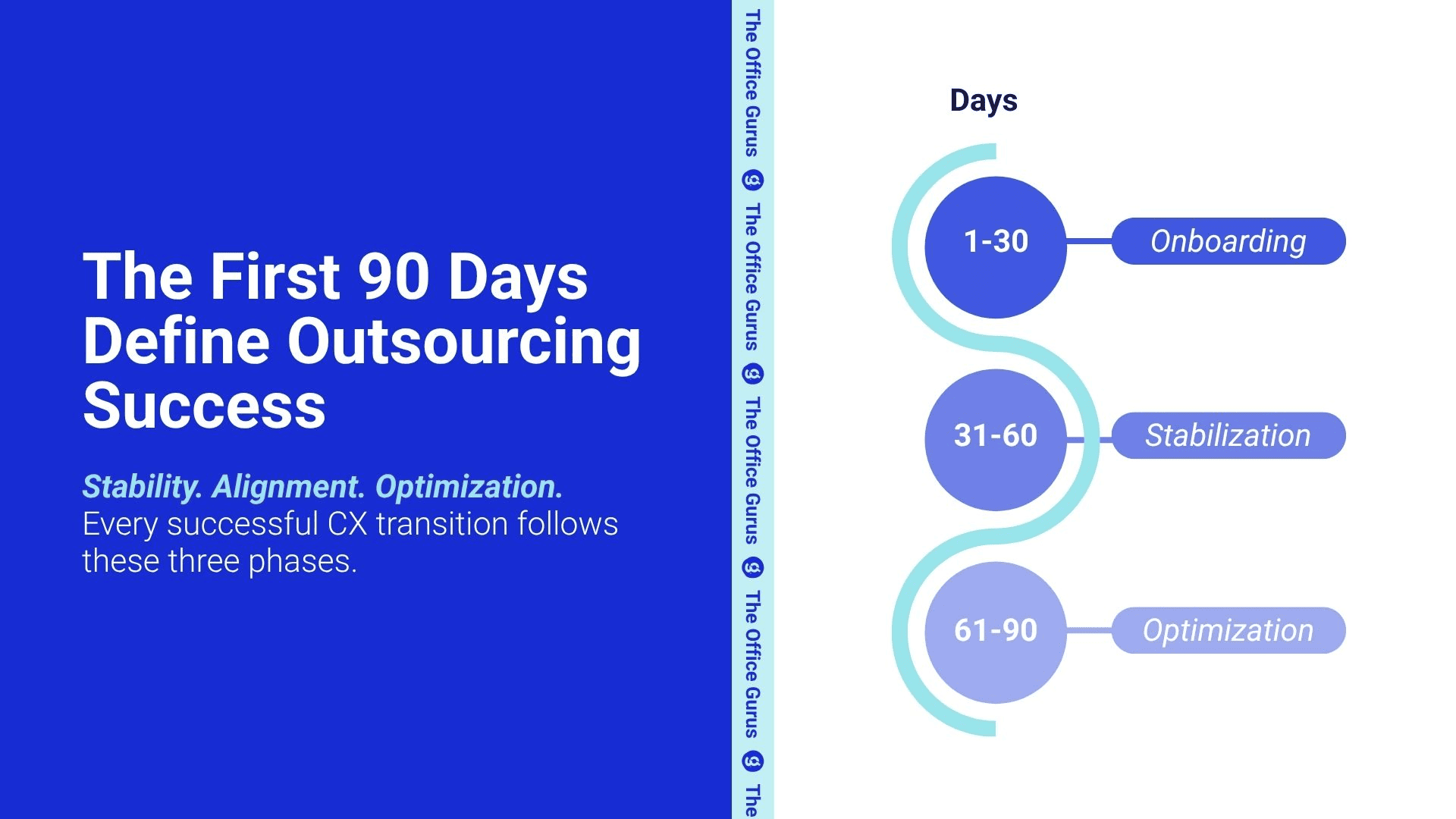
The first 90 days of customer experience outsourcing typically focus on three stages:
- Days 1–30: onboarding, system access, training, and knowledge transfer
- Days 31–60: operational stabilization, QA alignment, and KPI tracking
- Days 61–90: optimization, automation, reporting, and continuous improvement
Successful CX transitions depend on structured onboarding, clear governance, workforce readiness, and ongoing performance optimization, not just staffing. Mature outsourcing partners also introduce AI-assisted workflows, automated QA, and real-time support tools to improve efficiency and customer outcomes early in the engagement.
What Companies Expect vs. What Actually Happens
Many companies assume that outsourcing customer support is primarily about reducing costs or quickly adding headcount.
In reality, the transition is far more operational.
The first 90 days involve:
- Knowledge transfer
- Process mapping
- QA calibration
- Workflow redesign
- Systems integration
- Workforce ramping
- Escalation planning
- Customer communication
- Reporting alignment
The goal is not simply to “move support elsewhere.” The goal is to build a stable operational extension of your brand.
This is also where many outsourcing initiatives either succeed or fail. Companies that underestimate the complexity of onboarding often experience inconsistent service quality, slow response times, and internal frustration during the transition period.
Strong CX outsourcing partners reduce that risk through structured implementation plans, defined governance, phased production rollouts, and continuous optimization frameworks.
Days 1–30: Onboarding and Knowledge Transfer
The first month focuses on establishing operational stability while minimizing customer disruption.
This phase includes onboarding, access provisioning, training, workflow documentation, and early production support.
Governance and Access Setup
The transition typically begins with:
- Legal and compliance reviews
- SLA alignment
- Secure system access
- Escalation planning
- Communication workflows
A mature CX partner establishes governance quickly so both teams understand responsibilities, reporting structures, and decision-making processes from day one.
Security protocols such as MFA, encrypted access, audit trails, and least-privilege permissions are also implemented early to protect customer data and maintain compliance standards.
Discovery and Knowledge Transfer
During the first two weeks, teams work together to map:
- Customer journeys
- Common contact drivers
- Escalation paths
- Support workflows
- Existing service gaps
This is where operational context becomes critical.
Successful transitions rely heavily on:
- SME shadowing
- Ticket and call reviews
- Playbook creation
- Process documentation
- Live workflow walkthroughs
The goal is not only to transfer information, but also to transfer judgment, tone, and brand expectations.
Early Stabilization
By weeks three and four, outsourced teams usually begin handling a controlled percentage of customer interactions under close supervision.
This phase often includes:
- Daily operational standups
- QA reviews
- Escalation monitoring
- Coaching feedback loops
- Macro and workflow optimization
Quick wins during this stage may include:
- Improving knowledge base articles
- Simplifying ticket routing
- Refreshing support templates
- Reducing repetitive manual tasks
By the end of the first month, the foundation for stable operations should already be in place.
Days 31–60: Stabilization and Operational Alignment
Once onboarding is complete, the focus shifts toward consistency, scalability, and operational control.
This is where outsourcing moves from setup mode into production performance.
Role-Specific Training and Certification
Training expands beyond onboarding into operational mastery.
Agents typically receive:
- Product and policy training
- Soft skills coaching
- De-escalation training
- Channel-specific guidance
- QA calibration support
Certification checkpoints help ensure that agents move into full production only after meeting defined quality thresholds.
At the same time, team leaders and supervisors begin implementing:
- Coaching cadences
- Performance management workflows
- QA reviews
- Live feedback sessions
Technology Integration and Reporting
The second month is also when deeper system integrations are finalized.
This may include:
- CRM integrations
- Ticketing workflows
- Telephony connections
- Knowledge base synchronization
- Reporting dashboards
Operational visibility becomes increasingly important during this stage.
Most organizations begin tracking:
- First contact resolution
- Response times
- QA scores
- Average handle time
- Backlog health
- Customer sentiment trends
By the end of month two, outsourced teams should be approaching full production capacity with KPI baselines established and performance becoming predictable.
Days 61–90: Optimization and Performance Improvement
After stabilization comes optimization.
This is the phase when companies begin to identify measurable improvements in both customer experience and operational efficiency.
Structured QA and Coaching
Successful CX operations rely on continuous calibration.
By month three, most mature outsourcing programs have:
- Formal QA scorecards
- Calibration sessions
- Coaching plans
- Escalation trend analysis
- Customer sentiment reviews
Performance improvement becomes increasingly data-driven rather than reactive.
Reporting and Operational Insights
Executive reporting also becomes more strategic during this stage.
Instead of focusing only on operational metrics, organizations begin connecting CX performance to broader business outcomes such as:
- Retention
- Churn reduction
- Repeat purchase behavior
- Expansion opportunities
- Customer loyalty
Trend analysis helps uncover:
- Recurring customer pain points
- Product or policy issues
- Avoidable contact drivers
- Staffing inefficiencies
This creates a continuous improvement loop that allows support operations to evolve over time.
How AI Changes the First 90 Days
Modern CX outsourcing is no longer driven only by staffing. Increasingly, the first 90 days also include AI-enabled workflows that improve speed, consistency, and agent performance.
Mature CX partners now deploy technologies such as:
- AI-powered agent assist
- Automated quality assurance
- Real-time guidance
- Intelligent routing
- Virtual agents for verification and FAQs
- AI insights and analytics
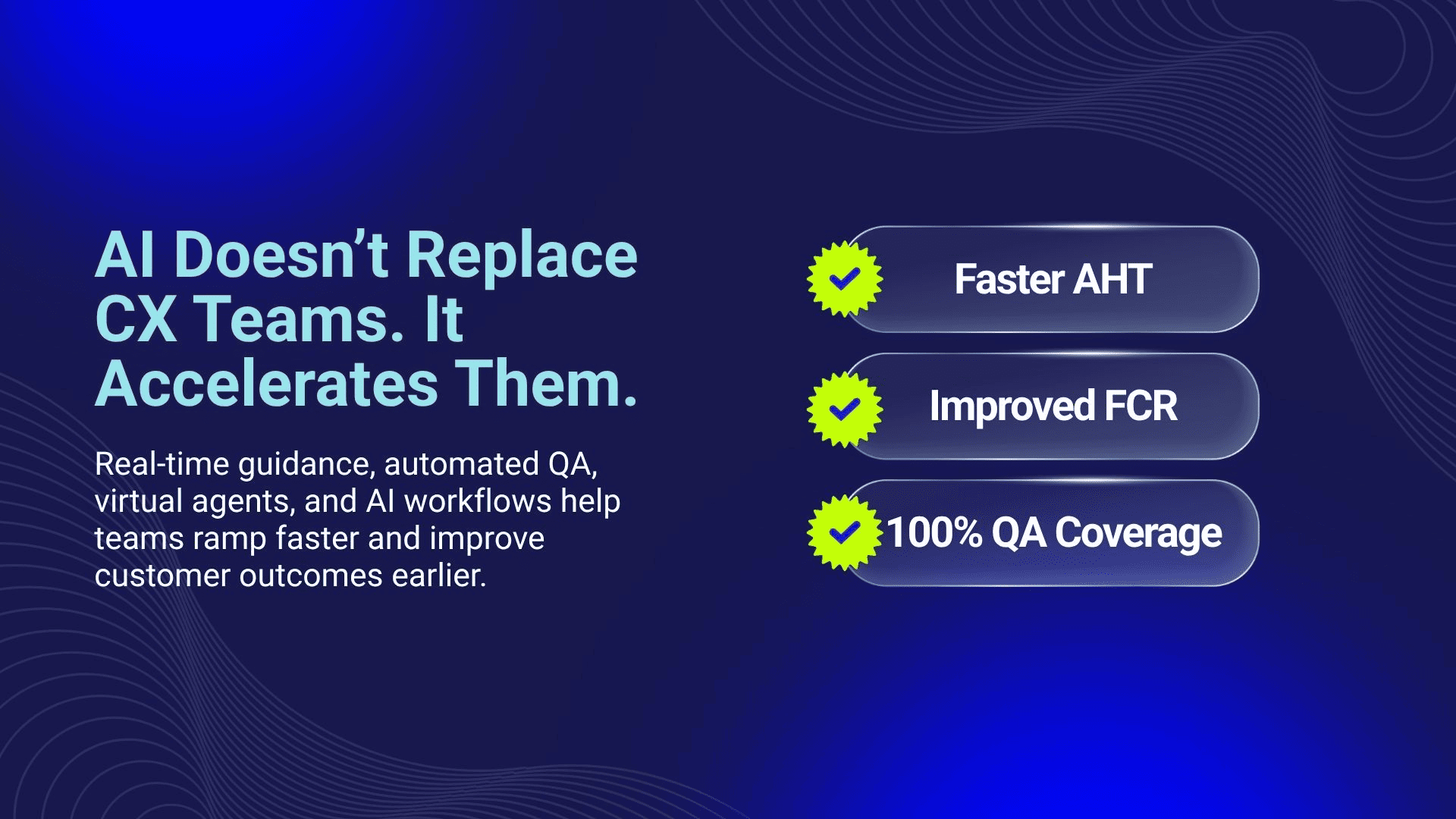
These tools help reduce average handle time, improve first-contact resolution, and increase agent capacity without sacrificing the customer experience.
For example, AI-assisted onboarding programs can:
- Automate repetitive after-call work
- Surface next-best actions for agents in real time
- Provide 100% QA coverage on pilot interactions
- Reduce verification errors during customer authentication
- Accelerate training and ramp timelines
Virtual agents can also handle repetitive opening workflows such as greetings, verification, and account lookup before seamlessly transferring customers to live agents. This allows human agents to focus more directly on issue resolution while improving efficiency during high-volume periods.
Some organizations also implement technologies such as accent smoothing, real-time translation, and AI-assisted coaching to improve communication clarity and customer satisfaction during early ramp-up phases.
The result is a faster stabilization period, stronger operational consistency, and a smoother customer transition overall.
What Determines Success in CX Outsourcing
Clear metrics and a forward-looking plan ensure the transition delivers value quickly and continues to improve. Use 30/60/90-day checkpoints to guide decisions and investments, especially if you are scaling global CX outsourcing.
30/60/90-Day Success Metrics
| Checkpoint | Primary Focus | Example Metrics | Typical Targets |
| Day 30 | Stabilization | Credentialing completion, knowledge base coverage, training graduation rate, response time trend, and early error rate | Access 100% complete; 80%+ core KB coverage; response times trending toward SLA; error rate declining week over week |
| Day 60 | Efficiency and Consistency | Service level attainment, first contact resolution, QA pass rate, backlog health | SLAs met on core channels; FCR improving; 80–85% QA pass; backlog within plan |
| Day 90 | Customer Impact and Quality | CSAT, NPS (if applicable), repeat contact rate, reduction in top contact drivers | 90%+ QA pass on mature queues; CSAT at or above pre-transition; repeat contacts reduced; top drivers trending down |
The most successful outsourcing transitions share several common characteristics.
Clear Governance
Strong programs establish:
- Clear ownership
- Escalation paths
- Reporting cadences
- KPI definitions
- Change management processes
Without governance, operational friction escalates quickly.
Strong Knowledge Transfer
Incomplete knowledge transfer is one of the biggest causes of early instability in outsourcing.
High-performing organizations invest heavily in:
- Documentation
- SME collaboration
- Call shadowing
- Scenario simulations
- Process walkthroughs
Consistent Communication
Transparent communication matters both internally and externally.
Leadership teams, frontline employees, and customers should understand:
- What is changing
- What is staying the same
- How will support continuity be maintained
This reduces uncertainty and protects customer trust during transition periods.
Continuous Improvement
The best outsourcing relationships continue evolving after stabilization.
Successful CX operations regularly optimize:
- Workflows
- Automation opportunities
- QA standards
- Staffing models
- Escalation handling
- Self-service capabilities
The first 90 days establish the foundation for that long-term improvement cycle.
Common CX Outsourcing Mistakes to Avoid
Even well-planned transitions can struggle when organizations overlook operational fundamentals.
Common mistakes include:
- Unclear SLAs and KPI definitions
- Weak documentation
- Rushed onboarding
- Insufficient workforce planning
- Delayed QA calibration
- Poor internal communication
- Unmanaged tooling changes
Many of these issues become expensive to fix later.
The strongest CX transitions prioritize operational clarity early, rather than reacting to problems after launch.
What to Expect From a Mature CX Partner
The right outsourcing partner provides far more than staffing support.
You should expect:
- Structured onboarding
- Operational transparency
- Proactive communication
- Secure infrastructure
- Continuous QA management
- Performance reporting
- Optimization recommendations
- AI-enabled efficiency improvements
Most importantly, the partner should function as an extension of your internal operation, not a disconnected vendor relationship.
The first 90 days should demonstrate not only execution capability, but also strategic alignment with your customer experience goals.
Final Thoughts
The first 90 days after outsourcing CX are not just a transition period; they establish the operational foundation for everything that follows. The most successful companies treat this phase as a structured transformation initiative, not simply a staffing handoff. They align leadership early, invest in knowledge transfer, define clear KPIs, and build feedback loops that allow the operation to improve quickly.
In the first month, the priority is stability. In the second, consistency and visibility. By the third, the focus shifts toward optimization, automation, and long-term scalability.
When executed correctly, CX outsourcing becomes more than a support solution. It becomes a growth lever that improves customer experience, operational efficiency, and organizational flexibility simultaneously. But getting there requires more than extra capacity; it requires the right partner.
At The Office Gurus, we help organizations build scalable, technology-enabled CX operations designed around both customer expectations and business outcomes. From onboarding and workforce optimization to AI-powered support enhancements, our teams work as an extension of your brand from day one.
Ready to Build a Stronger CX Operation?
Book a strategy session with our Gurus to discuss your customer experience goals, transition challenges, and growth opportunities, and see what the right outsourcing partnership should actually look like.