The Philippines has long been a leading destination for delivering customer experience. Today, U.S. leaders evaluating outsourcing to the Philippines ask sharper questions than before. Cost still matters, but quality, security, and operational control now carry equal weight.
The country answers those questions with a skilled, English-proficient workforce, the capacity to scale, and a service-oriented business culture. Here is what CX leaders should know before building a program there.
Why U.S. Companies Are Outsourcing to the Philippines
The strongest reason is talent. Filipino professionals bring strong English proficiency, neutral, easy-to-understand accents, and deep familiarity with U.S. customer expectations. That combination shortens ramp-up time and helps agents represent a brand naturally from the first interaction.
The ecosystem matters just as much. Customer care, technical support, and back-office work have long been part of the Philippine economy. Experienced talent, management depth, and service-focused training are already in place, which lowers the risk of launching a new program.
Then there is scale. Teams can start small to validate a program, then grow into dedicated groups as volume rises or seasonal peaks arrive. That flexibility is why outsourcing to the Philippines works as a long-term strategy, not a short-term fix.
What Makes the Philippines Work for Customer Service Outsourcing
Customer service outsourcing in the Philippines works because the skills match the job. Agents pair a strong service orientation with structured training across voice, chat, and email, which supports consistent quality in high-volume programs.
That consistency is why many CX leaders treat the Philippines as a quality decision, not a lowest-rate decision. A well-run call center outsourcing program in the Philippines is judged by first-contact resolution, QA scores, and customer satisfaction, not just cost per hour.
The best outcomes come from partners who invest in people. Ongoing coaching, clear career paths, and stable teams keep product knowledge in-house and keep customers talking to agents who understand them.
Coverage, Security, and Technology Considerations
The time difference can work in a program’s favor. Teams in the Philippines can extend coverage into U.S. evenings, overnight hours, and weekends. Strong programs plan coverage through scheduled shifts within a dedicated team, keeping service consistent around the clock.
Security carries equal weight in offshore outsourcing to the Philippines. Enterprise-ready operations rely on secure access controls, strict compliance processes, and data protection practices that meet client and industry requirements.
Technology ties it together. CRMs, omnichannel platforms, and QA automation give leaders visibility into performance across every channel. AI-assisted tools surface knowledge and next steps in real time so agents resolve issues faster. These tools sharpen agents’ judgment; they don’t replace it.
Inside The Office Gurus’ Philippines Operations
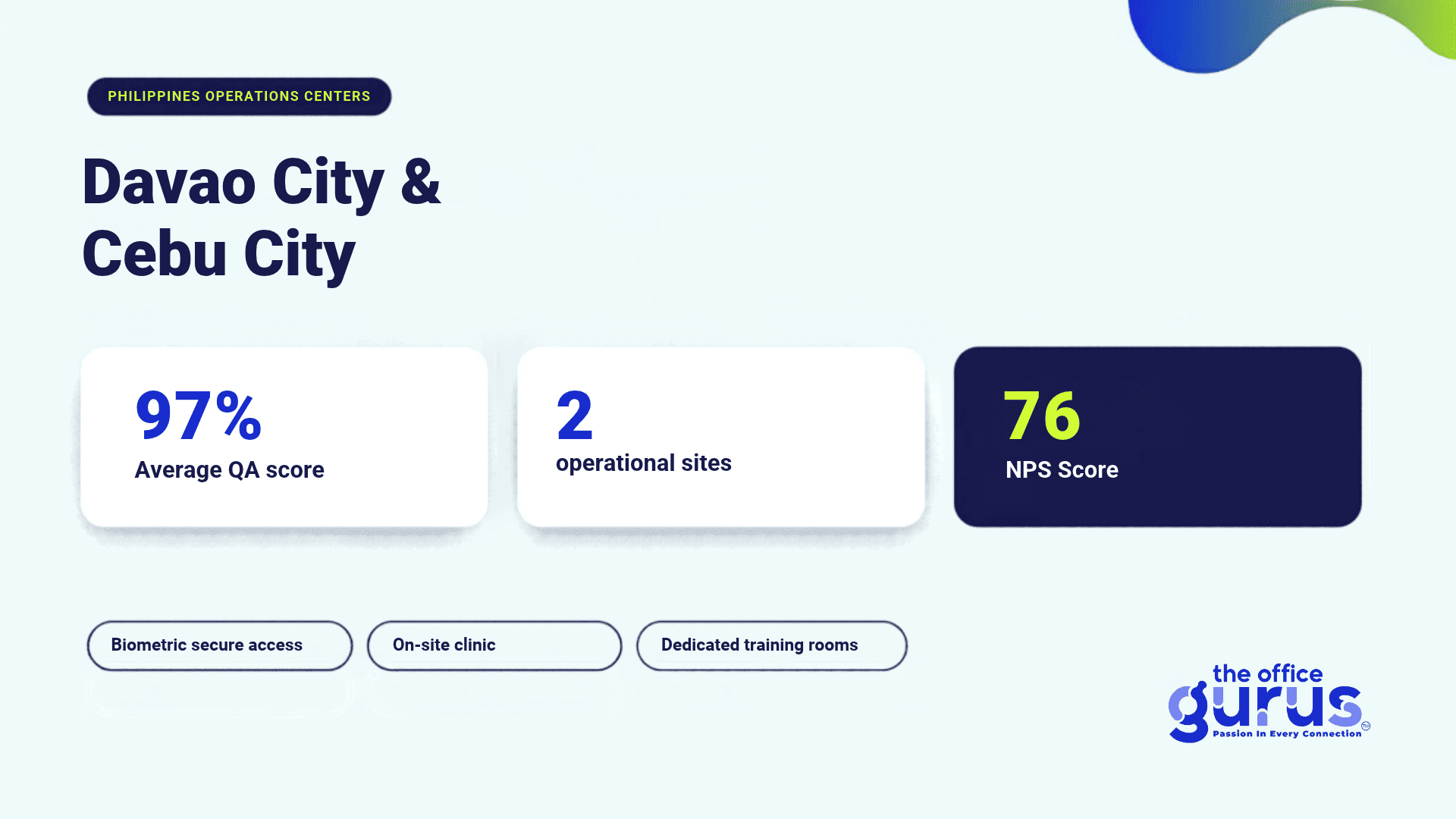
The Office Gurus runs its Philippines delivery centers in two of the country’s leading business and outsourcing hubs: Davao City and Cebu City. Both cities offer strong infrastructure, deep talent pools, and fast-growing economies that support a stable, dependable workforce.
Our operations are built for performance, security, and employee well-being:
- Two operational sites in Davao City and Cebu City
- Biometric facial recognition for secure access
- A government-approved on-site clinic and a daycare facility for working parents
- Two training rooms and a conference room for ongoing development
From Davao and Cebu, our teams support U.S. clients with inbound and outbound customer support, sales and lead generation, Tier 1 and Tier 2 technical help desk, back-office processing, and customer retention programs.
GuruAssist, TOG’s AI-assisted toolkit, gives agents real-time prompts, knowledge snippets, and compliance reminders, while supervisors use the same data to guide coaching. GuruAssist supports the interaction; the agent still owns it.
That model drives results across TOG programs, including a 97% average QA score, 96% CSAT for a U.S.-based eCommerce partner (2024), 47% total cost savings for a client transitioning to TOG, and a 25% reduction in cost per acquisition for a Fintech client.
What CX Leaders Are Asking About Outsourcing to the Philippines
Why do U.S. companies outsource to the Philippines?
U.S. companies choose the Philippines for its mature customer experience ecosystem, high English proficiency, and strong familiarity with U.S. customer expectations. The country also offers the scale to grow teams as demand changes, making it a reliable base for customer support, technical help desk, and back-office programs.
What makes the Philippines a strong choice for customer service outsourcing?
Agents bring clear, easy-to-understand English and a strong service orientation. Combined with structured training and experience across voice, chat, and email, that skill set supports consistent quality in high-volume customer service programs.
How do time zone differences work when outsourcing to the Philippines?
Many programs use the time difference to extend coverage into U.S. evenings, overnight hours, and weekends. At The Office Gurus, 24/7 coverage runs on planned shifts within a dedicated team, so customers always reach agents trained on that specific program.
Can I outsource technical support to the Philippines?
Yes. Philippines-based teams commonly handle Tier 1 and Tier 2 technical help desk work. TOG’s operations in Davao City and Cebu City support technical help desk alongside customer care, sales, and back-office services.
Is outsourcing to the Philippines worth it?
It is when the partnership is built for quality, not just cost. The strongest results come from partners with dedicated teams, disciplined QA, secure facilities, and leadership that stays close to performance. Across its programs, TOG maintains a 97% average QA score.
Closing Thoughts
The Philippines offers U.S. companies a proven path to scalable, high-quality customer experience: skilled, English-proficient talent; coverage across U.S. hours; and an ecosystem built around service. With the right partner, outsourcing to the Philippines becomes a lasting extension of your CX operation, not just another vendor.
Want a closer look at what that means on the ground? Visit our Philippines location page or book a call to explore what a partnership could look like for your team.