


Low hourly rates can be appealing, but they rarely reflect the real cost of outsourcing. In customer support, sales assistance, and back-office operations, your hourly rate is only one input. The outcome you need is consistency, quality, and predictable business impact. At The Office Gurus, an Experience Process Outsourcing partner, we help leaders see beyond the rate card to the total cost of ownership. This article explains where “cheap” creates hidden costs, and how to evaluate partners on the outcomes that protect your brand and your budget.
The rate card illusion
Hourly rates are easy to compare, but they don’t reflect the outcome. The outcome is sustained performance: meeting your service levels, resolving issues on first contact, controlling rework, and keeping customers satisfied. The gap between the lowest hourly bid and the best total cost can be significant once you account for productivity, quality, and downstream customer impact.
Total outsourcing cost goes beyond payroll. It includes ramp and training time. It includes productivity per hour, not just attendance. It includes quality, rework, attrition, and the effect on customer experience. A $2-per-hour lower rate can disappear quickly if average handle time rises or escalations start consuming your most experienced staff.
Consider a vendor that needs 15–20% more agents to hit the same service levels, simply because calls run longer and processes are inconsistent. Even at a lower rate, that staffing gap drives up total spend. These costs don’t show up on the rate card. They show up in your P&L.
Choosing a BPO partner on rate alone rarely holds up over time. This calls for a mindset shift in procurement and operations; comparing price is necessary, but it isn’t sufficient. The better question is: what does it actually cost to hit your SLAs, your CSAT goals, and your revenue targets, quarter after quarter? Selecting a partner on rate alone is like buying the cheapest parts for a high-performance engine, then wondering why it can’t hold up under load.
We’ve seen this exact dynamic play out inside a live operation: a team measured strictly against handle-time goals, optimizing for speed until accuracy and trust started slipping. Our team identified the patterns behind the gap and used the data to show leadership that efficiency and quality weren’t in conflict and that they could improve together.
At the root of it, this is a question about what you’re actually buying: a vendor selling hours, or a strategic partner invested in your outcomes.
Where the real cost hides
The highest hidden costs of ‘cheap’ outsourcing often come from a few consistent outsourcing partner red flags and operational performance gaps that compound over time. They increase staffing needs, add management overhead, and erode the customer experience.
- Higher AHT and staffing needs: if average handle time creeps up even 30 seconds, staffing has to increase to protect service levels. Longer interactions from less proficient teams mean more hours to cover the same volume. The savings from a lower rate get offset by additional headcount and schedule inefficiencies.
In one of The Office Gurus’ engagements, a client’s average handle time was running a full minute over target. Our QA team used speech analytics with keyword spotting to identify the call patterns driving the gap, then optimized the opening script to streamline conversations without cutting corners on service. The result: a 25.5% reduction in AHT, with the improvement holding across the agent population.
- Attrition and longer ramp time: high turnover forces constant recruiting and retraining. It resets institutional knowledge and delays proficiency. Supervisors spend their time stabilizing new hires instead of driving continuous improvement. The result is longer time-to-proficiency and more errors that require rework.
- More escalations, lower consistency: inconsistent process adherence leads to repeat contacts and escalations. Each escalation pulls in a senior agent or supervisor, driving up queue volumes and increasing churn risk. Consistency isn’t a soft metric; it’s a real cost lever.
At The Office Gurus, our human-led teams are supported by GuruAssist, our AI-assisted knowledge and workflow layer. It standardizes responses, flags exceptions, and guides agents in real time. The result is lower AHT, fewer errors, and fewer escalations, outcomes that actually lower total cost.
The compounding effect on CSAT and retention
Customer experience is a profit center, and customer satisfaction is one of its clearest indicators. Poor support leads to higher churn, more refunds, and negative word of mouth. Even small dips in quality can cascade into lost lifetime value.
Inconsistent service undermines trust. When customers get different answers from one interaction to the next, first contact resolution drops and repeat contacts rise. Consistent tone, policy, and resolution accuracy protect both your brand and your budget.
This dynamic plays out operationally, too. When one of The Office Gurus‘ clients faced a sudden demand surge, they estimated needing 150+ new agents, with training alone expected to take months. We paired GuruAssist’s real-time guidance with automated QA to accelerate the ramp. The result: a 71% reduction in time-to-proficiency and a 32% increase in agent retention, with 100% of calls quality-assured throughout the transition.
With The Office Gurus’ operating model, we focus on reliable resolution and predictable experiences. Calibrated QA programs and GuruAssist’s real-time guidance help maintain high first contact resolution. Clients see fewer repeat contacts and fewer escalation-related refunds, a direct line from operational rigor to stronger retention economics.
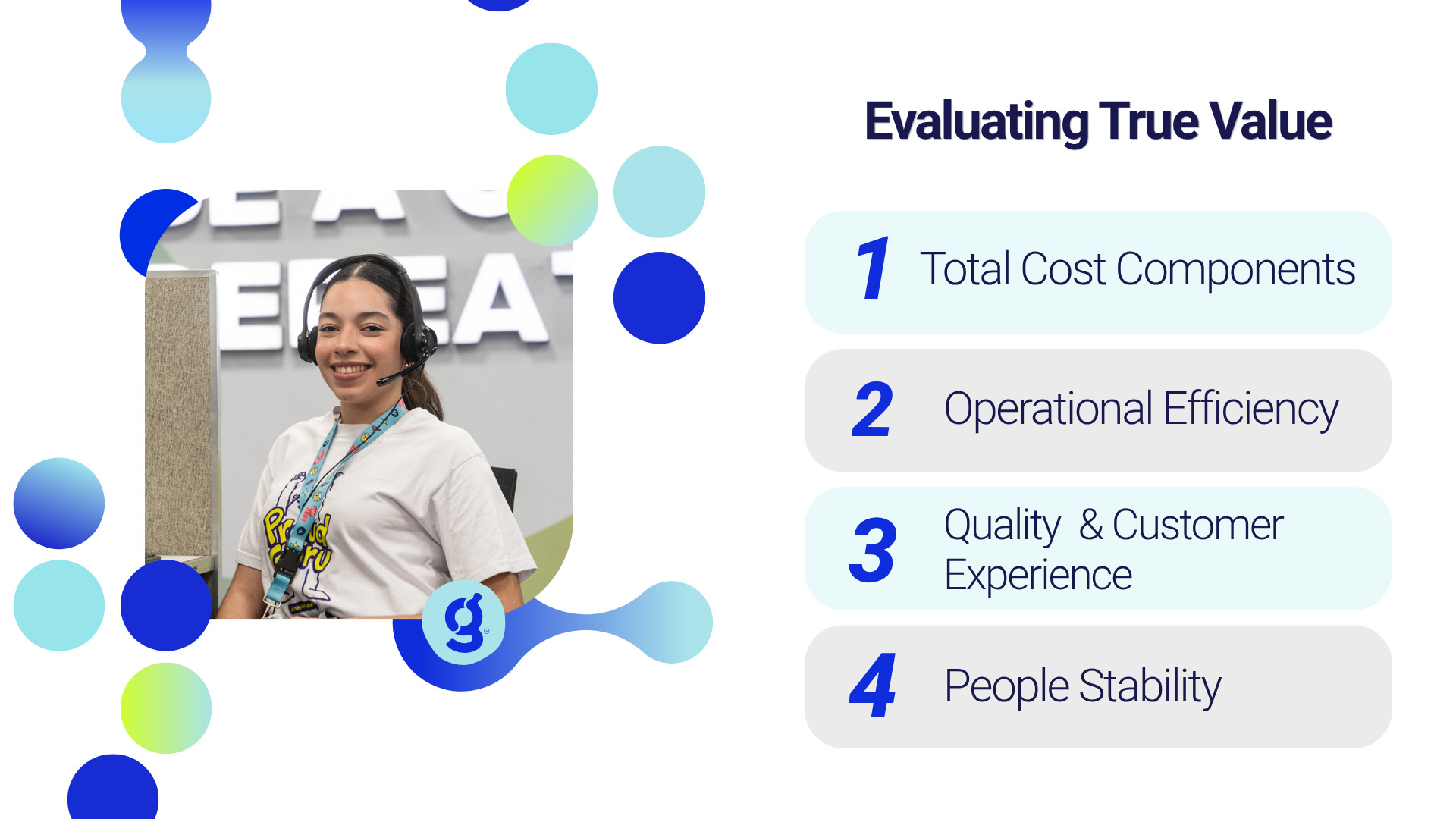
Evaluating true value with a scorecard, not a rate sheet
To compare partners fairly, you need a strategic vendor evaluation, a structured, outcomes-based way to weigh price alongside performance. The Office Gurus’ CX Outsourcing Partner Scorecard helps leaders measure what actually matters and make informed decisions.
The Scorecard looks beyond hourly rate to the performance metrics and cost elements that drive real value:
- Total cost components: training and ramp time, attrition and backfill expense, QA and supervisory overhead
- Operational efficiency: AHT, adherence, occupancy
- Quality and customer experience: FCR, CSAT, complaint and refund rates
- People stability: attrition, time-to-proficiency, employee engagement
Short, controlled pilots are one of the clearest ways to see these dynamics play out. Define a volume segment, set clear success criteria, and track the impact on AHT, escalations, and CSAT. Deloitte’s research on shared services and outsourcing notes that organizations increasingly use pilots and phased transitions to validate value before scaling (Deloitte, 2023, Global Shared Services and Outsourcing Survey). A partner with a slightly higher rate that delivers fewer escalations and higher FCR can lower your total cost by reducing both headcount and rework.
Outsourcing isn’t set-and-forget. Establishing a governance rhythm, monthly business reviews, quarterly improvement sprints, and incentive-tied outcomes keeps a partnership honest over time. The Office Gurus’ scorecard framework and governance playbook keep programs aligned to outcomes, backed by transparent reporting and GuruAssist analytics.
What leaders ask about outsourcing costs
What does total cost of outsourcing include beyond hourly rates?
The real cost of outsourcing includes ramp and training time, productivity per hour, attrition and backfill costs, QA and supervisory overhead, and the downstream effect on customer experience, all of which can outweigh a lower hourly rate.
How do low outsourcing rates affect service quality and consistency?
Lower rates often mean less experienced teams and higher turnover, which shows up as inconsistent process adherence, more repeat contacts, and more escalations, all of which drive cost back up.
What hidden costs should I expect when outsourcing to the lowest bidder?
The most common hidden costs come from higher average handle time, longer ramp-up periods after attrition, and escalation volume, none of which appear on a rate card but all of which show up in staffing requirements and rework.
Closing thoughts
The lowest hourly rate can be the most expensive choice once you account for productivity, quality, and customer lifetime value. Partners that invest in training, coaching, and a strong culture deliver better outcomes at a lower total cost over time.
Shift your evaluation from cost per hour to cost per outcome. As a human-led, AI-assisted BPO partner, The Office Gurus focuses on the operational disciplines that reduce variability and cost, with real-time guidance through GuruAssist, embedded coaching, and proactive workforce management. These capabilities don’t just lower rework and escalations. They protect your brand and expand the value of every customer relationship.
Next step: Download the CX Outsourcing Partner Scorecard to evaluate partners through an outcomes lens and select a partner built for a lower total cost of ownership, not just a lower rate.