



Every failed outsourcing relationship looked promising on day one. Selecting the right outsourcing or BPO partner can accelerate growth, elevate customer experience, and reduce operational risk. Choosing poorly does the opposite: rising costs, missed service levels, security incidents, and brand damage. Most failed relationships come down to a rushed evaluation, unrealistic expectations, or a partner whose operating model never matched the business’s real needs, not because outsourcing itself was the wrong move. This guide walks through where selection typically breaks down, why those errors happen, and what a rigorous evaluation, contract, and governance process looks like in practice.
Why Getting Partner Selection Right Matters
Outsourcing decisions touch customer journeys, sensitive data, budgets, and brand reputation all at once. Knowing the difference between a vendor and a strategic partner is what separates relationships that compound value over time from the ones that unravel within a year.
A poor choice tends to show up in three ways: cost overruns from hidden fees and rework, service disruption when a provider lacks the capacity or domain knowledge to keep pace, and, most damaging, a security incident or compliance lapse that exposes data and invites regulatory scrutiny. Each of these traces back to the same root cause: the evaluation process didn’t surface the risk before the contract was signed.
Long-term outcomes depend on whether your objectives, culture, and KPIs actually align with how the provider operates. If your goal is reducing churn but your partner is incentivized purely on handle time, you’ll get short-term efficiency at the expense of the metric you actually care about. Cultural fit matters just as much: how a provider manages people, communicates, and solves problems should complement your own operating style, not fight it.
Low hourly rates rarely reflect the total cost of ownership. Transition, training, process redesign, quality assurance, technology integration, management overhead, attrition replacement, and risk events all factor into what a partnership actually costs. A slightly higher rate paired with stronger first-contact resolution and lower error rates often works out cheaper. It delivers a better customer experience than the option that looked cheapest on paper.
Frequent Selection Mistakes and How to Avoid Them
Most failed partnerships share the same handful of root causes. A structured process that looks past price is what catches these before they become expensive problems.
Skipping due diligence. A rigorous check covers:
- Background checks on ownership, leadership, and litigation history.
- Financial stability, validated through audited statements and references from major clients.
- Certifications and compliance coverage: SOC 2, ISO 27001, PCI DSS, or HIPAA where relevant, plus data residency capabilities.
- Evidence, not promises: penetration test summaries, disaster recovery results, and recent audit reports.
Overweighting price or surface-level metrics. A stronger evaluation weighs price against:
- Talent depth, language proficiency, and training programs.
- Automation maturity: speech analytics, RPA, and AI-assisted agents that support human reps in real time, since this increasingly separates strong providers from the rest.
- Quality evidence: sampled call recordings, tickets, and QA scorecards, plus before-and-after case studies with real numbers attached.
- Not verifying people, process, and technology fit: people factors include language proficiency, cultural fluency, and attrition. Process factors include SLAs, escalation procedures, and change control. Technology considerations include CRM and CCaaS compatibility, access controls, encryption standards, and disaster recovery targets. If you need 24/7 coverage or elevated data controls, validate this through site visits or virtual walkthroughs, not a sales deck.
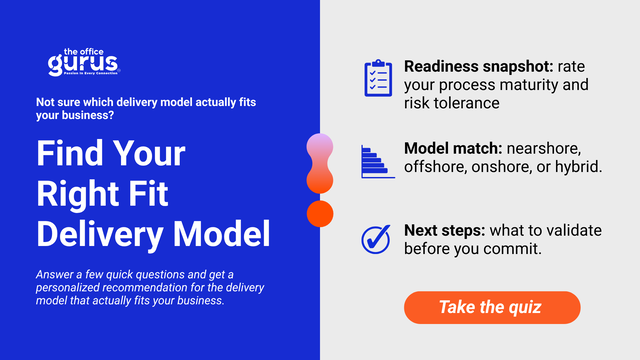
- Mismatched operating model: don’t default to nearshore, offshore, onshore, or a hybrid approach out of habit or because a previous employer used it. The right model depends on your process maturity, risk tolerance, data classification needs, and how much real-time oversight you can realistically provide.
A few practices consistently separate confident decisions from guesswork:
- Use a weighted scorecard across capability, quality, security, culture, scalability, and commercial terms rather than relying on gut feel.
- Run live pilots or A/B trials with defined success criteria and shared dashboards. Pilot results tell you more than any pitch.
- Schedule executive alignment sessions to confirm cultural fit and escalation philosophy before anything is signed.
Evaluation, Contracting, and Governance Pitfalls
Strong selection is only half the equation. Weak contracts, rushed transitions, and thin governance can erode value even after you’ve picked the right partner.
Contract and SLA Mistakes
- Vague scope and KPIs: translate business outcomes into precise service definitions such as volumes, languages, channels, hours, supported systems. Loose language here is where scope creep starts.
- Imprecise metrics: set measurable SLAs, such as first-contact resolution, quality scores, CSAT, average speed of answer, and error rates, and tie incentives and credits to the ones that matter, with clear baselines and improvement targets.
- Missing controls: build in data protection obligations, audit rights, change control, disaster recovery requirements, and subcontracting restrictions from day one.
Transition and Change Management Breakdowns
- Insufficient knowledge transfer: a real transition plan or onboarding process covers process documentation, training and certification, environment setup, and a phased ramp, not a single handoff call.
- Unclear ownership: build a runbook for incident management, identify the subject matter experts on both sides before launch, and protect their time.
- No pilot or hypercare: launch customer-facing programs with a defined pilot and hypercare period, plus a rollback plan if metrics dip, and assign clear ownership for the handoff itself.
Weak Performance Governance
- Inconsistent reviews: set a cadence, such as weekly operational reviews, monthly deep-dives, and quarterly business reviews, backed by disciplined workforce planning and capacity reviews, and stick to it even when things are going well.
- Limited visibility: use one shared dashboard that combines operational metrics, quality findings, and financial performance, rather than several disconnected reports.
- No improvement engine: document escalation paths and maintain a running list of improvement initiatives with owners and expected impact. Governance should produce action, not just meeting minutes.
Red Flags and Green Flags When Choosing a BPO
Use these signals to separate marketing from reality. They are practical cues for evaluating BPO providers.
Red Flags
- Unwillingness to share audit evidence or recent security and disaster recovery test results.
- Vague answers about attrition, tenure, or training outcomes.
- Aggressive pricing with no transparent productivity assumptions behind it.
- Lack of transparency about subcontractors or delivery locations.
- Generic case studies with no quantified results.
- Promises of immediate cost reduction with no mention of process change.
Green Flags
- Detailed references with quantified outcomes and contactable sponsors.
- Transparent staffing and training plans with realistic ramp scenarios.
- Real-time dashboard access during the pilot, not just after signing.
- Clear evidence artifacts on risk and compliance, ready without being asked.
- Willingness to co-design the roadmap and sit in on calibrations before the contract is signed.
Want a more structured way to score these signals? Download the CX Outsourcing Partner Evaluation Scorecard
Frequently Asked Questions
Why do outsourcing partnerships fail?
Most failures trace back to the evaluation stage: a rushed selection process, a partner chosen mainly on price, or an operating model that never matched the business’s real needs. The relationship rarely fails because outsourcing itself was the wrong strategy.
What mistakes should companies avoid when outsourcing customer support?
The most common ones are skipping due diligence, over-indexing on price instead of capability and culture, and failing to verify how well a provider’s people, processes, and technology actually fit the operation before signing.
How do you choose the right outsourcing partner?
Start with a clear business case, run a disciplined RFI and RFP process, evaluate providers on a weighted scorecard rather than instinct, and confirm cultural and executive alignment before finalizing a contract.
What due diligence should be done before hiring an outsourcing firm?
Verify financial stability, ownership, and litigation history, along with relevant certifications such as SOC 2, ISO 27001, or PCI DSS. Ask for evidence, such as audit reports, penetration test summaries, and disaster recovery results, rather than accepting claims at face value.
Which performance indicators best measure outsourcing success?
A balanced mix works best: customer and quality metrics like CSAT and first-contact resolution, efficiency indicators like average handle time and service level, and workforce stability metrics like attrition and tenure. No single number tells the full story.
How can companies avoid scope creep in outsourcing contracts?
Define scope, volumes, channels, and supported systems precisely in the contract, and tie incentives to specific, measurable KPIs rather than general service expectations. Vague language is where scope creep almost always starts.
How can companies avoid switching outsourcing providers later?
Strong governance from day one, including regular business reviews, shared dashboards, and a documented improvement process, catches performance issues early, before they become reasons to end the relationship and start a new search.
How do you know if your organization is ready to outsource?
Readiness comes down to process maturity, documentation quality, and how much real-time oversight you can provide. A readiness assessment before approaching the market saves time during vendor selection.
Key Takeaways for Decision-Makers
- Anchor decisions in total cost of ownership and outcome alignment, not rate cards.
- Demand evidence during evaluation: certifications, audits, and real operational artifacts, not marketing claims.
- Write contracts that translate business outcomes into precise scope, SLAs, and incentives to prevent scope creep down the line.
- Plan transitions deliberately, with a defined pilot and hypercare period.
- Stand up governance on day one: cadence, dashboards, escalation paths, and a real improvement process.
Reliable outsourcing outcomes are built during evaluation, contracting, and launch, not fixed after problems surface. Close the decision-quality gaps early, with the same discipline used to choose an outsourcing partner in the first place, and the partnership has a real chance to deliver measurable value over time.
At The Office Gurus, we’ve built these evaluation and governance principles into how we operate every client program, not just how we pitch new ones. Our Experience Process Outsourcing approach pairs experienced teams and AI-assisted agents with the kind of transparent reporting and shared accountability this guide describes, across the retail, healthcare, financial services, and travel programs we support today.
If you’re weighing a new outsourcing decision or reassessing a current partner, this is the moment to talk with a Guru. We’re glad to talk through where your evaluation stands.