


If your QA team reviews 5% of calls, what’s actually happening in the other 95%? For most contact centers, the honest answer is: nobody knows. Artificial intelligence is changing that by evaluating every interaction, scoring against your scorecards in near real time, and flagging risk consistently. The outcome is broader visibility into performance, faster coaching cycles, and stronger compliance control. Below, we explain why legacy sampling struggles, how AI-assisted QA works in practice, and what leaders can expect as they modernize their programs.
Why traditional QA sampling creates blind spots
Most QA programs still review a small fraction of activity. In today’s multichannel environment, that approach leaves too much unseen and slows the pace of improvement. Ask yourself: if you could only see 5% of your team’s conversations, how confident would you really be in what the other 95% looks like?
- Sampling limits: reviewing 1–5% of interactions means most conversations never get evaluated. High performers may not be recognized, recurring errors can go undetected, and a single call can skew an agent’s perceived performance.
- Scorer variability: even with calibration, evaluators interpret rubrics differently. Fatigue, bias, and shift differences lead to inconsistent results, which undermines trust and makes benchmarking difficult.
- Slow feedback: pulling, scoring, and distributing evaluations can take days or weeks. By then, issues may have spread across teams, and the opportunity for timely coaching has passed.
In short, manual sampling struggles to keep up with volume, channel diversity, and changing customer expectations. It also increases compliance exposure because risk is discovered reactively rather than prevented proactively.
How AI-assisted QA works in practice
Solving these blind spots starts with how AI-assisted QA actually works. Rather than sampling a handful of calls, it applies speech-to-text, natural language processing, and machine learning across every eligible interaction, aligned to your existing scorecards and policies. The goal isn’t to replace human judgment, but to apply it at scale, with speed and consistency.
That means every eligible call, chat, and email gets reviewed, producing a complete view of performance across agents, queues, and contact reasons, including the patterns and outliers that sampling simply misses. Conversations are scored as they happen or immediately after, with the system highlighting missed steps, risky language, escalations, and churn signals so supervisors can step in sooner rather than later. Underneath that, models track sentiment shifts, empathy cues, and friction points, correlating them with outcomes like repeat contacts or refunds, while also checking authentication, disclosures, and prohibited language to reduce audit findings. And because the same rubric is applied every time, teams reduce scorer drift and get fairer comparisons across shifts and sites, with periodic calibration keeping standards sharp.
With these capabilities in place, QA leaders can reallocate time from administrative scoring to strategic analysis and coaching. The system handles volume and consistency; people retain control of standards, edge cases, and development. This is the kind of full-coverage evaluation that platforms like GuruAssist are built to deliver, applying your existing scorecards at scale, in real time.
From sampling to full-coverage: what changes for QA teams
Moving from manual sampling to AI-assisted QA reshapes daily workflows and the value QA delivers to the organization.
- Targeted coaching: Instant scoring with time-stamped examples lets coaches meet agents sooner, reinforcing training in the moments that matter and reducing repeat errors.
- Trend analysis at scale: With full coverage, QA leads can spot systemic knowledge gaps, script issues, or process friction by line of business, queue, or policy change.
- Stronger compliance: Automated checks run on every interaction, reducing missed disclosures and improving audit readiness. Exceptions are routed to analysts for human review.
- Higher trust and clarity: Consistent criteria reduce perception of unfairness. Agents get clear expectations and examples of what good looks like.
The net effect is a tighter feedback loop. Supervisors and QA collaborate with training and operations to iterate on scorecards and knowledge content based on complete, current data.
Case study: hospitality client achieves full coverage and faster ramp with GuruAssist
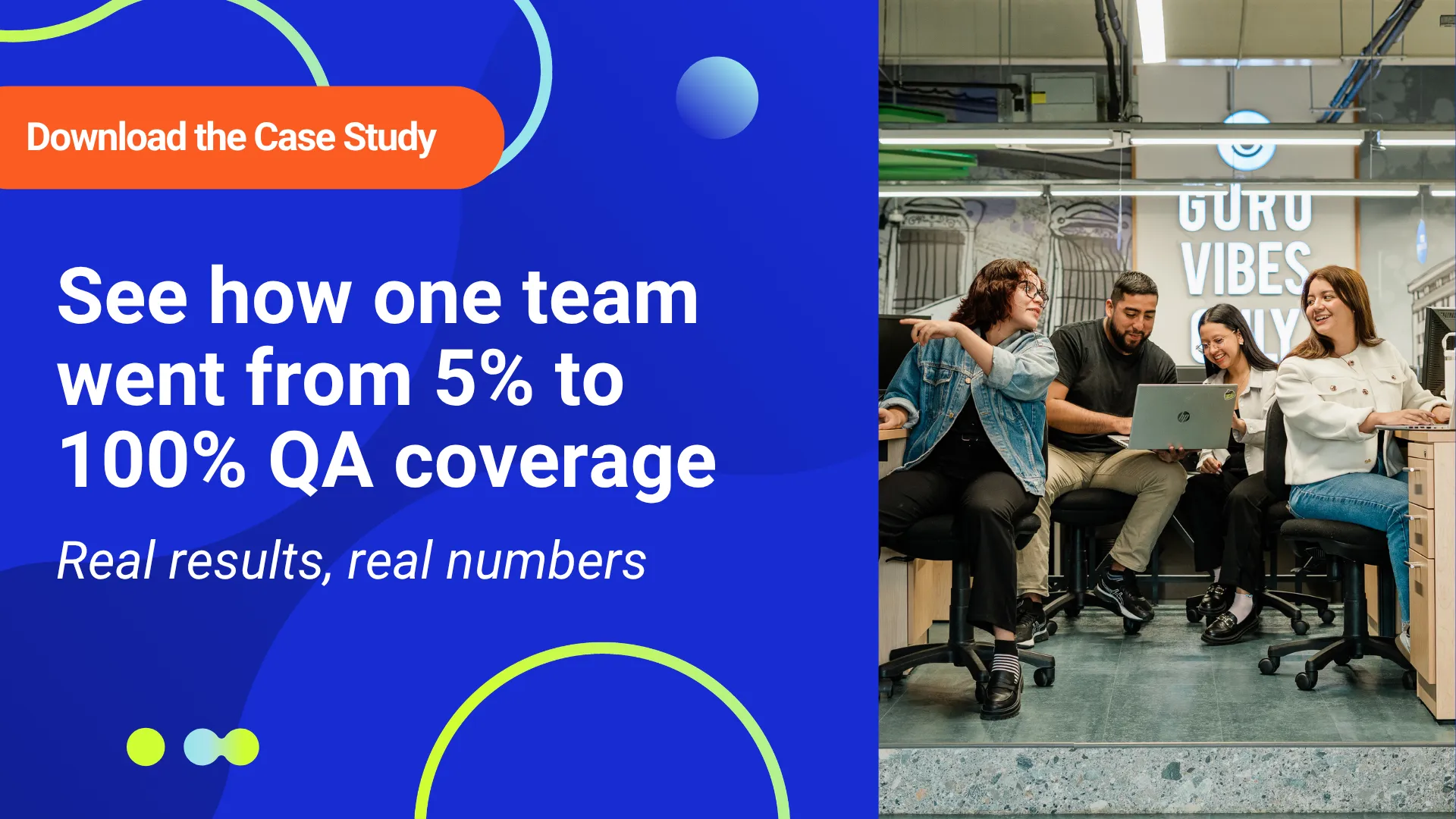
A national central reservations and concierge services organization supporting over 200 luxury resorts was manually reviewing just 5% of customer conversations, leaving the vast majority of calls unreviewed.
With GuruAssist, the organization moved from that 5% manual sample to scoring 100% of applicable calls with human-level accuracy, while also equipping agents with real-time guidance during customer interactions. The results were immediate: agent time-to-proficiency dropped by 71%, and QA coverage jumped from a small fraction of calls to full visibility across the team.
Want the full breakdown including certification results, retention impact, and the exact approach behind these numbers?
Sample metrics to track
| Metric | Definition | Why It Matters |
| Evaluation coverage | % of interactions reviewed and scored | Confirms full visibility and reduces blind spots |
| Time-to-feedback | Elapsed time from interaction to coaching delivery | Shorter cycles improve skill retention and outcomes |
| Compliance pass rate | % of interactions meeting required checks | Indicates audit readiness and policy adherence |
| Coaching uptake | Completion and effectiveness of coaching actions | Shows whether feedback translates to behavior change |
| First contact resolution | % of issues resolved without repeat contact | Links quality behaviors to operational outcomes |
| Agent retention | Retention rate over time | Reflects impact of fair, consistent coaching and clarity |
These metrics work best alongside a broader view of agent performance, one that looks past AHT and CSAT to capture the full picture of coaching impact
What QA leaders are asking about AI-assisted QA
How is AI changing quality assurance in contact centers?
AI is moving QA from small, manual samples to full-coverage, real-time evaluation scoring every eligible interaction against existing rubrics instead of a small fraction of calls.
What is AI-assisted QA?
AI-assisted QA uses speech-to-text, natural language processing, and machine learning to review and score customer interactions at scale, applying consistent criteria while keeping human judgment in control of standards, edge cases, and coaching.
Can AI automate call scoring?
Yes. AI can apply a team’s existing scorecard to every eligible call, chat, or email, flagging missed steps, risky language, and compliance concerns as they happen or immediately after.
What are the main benefits of using AI for quality assurance in contact centers?
The main benefits are full interaction coverage, faster and more consistent feedback, stronger compliance detection, and more time for QA teams to focus on strategic coaching rather than manual scoring.
How does GuruAssist support QA teams?
GuruAssist evaluates 100% of applicable calls with human-level accuracy and automatically surfaces personalized coaching suggestions for each agent, freeing QA teams to focus on higher-impact development work instead of manual review.
Closing thoughts
AI-assisted quality assurance replaces manual sampling with full-coverage, real-time evaluation. It delivers consistent scoring against your standards and surfaces coaching opportunities and compliance risks that would otherwise go unseen. The technology is an amplifier for QA teams, not a substitute for human judgment.
As demonstrated by the hospitality client using GuruAssist, moving from roughly 5% manual review to 100% AI-assisted coverage helped cut time-to-proficiency and lift retention in a single quarter. The organizations that combine automation with expert coaching will build more resilient, high-performing QA programs in the years ahead.
To learn more about how our platform can bring full-coverage quality assurance to your contact center, explore GuruAssist or contact us for a consultation.
Related Articles
- Clear the Backlog: AI + Human QA for Exception Handling That Actually Works
- 7 Reasons Why Quality Assurance Automation is Important
- How GuruAssist Improves Agent Performance Through Real-Time Guidance
About The Office Gurus: The Office Gurus® has risen to become one of the leading global BPO companies, providing customized contact center solutions that combine advanced technology with human-centered service delivery. With operations across multiple countries and recognition as an industry leader, we help businesses optimize their quality management processes while achieving exceptional customer experiences.