


Agent enablement is moving from static, one-time onboarding to continuous, real-time-supported learning. AI-assisted tools are now embedded in the flow of work, guiding agents as they handle live interactions and giving supervisors sharper levers to coach performance. As digital channels multiply and automation handles routine tasks, the remaining human interactions are more complex and sensitive. Training needs to build judgment, confidence, and consistency faster without disrupting service. This article outlines why legacy approaches fall short, how AI-assisted coaching elevates outcomes, which skills matter most, and how to structure a modern framework that scales with operational needs. It charts the future of agent training in AI-powered contact centers and shows how a balanced, human-and-machine approach strengthens every stage of agent onboarding and ongoing development.
Why traditional training models are being left behind
Classroom-heavy curricula and long intervals between refresher sessions cannot keep pace with today’s operations. When agents learn in isolation from real work, knowledge decays before it is applied. The result is a gap between theoretical understanding and the pressure of live conversations, where policies, systems, and tone must all come together in seconds. This gap widens as live context shifts rapidly across channels.
Meanwhile, the interaction mix has shifted. Self-service and automation handle straightforward inquiries, leaving agents to manage exceptions, multi-step resolutions, and emotionally charged situations. These interactions demand critical thinking, cross-system navigation, and empathy skills that are best built through practice, feedback, and reinforcement in realistic contexts, not slides or infrequent side-by-sides. Effective training must mirror this reality to reduce variability on the front lines.
Operational realities also push for faster ramp. High-volume environments cannot sustain long classroom cycles that delay time-to-competency. Training must shorten the path to proficiency and provide just-in-time reinforcement on the floor. As staffing models evolve, agents increasingly supervise automation, adjudicate edge cases, and apply judgment across blended workflows. Career paths are broadening as well, with new roles emerging in bot improvement, data-informed quality, and AI workflow optimization.
Legacy training is too slow and too generic for these demands. AI-assisted coaching enables personalized development, real-time support, and continuous improvement without pulling agents away from customers, always working alongside human coaching rather than replacing it. This reflects a broader shift already underway: agent training is an ongoing process, not a single event, and treating it that way is the pragmatic path forward for the future of agent training in AI-powered contact centers.
How AI is reshaping agent training
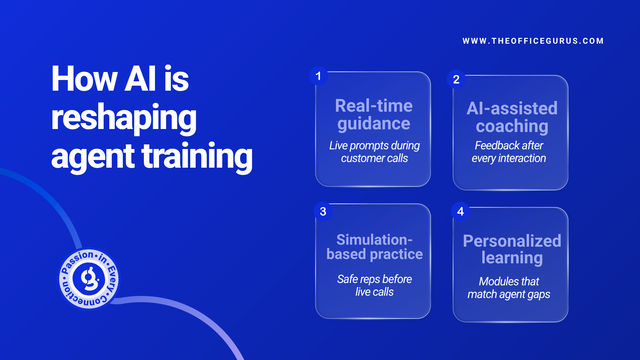
Real-time guidance during live interactions bridges the gap between learning and doing. AI-assisted prompts can suggest compliant phrasing, surface relevant knowledge articles, or flag potential policy risks as a conversation unfolds. This immediate support helps newer agents ramp faster and helps experienced agents maintain consistency when the stakes are high. This guidance lives directly in the workflow, accelerating onboarding and reducing rework.
AI-assisted coaching and feedback loops transform quality assurance from a retrospective audit into daily development. Models can spotlight moments worth review, summarize coaching opportunities, and reveal patterns across teams. Supervisors spend less time hunting for examples and more time on targeted, high-impact coaching. Agents get specific, timely feedback that translates into measurable performance gains, turning AI-assisted training into a daily practice rather than a one-time event.
Simulation-based practice environments bring realistic rehearsal to the training mix. Generative scenarios mirror your products, policies, and customer personas across voice, chat, and social. Difficulty levels adjust to agent performance, building confidence step by step before agents face complex, live interactions. These simulations reinforce both knowledge and soft skills, accelerating time-to-competency and strengthening first-contact resolution, key goals of any modern training program.
Personalized learning paths align training to individual needs. Instead of generic courses, agents receive modules that target their unique gaps, verification steps, empathy phrasing, or system workflows based on performance signals and knowledge checks. The result is a shorter, more engaging learning journey that keeps skills current amid frequent changes to products and policies.
At every point, AI-assisted tools augment human coaching. Supervisors still shape the “why” and “how,” especially for nuanced judgment, tone, and exception handling. The blend of real-time guidance, simulations, and targeted coaching builds durable capability faster than traditional methods.
The skills agents need in an AI-powered contact center.
Judgment and escalation awareness: these are central as agents become the final checkpoint for complex issues. They must understand when to trust recommendations, when data might be incomplete, and when to escalate to specialists, legal, or fraud teams. Clear playbooks, paired with AI prompts that surface risk signals, enable decisive action without compromising compliance.
Emotional intelligence differentiates great experiences: as AI-assisted agents focus on higher-stakes conversations, training should emphasize rapport, validation, and de-escalation. Real-time coaching can prompt empathetic phrasing and tone adjustments while preserving authenticity, especially in moments of frustration or confusion.
Adaptability to AI-assisted workflows is now a core capability: agents need fluency with recommendation engines, knowledge retrieval, and automated wrap-up, plus an understanding of how suggestions are generated and where gaps might exist. This ensures agents can move quickly while maintaining accuracy and compliance.
A continuous learning mindset underpins long-term performance: with products, policies, and support tools updating frequently, agents who embrace change, seek feedback, and cross-skill can grow into advanced responsibilities. Recognition and rewards should reinforce learning milestones and skill expansion, not just volume or handle time. Strong onboarding sets the tone for this growth trajectory.
Building a modern training framework
A modern framework blends AI-assisted guidance with human coaching and peer-led practice to deliver continuous, real-time-supported learning. The practical foundation for training that scales.
- Blended learning in the flow of work: automated nudges handle micro-corrections and knowledge retrieval, while supervisors prioritize soft skills, strategic thinking, and edge cases. Peer role-play and expert clinics reinforce best practices and accelerate skill transfer.
- Continuous reinforcement rather than front-loading: replace heavy upfront courses with ongoing microlearning and on-the-job practice. Short, five- to ten-minute modules tied to recent error patterns or product updates, plus monthly simulation drills for high-risk or seasonal scenarios, keep skills fresh and aligned with evolving requirements.
- Coaching built into daily operations: use AI-assisted identification of moments worth reviewing, anchor feedback to documented standards, and fold coaching goals into performance reviews so learning progress, not just output metrics, gets recognized. Keep knowledge articles and prompts current based on real cases so guidance stays accurate under pressure.
- Clear metrics that connect training to outcomes: track agent-level measures such as time-to-competency, quality scores, policy adherence, and knowledge assessments. Pair these with customer outcomes: CSAT or NPS, first-contact resolution, handle time, and operational metrics like error and escalation rates.
- Lightweight governance to build trust: clarify which interaction data is used for training, apply role-based access, and set retention policies. Keep privacy practices transparent and proportionate to your regulatory context without weighing down the program.
The goal is a durable system where learning, coaching, and performance management reinforce each other. AI-assisted tools take the friction out of practice and feedback, while human coaches guide behavior change and judgment. This is how training evolves from static sessions into a living system.
Measuring training effectiveness
Leaders need measurement that links training investments to business results. A simple structure spanning agent, customer, and operational levels creates visibility and accountability:
| Level | Example Metrics | Use Cases |
| Agent | Time-to-competency, quality scores, policy adherence, knowledge assessments | Identify specific capability gaps, validate impact of microlearning and simulations |
| Customer | CSAT or NPS, first contact resolution, average handle time | Demonstrate experience improvements tied to coaching and real-time guidance |
| Operational | Error rates, escalation rates, compliance findings | Quantify risk reduction and cost impacts from improved training and process adherence |
Complement outcome metrics with leading indicators such as coaching completion rates, simulation performance, and usage of real-time prompts. Early adopters report that correlating these leading indicators with downstream results helps pinpoint which training elements drive the biggest gains, a discipline closely tied to how to measure AI-assisted agent performance beyond AHT and CSAT.
Want ready-to-use templates for this? Download the AI-Assisted Agent Performance Workbook for coaching session templates, a performance review dashboard, and a monthly review agenda you can use immediately.
What leaders ask about AI-assisted training
How does AI reduce agent ramp-up time?
By delivering real-time prompts and personalized learning paths during live work. Agents get immediate guidance on compliant phrasing, policy steps, and knowledge resources, which speeds up time-to-competency without sacrificing quality.
Will AI replace human coaches?
No. AI-assisted coaching scales the repetitive parts of quality review — identifying examples, summarizing opportunities, and spotting patterns — so human coaches can focus on context, empathy, and nuanced judgment. The strongest results come from a blend of AI-assisted tools and human mentorship.
What are the best metrics to prove training ROI?
Start with time-to-competency, quality scores, and policy adherence at the agent level. Pair these with CSAT or NPS, first contact resolution, and handle time for the customer lens, plus error and escalation rates operationally. Attribute improvements to specific training elements, like simulations or real-time guidance, to quantify impact.
How do we keep simulations realistic?
Seed scenarios with recent transcripts and outcomes. Include varied customer personas, channels, and system steps, and rotate edge cases frequently. Track performance in simulations and adjust difficulty per agent to maintain stretch without overwhelming learners.
What about data privacy when using AI for training?
Use the minimum necessary interaction data, apply role-based access, and set clear retention policies. Communicate these controls to agents to build trust while keeping the training program light and effective.
How can smaller teams get started?
Begin with a focused pain point, such as real-time knowledge retrieval in a single queue, and measure time-to-competency and quality impacts over a short window. As value is demonstrated, add simulations and coaching analytics to deepen the program.
Building your AI-ready training roadmap
Adopting AI-assisted coaching works best when it follows clear principles rather than a rigid playbook. Start with contained use cases where real-time guidance or knowledge surfacing removes friction without disrupting operations. Establish a baseline for time-to-competency and quality, agree on the success criteria that matter to your program, and gather ongoing feedback from agents and supervisors to refine prompts, workflows, and content. This targeted approach delivers early wins without overextending your team.
As capabilities mature, shift focus to transferable skills that outlast any single tool: customer advocacy, critical thinking, data literacy, and process orientation. Build an upskilling path that moves agents from basic collaboration with AI-assisted tools toward more advanced responsibilities, and align recognition and progression with these competencies to strengthen retention.
Sustain momentum by making training part of the operating cadence, not a series of one-off events. Integrate microlearning into team huddles, keep recurring simulations on the calendar for high-risk scenarios, and connect learning content to live performance data so agents can see the direct impact on customer outcomes. Organizations that treat training this way continuous, real-time-supported, and built around people, not just tools will be the ones setting the pace for the future of agent training in AI-powered contact centers.
Ready to build an AI-assisted training program that fits your team? Talk to a Guru to explore how the right AI-assisted partner can help you meet your customer experience goals.